TINTYPE TUESDAY: Peeking Behind the Scenes on THE LADY EVE!
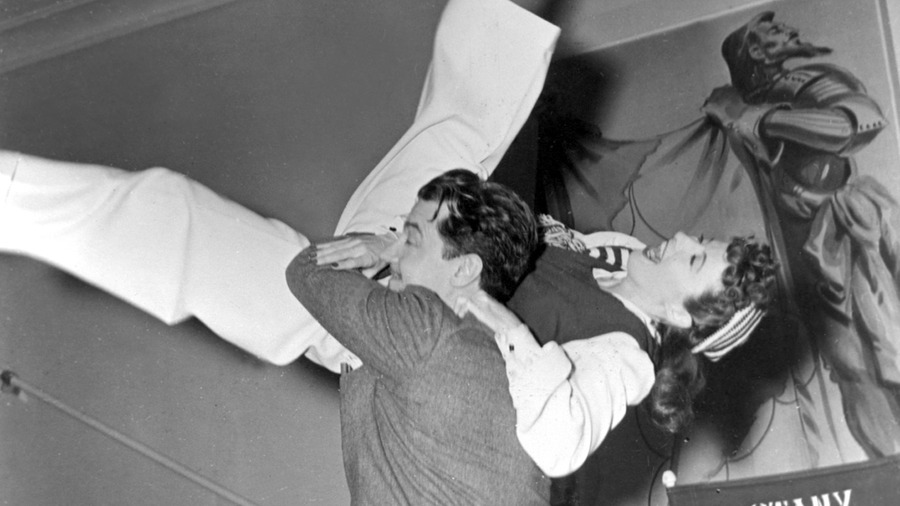
When’s the last time you had this much fun at work?
But then who has a boss like Preston Sturges?
The set of The Lady Eve “was so ebullient that instead of going to their trailers between setups, the players relaxed in canvas chairs with their sparkling director, listening to his fascinating stories or going over their lines with him,” wrote Axel Madsen in his biography of Barbara Stanwyck. “To get into mood for Barbara’s bedroom scene, Sturges wore a bathrobe.” The actress gleefully compared the set to a carnival.

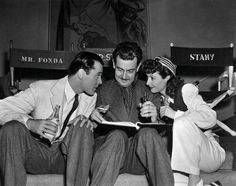
And the director was the head barker, with a wardrobe to match. Sturges favored brightly colored berets, felt caps with feathers sprouting from them, top hats, silk and cashmere scarves, and sports coats so loud they looked as if they’d been stolen off the winner of the sixth race at Santa Anita. They not only suited his personality, but, he claimed, they helped crew members spot him amid the throngs of technicians, actors and members of the public meandering around the set. The public, you say? Yup. To keep things light and unpredictable, Sturges openly encouraged visitors to his sets, from friends, colleagues and press reps to whoever happened to be wandering down Melrose Avenue that day.
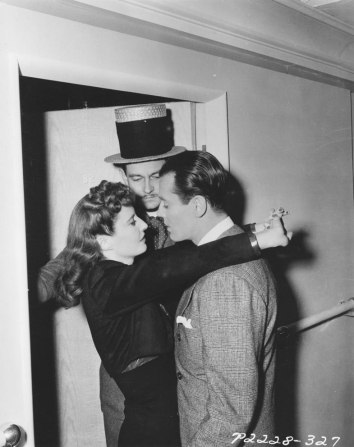

The Lady Eve marked the second time Sturges teamed with Stanwyck. He’d written the screenplay for the criminally underrated Remember the Night hoping that Paramount would be able to borrow Carole Lombard, and was at first disappointed when he had to “settle” for Stanwyck. Until he saw her work and realized her tempo and his dialogue went together like a felt hat and a feather. During one of their long, lively conversations, Stanwyck complained to the director that no one wrote comedies for her, and he promised to put that right. Soon after, he penned the screenplay for The Lady Eve while in Reno, awaiting his third divorce.
“He kept his word, and how!” recalled Stanwyck years later. “By that time I wasn’t under contract, and he had to borrow me. I figured that would kill it. But somehow The Lady Eve all came together.”
The film also marked the start of Stanwyck’s long and happy relationship with Edith Head. While other designers with less talent and imagination saw her long waist as a figure flaw, Head accentuated it with wide waistbands that tapered in the back, giving way to sumptuous skirts that draped elegantly over fabulous legs. Thrilled with the designs, the ever-loyal Stany found a way to show her gratitude. “Edith always covered her mouth when she laughed and I didn’t know why,” the actress remembered. “Finally she showed me her teeth and I understood. They were awful—not diseased, but some were missing and she felt self-conscious. She told me she had been to dentists and they said nothing could be done. I informed her that my dentist could fix anything—he’d fixed my smile!” And he went on to fix Edith’s.


As usual, Sturges had to battle his bosses for just about every scene he wrote. In this case, producer (later director) Albert Lewin blustered that “the first two-thirds of the script, in spite of the high quality of your jokes, will require an almost one hundred percent rewrite.” He especially objected to the entire snake subplot and the physical comedy that sprang from it.
“I happen to love pratfalls, but as almost everything I like, other people dislike, and vice versa,” Sturges recalled in his memoir. “My dearest friends and severest critics constantly urged me to cut the pratfalls from five down to three. There are certain things that will convulse the audience, when it has been softened up by what has occurred previously, that seem very unfunny in cold print. Directing and acting have a lot to do with it too. I had my fingers crossed when Henry Fonda went over the sofa. I held my left ear when he tore down the curtains, and I held everything when the roast beef hit him.”
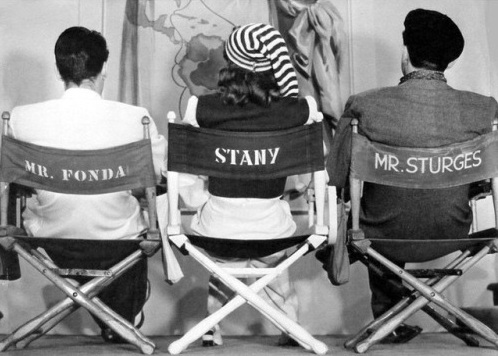
Sturges had borrowed Fonda from Fox—which Stanwyck later called a “piece of intriguing casting. Hank had been Zanuck’s Abraham Lincoln in so many things, whether his name was Tom Joad or Jesse James. How did Sturges know he was a sensational light comedian?”
“Henry Fonda was delicious to work with,” she once said. “We made three films together, and I was sorry when each one was over. I wish we had done more movies together. I loved Hank.”
And at a tribute to Stanwyck, Fonda returned the feeling, even using the same luscious adjective: “Everyone who is close to me knows I’ve been in love with Barbara Stanwyck since I met her. She’s a delicious woman. We’ve never had an affair. She’s never encouraged me, but dammit my wife will verify it, my daughters and son will confirm it, and now you can testify to the truth.”
TINTYPE TUESDAY is a new feature on Sister Celluloid, featuring fabulous classic movie pix (and often a bit of backstory!) every week, to help you make it to Hump Day! Why not bookmark the page, here, to make sure you never miss a week?
And please check out our other new feature, STREAMING SATURDAYS, which brings you a free, fun classic film every weekend! You can bookmark that, and watch movies you may have missed, here!
New Feature: TINTYPE TUESDAYS!! Fun Classic Movie Pix for That In-Between Day
We all have our little tricks to get through Monday, and Wednesday is Hump Day, and by Thursday we can see the weekend peering over the hill… but what of Tuesday? To throw a little love to the neglected almost-middle child of the week—which we’re supposed to muddle through without, well, anything—Sister Celluloid is launching a new feature, TINTYPE TUESDAYS, where we’ll post some fun classic movie pix every week!
And we’re kicking things off with… Great Moments in Lady Chin Dimples! Starring (so far) Elsa Lanchester, Janet Gaynor, Sophia Loren, Ava Gardner and Jean Harlow…




Please do add your favorite cleft-chinned classic actress in Comments; I know there are tons more out there, but I wanted to get this party started!
By the way, this is the second new feature in a month; earlier we launched STREAMING SATURDAYS, bringing you a fabulous free movie every weekend! You can check that out here!
And be sure to check back next week for another edition of TINTYPE TUESDAYS!
Ingrid Bergman and Cary Grant: An “Indiscreet” Friendship
“A kiss could last three seconds. We just kissed each other and talked, leaned away and kissed each other again. Then the telephone came between us, then we moved to the other side of the telephone. So it was a kiss which opened and closed; but the censors couldn’t and didn’t cut the scene because we never at any one point kissed for more than three seconds. We did other things: we nibbled on each other’s ears, and kissed a cheek, so that it looked endless, and became sensational in Hollywood.” —Ingrid Bergman, recalling The Kiss That Launched A Thousand Antacids in the Hays Office.
In a way, that Notorious kiss mirrored Bergman’s lifelong friendship with Cary Grant: an effortless intimacy, never really separated even when apart—and always finding their way back to each other.


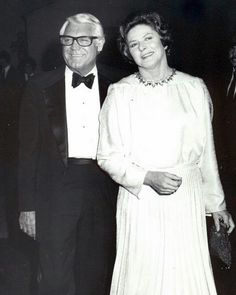
They first met briefly in 1938, at a party David O. Selznick threw to welcome Bergman to Hollywood and promote Intermezzo. But they didn’t spend any real time together until Alfred Hitchcock teamed them up eight years later. Bergman had just painfully parted from war photographer Robert Capa, whom she’d met and fallen in love with while entertaining the troops in Europe. Grant was in the midst of a divorce from heiress Barbara Hutton. Orphans of the storm, they found safe harbor with each other.
Usually friendly but reserved toward his co-stars, Grant immediately sensed Bergman’s deep unhappiness and unease. Though she’d worked with Hitchcock before, on Spellbound, the part of Alicia Huberman called for her to be far more vulnerable and much less in control—emotions uncomfortably close to her real life at the time. Grant instinctively took her under his wing, protecting her from the rigors of a role that frayed every raw nerve.
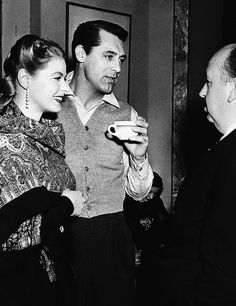

The two grew close as they worked through their intimate scenes between takes, and often talked late into the night—sometimes about their director, who once called Grant “the only actor I ever loved” but was, at times, his usual autocratic self with Bergman, perhaps to mask his growing feelings for her.
“Ingrid took acting so seriously—she was a splendid, splendid performer but she wasn’t very relaxed in front of the camera,” Grant recalled years later. “She spoke English beautifully, of course, but she would occasionally have problems with some of its nuances.
“One morning, she had difficulty with her lines,” he went on. “She had to say her lines a certain way so I could imitate her readings. We worked on the scene for a couple of hours. Hitch never said anything. He just sat next to the camera, puffing on his cigar.”
Fearing he might be making her even more self-conscious, Grant stepped away from the set. “Later, when I was making my way back, I heard her say her lines perfectly,” he said. “At which point Hitch said ‘Cut!’ Followed by ‘Good morning, Ingrid.'”
After filming one of the most famous scenes—where the camera swoops down the spiral staircase to zero in on the key in Bergman’s hand—Grant did something he’d almost never felt compelled to do on a set before or since: he kept a souvenir. More on that later…
As the summer of ’46 wore on, the Notorious set became more relaxed. Bergman and Hitchcock had become such friends that he even allowed her to—gasp!—make suggestions about certain scenes. And she and Grant, it was clear, would remain close, regardless of where life or movies took them. A few months later, at the 1947 Academy Awards, Grant declared, “I think the Academy ought to set aside a special award for Bergman every year whether she makes a picture or not!”

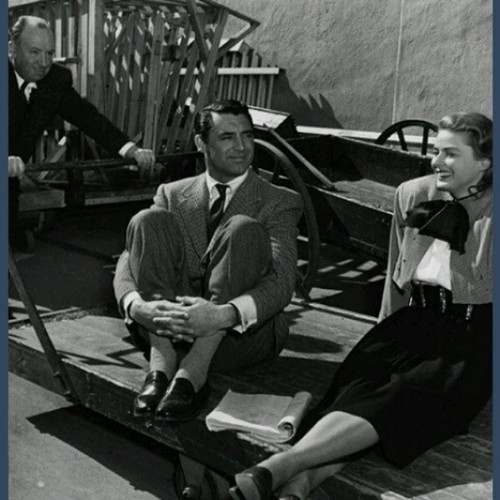
When the movie wrapped in August 1946, Grant made the unlikely segue into The Bachelor and the Bobby Soxer, while Bergman headed to New York to star in Maxwell Anderson’s Joan of Lorraine. Wandering along Broadway one day, she ducked into a theatre to see Roberto Rossellini’s Open City and was powerfully struck by its rawness and lack of artifice. After seeing a second film by the director, she wrote to him with an unusual offer:
“Dear Mr. Rossellini, I saw your films, Paisan and Open City, and enjoyed them very much. If you need a Swedish actress who speaks English very well, who has not forgotten her German, who is not yet very understandable in French, and who, in Italian, knows only ‘ti amo,’ I am ready to come and make a film with you.”
He accepted.
After shooting Under Capricorn, her final film for Hitchcock, as well as Joan of Arc, based on the Anderson play, Bergman headed to Italy. Not long after, in April 1949, news of the married mother’s affair with her Italian director became public. The following February, while in the midst of a divorce and ugly custody battle, she gave birth to their son, Robertino. She and Rossellini married in May 1950.
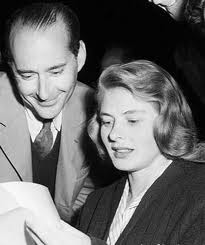
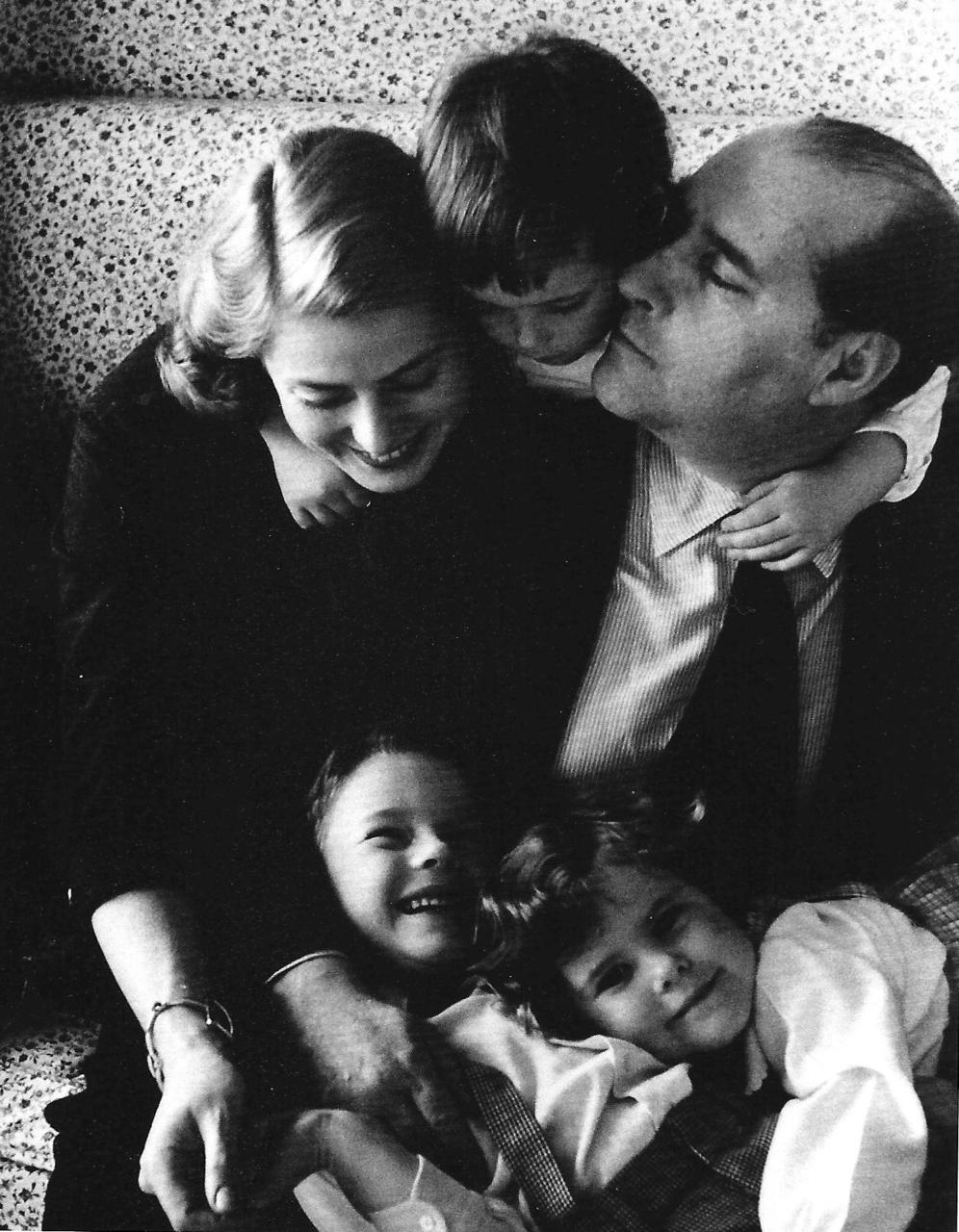
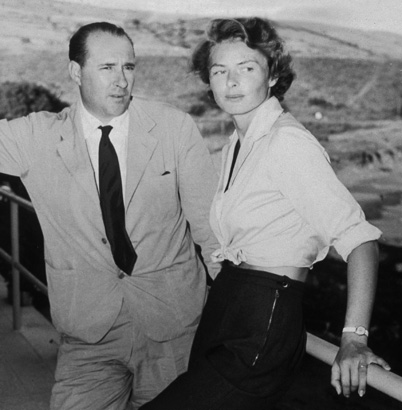
Bergman was excoriated by preachers, politicians and pundits; she was even denounced from the floor of the US Senate, as if she belonged in the same company as Hitler and Mussolini. American studios slammed their doors, many colleagues turned their backs, and disillusioned moviegoers took to their fainting couches. “People saw me as Joan of Arc and declared me a saint,” she recalled later. “I’m not. I’m just a woman, another human being.”
The list of those who didn’t condemn Bergman was considerably shorter—and at the head of it was Cary Grant. He stood by her and defended her, staying in close touch through all her years in Italy.
But after almost eight years and six films together, Rossellini and Bergman parted in 1956—and by then, Hollywood was ready to “forgive” the actress. She returned to the States to take the lead in Anastasia, and promptly picked up an Oscar nod. The night of the ceremony, she was in Paris starring in Tea and Sympathy. In the event she won, there was only one person she wanted to accept the award on her behalf.
And she won. And he did.
Not long after, Grant teamed with director Stanley Donen to produce Indiscreet, and both dearly hoped that Bergman would sign on. Donen arrived in Paris to make a personal pitch—but, having already learned of Grant’s involvement, though nothing else, she was one step ahead of the director. Before he could even settle into the sofa, she said, “I want to put you at ease—I’m going to do the picture.” Then she asked him what, exactly, the picture was.

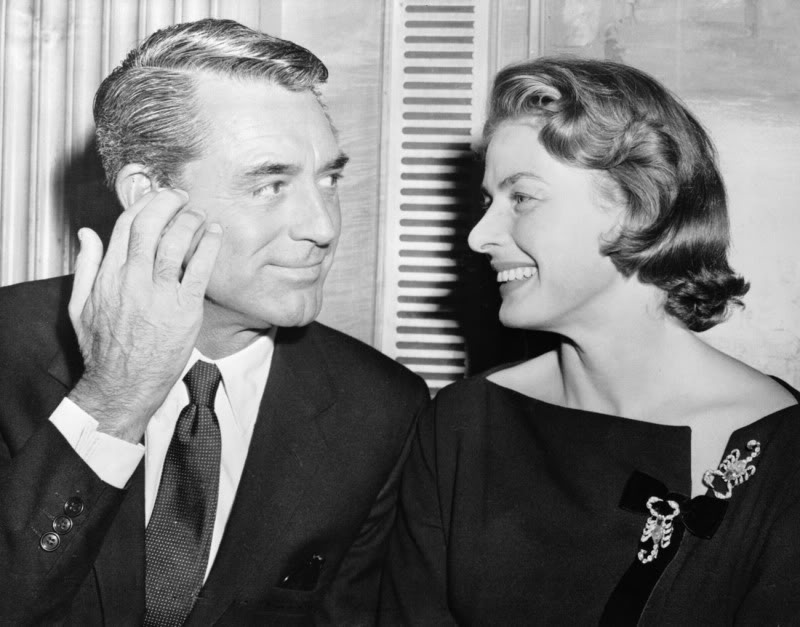
She would later learn that Grant—who knew her years in Italy had not been lucrative—was making sure she got a percentage of the gross receipts in addition to her fee. Oh and he had authorized a fabulous wardrobe for her, enlisting the aid of a fellow named Christian Dior.
By the time London location shooting began in 1957, Bergman and Rossellini had legally separated. Touching down at Heathrow Airport for a pre-film press conference, Bergman braced herself for the media jackals. She needn’t have worried. Grant was right there waiting.
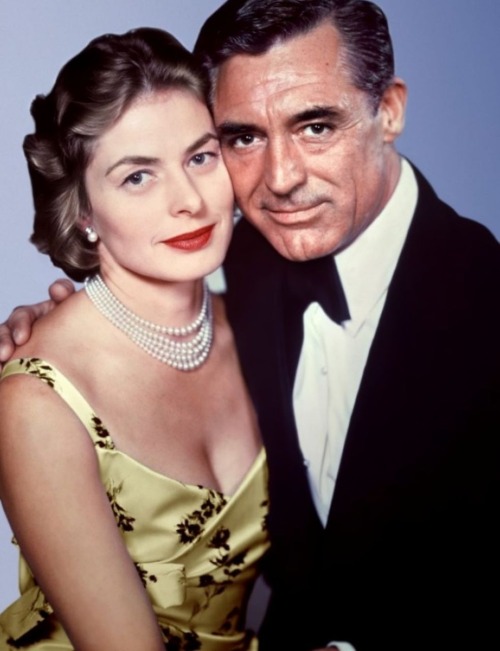
“I was taken into the transit lounge for the press conference, and there was Cary Grant sitting up on the table,” Bergman later recalled. “He shouted across the heads of the journalists ‘Ingrid, wait till you hear my problems!’”
But the Fleet Street hounds weren’t taking the bait; they continued to howl at Bergman about her impending divorce. “Come on fellas! You can’t ask a lady that!” Grant gallantly quipped. “Ask me the same question and I´ll give you an answer. So you´re not interested in my life? It’s twice as colorful as Ingrid’s!”
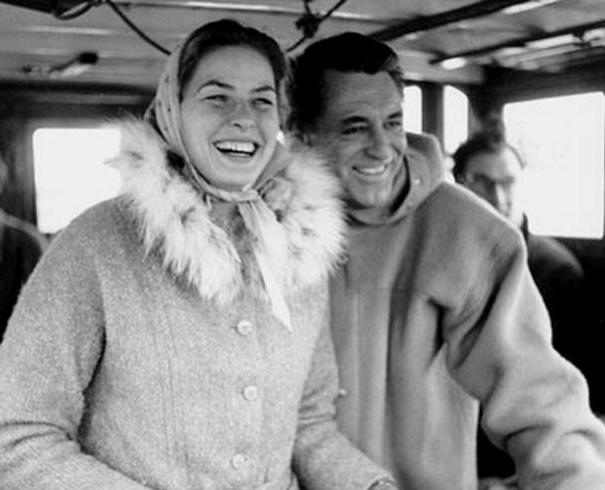
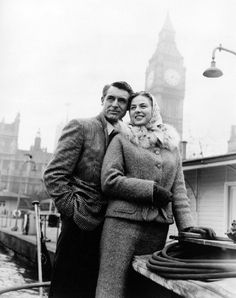
Once the rescue mission was complete, filming could commence. In Indiscreet, a romantic comedy based on Norman Krasna’s Kind Sir, Bergman plays Anna Kalman, a glamorous and accomplished actress who falls for Philip Adams (Grant), a world-renowned economist trapped in a loveless marriage with no hope of escape. At least that’s the tragic tale he’s woven for her. In reality, as we learn early on, it’s just an elaborate ruse to avoid serious involvement.
Their chemistry practically pours off the screen, whether they’re nuzzling in the drawing room or sharing the details of their day, split-screen, on the phone. She’s warm, he’s cool. She’s discreet, he’s direct. “Cary was always quick off the trigger,” director Stanley Donen remembered. “Bang—it was there. That was delightful. Ingrid just had a slower tempo. But it wasn’t a problem—they were magic together.”
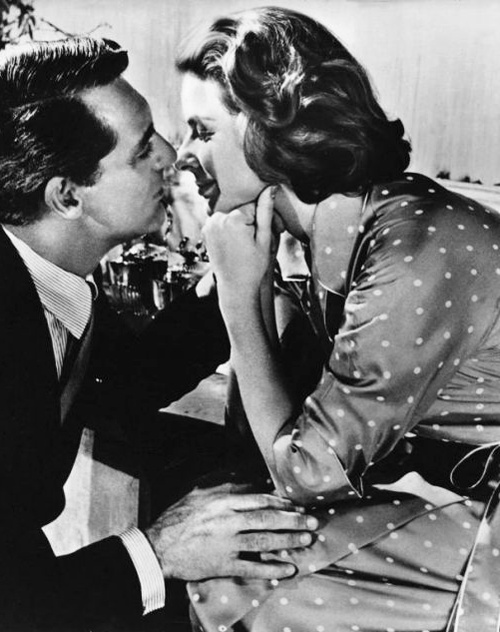
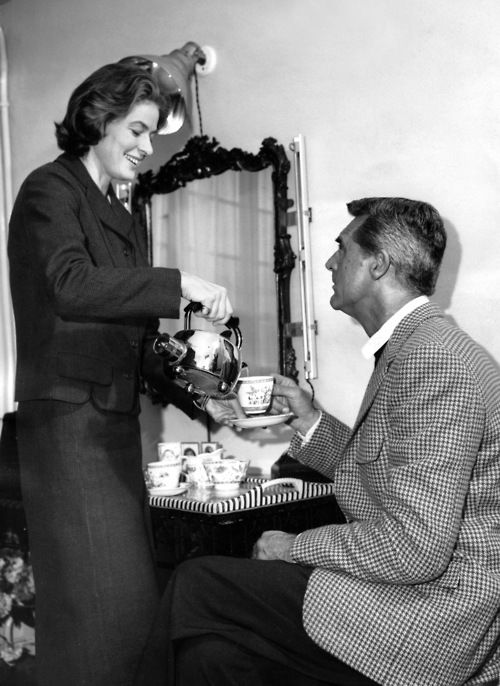
The whole film feels like a dance of sorts, but there’s also an actual dance scene, which is beyond fabulous. Anna’s discovered the truth about Philip and is seriously pissed. (“How dare he make love to me and not be married!”) But, never one to ruffle an elegant evening, she lets him lead her to the floor anyway. Oh and watch for the moment when Grant bursts into a fabulous, loose-legged jig:
When shooting wrapped, Bergman found a small, neatly wrapped package in her dressing room. Tucked inside was the key to the wine cellar, from Notorious, which Grant had slipped into his pocket as a keepsake years earlier, when they first became friends. With it was a note urging Bergman to keep the key for good luck.
Their last public appearance together was in 1979, when Bergman, looking luminous in royal blue, hosted the American Film Institute’s tribute to Hitchcock:
In the glorious closing scene of Notorious, the desperately ill Alicia clings to Devlin and whispers, with all the strength that’s left in her, “Oh you love me, you love me…” And he assures her, “Long ago, all the time, since the beginning…” And so it was with Cary Grant and Ingrid Bergman.

Here’s to Margaret Dumont—Who Always Got the Joke
“I’m not a stooge, I’m a straight lady—the best in Hollywood. There is an art to playing the straight role. You must build up your man but never top him, never steal the laughs.” — Margaret Dumont in 1937, discussing A Day at the Races, her fifth of seven films with the Marx Brothers.
Take that, Groucho.
For some reason known only to him and perhaps his therapist, the middle of the five Marx boys always insisted that Dumont never got the joke—even repeating the slight in his Honorary Oscar acceptance speech. It was cruel, it was self-serving, and it was clearly untrue.
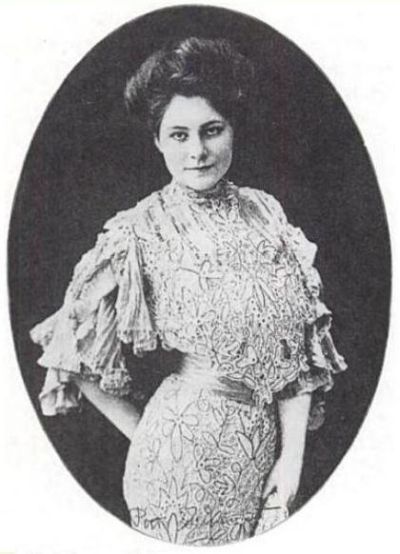

For starters, she was from Brooklyn—where they grow trees, not saps. Born Daisy Juliette Baker in October 1882, Dumont was sent South as a child to be raised by her godfather, writer Joel Chandler Harris of Uncle Remus fame. But while still a teenager, she headed back to New York to take up a life in the theater, first as Daisy Dumont, then as Marguerite, and finally Margaret. As you might have guessed from her booming voice that somehow trilled at the same time, she also trained in opera, touring in America and Europe (as did W.C. Fields’ favorite foil, Kathleen Howard; more on her incredible life here).
Dumont made her stage debut in 1902, in The Beauty and the Beast in Philadelphia’s Chester Theater. She also moonlighted in vaudeville down the road in Atlantic City, quickly gaining notice as a “statuesque beauty” who could also carry off a quip with grace and ease. One reviewer presciently noted her “queenly dignity and hauteur.”
In 1910 she left behind a promising career to marry industrialist John Moller Jr., heir to a sugar fortune, sneaking in just one minor film role (fittingly, as an aristocrat in 1917’s A Tale of Two Cities) during their eight-year marriage. But when Moller died suddenly in 1918, Dumont, who never remarried, turned back to the stage for solace.

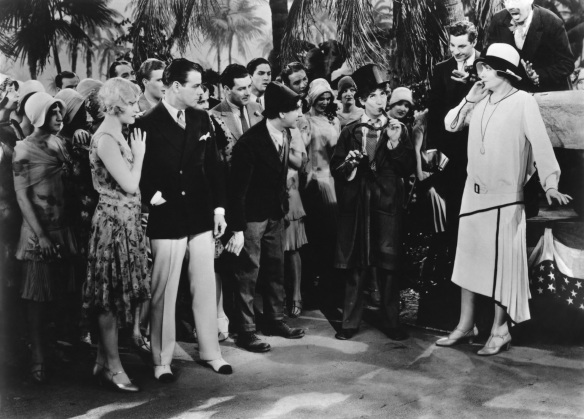
The young widow worked steadily on Broadway through the mid-1920s, when playwright George S. Kaufmann fell in love with her portrayal of a flighty matron in The Fourflusher. He tapped her for the role of Mrs. Potter, the perpetually put-upon dowager, in The Cocoanuts—thereby sealing a marriage made in comic heaven. (Dumont: “You must leave my room. We must have regard for conventions.” Groucho: “One guy isn’t enough. She’s gotta have a convention.”) She and the Marx Brothers reteamed on stage for Animal Crackers in 1928, and soon after, the whole troupe headed over the 59th Street Bridge to Astoria, Queens to shoot both plays as films for Paramount.
But most moviemakers were going West, and there was little doubt that when the boys headed to Hollywood, Dumont was going right along with them. Over the next 12 years and five films—Duck Soup, A Night at the Opera, A Day at the Races, At the Circus and The Big Store—she was the haughty, high-handed, wholly immovable object against which they threw every unstoppable force (including, in Duck Soup, tomatoes). She was the too, too solid center around which every plot, such as it was, revolved—her quicksilver features flickering from horror to amusement to affection to bewilderment and back again before you could say “Tuscaloosa.”
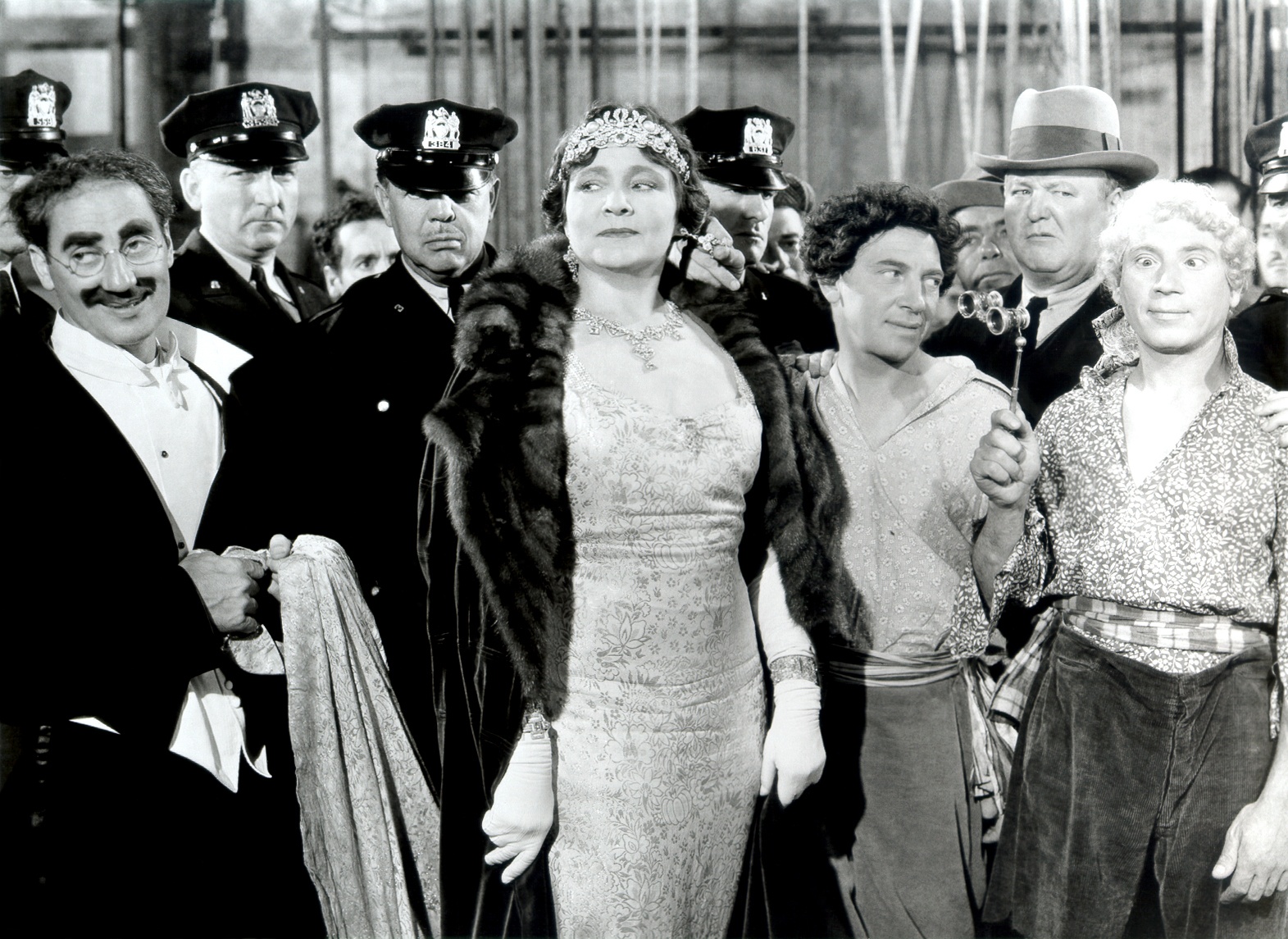
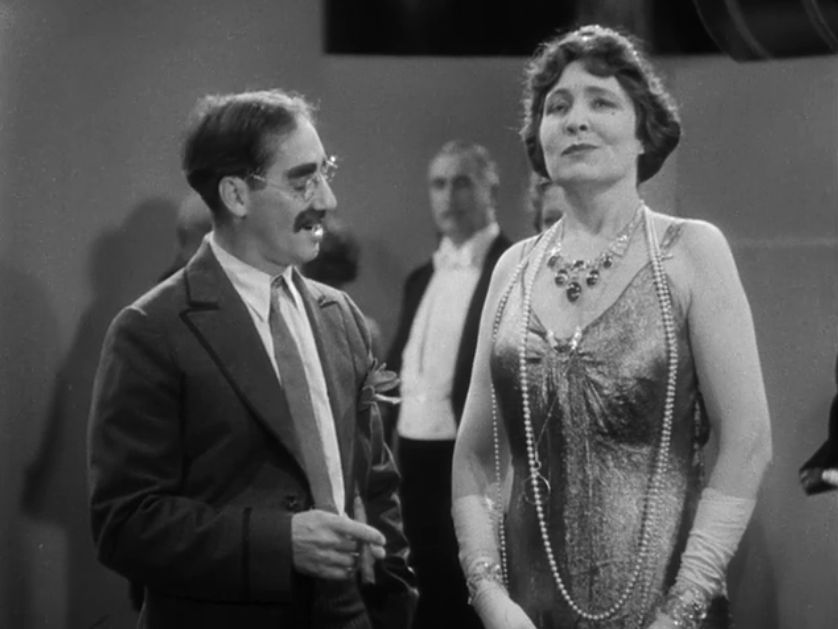
And it wasn’t only audiences who took notice. By the 1940s, just about every funnyman in town was lining up to work with Dumont, including W.C. Fields (Tales of Manhattan and Never Give a Sucker an Even Break—where Fields romanced Mrs. Hemogloben at her mountain retreat), Abbott and Costello (Little Giant), Laurel and Hardy (Dancing Masters), Danny Kaye (Up in Arms), Red Skelton (Bathing Beauty) and Jack Benny (The Horn Blows at Midnight).

Dumont continued to work steadily through the 1950s, mostly in television, including with Martin and Lewis on The Colgate Comedy Hour and with Bob Hope and Dinah Shore on their variety shows. Her final film role was as Shirley MacLaine’s mother in What a Way to Go! and her last TV performance was, appropriately, opposite Groucho in an update of the Captain Spaulding scene from Animal Crackers for The Hollywood Palace. On March 6, 1965, just eight days after the episode was taped, she succumbed to heart failure at age 82.
Dumont, who looks great, is in top form, as imposing as ever—breaking character only a few times to laugh, including when Groucho quips, “Don’t step on those few laughs I have.” And she sneaks in one other little bit of business: When Groucho leeringly jokes about his pictures of the native girls “not being developed yet,” she playfully pauses and then feigns an “Aha!” moment, as if she’s finally getting the joke for the first time. Talk about no good gag going unpunished…
In an interview with Dick Cavett several years later, Groucho dredged up the tired trope about Dumont not getting the jokes, and then recalled the 1965 TV session in especially ugly terms, claiming she behaved “as if she was still a big star,” sitting backstage clutching roses “that she probably bought herself.”
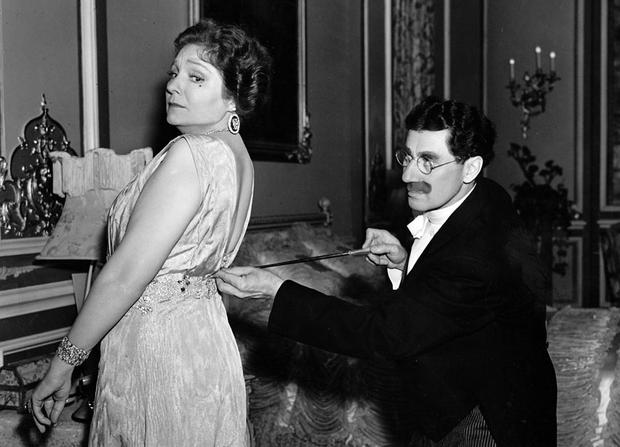
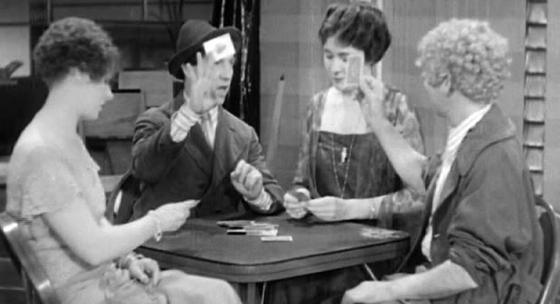
Now, I’m guessing that whenever a lady appeared on The Hollywood Palace, the producers left a bouquet in the dressing room. But even if Groucho thought she’d brought her own, why on earth would he be so nasty as to say so on national television? This is a woman who was as responsible as anyone on earth for the success of his films, whom even he sometimes called “the fifth Marx brother.” But maybe that’s precisely the reason he felt the need to take her down a peg or ten.
In deriding Dumont as dumb and haughty—even pathetic—Groucho was giving himself full marks as the brains behind their comic chemistry. After all, you can’t get credit for something you don’t know you’re doing. But in comedy, timing and rhythm are everything—and if you don’t get the gags, you’ll be hopeless on both counts. So why would the Marx Brothers use someone so clueless in seven films? And why would just about every other comedian in Hollywood snap her up as well?
Because she knew exactly what she was doing, that’s why. If her character had appeared to get the jokes—if they hit her smack in the face rather than gliding over her carefully coiffured head—they wouldn’t work at all; they’d just seem cruel. (How could we ever root for Groucho if he said something like, “I can see you right now in the kitchen, bending over a hot stove. But I can’t see the stove!” to a woman who knew what he meant?)
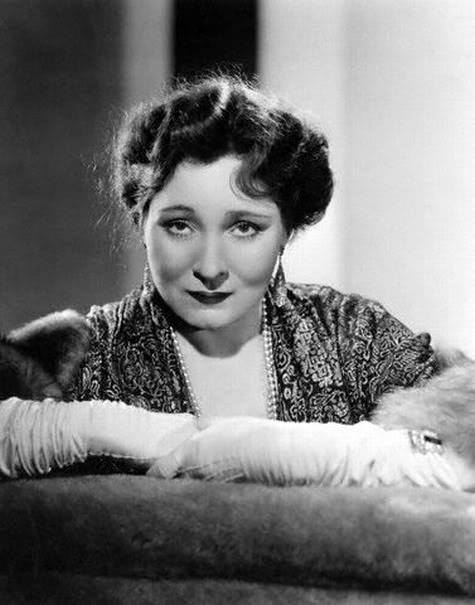
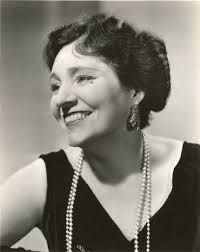
“The more one examines her early record, the less likely become all the later stories about her lack of humor or awareness of the Marx Brothers’ jokes,” writer Simon Louvish wryly noted in Monkey Business, his biography of the brothers. “It is not therefore Margaret Dumont who failed to see the joke, but the Marx Brothers, their interpreters and biographers, who have been unwitting victims of a desperate practical joke played upon us for three-quarters of a century by that greatest of dissimulating comediennes.”
I’ve often wondered why, when Groucho leveled his insulting charges, Dumont didn’t buttonhole a reporter or two to defend herself. The answer, I suspect, is that she was—not like the dowagers she played, but in a very real sense—a lady. And perhaps she thought the idea of her not getting the humor was a pretty funny gag. After all, this was a woman who always appreciated—and understood—a good joke. Even one at her own expense.
Step into John Barrymore’s Secret Hideaway, as Magical as the Man Himself
Settle in, my dears, and prick up your ears. The tale I have to tell you may be the most John Barrymore-esque story ever. And it has absolutely nothing to do with alcohol.
In 1917, the 35-year-old actor was not yet a legend but was fast on his way, relying less on his exquisite looks and digging more deeply into his boundless talent. He’d just closed in John Galsworthy’s prison drama, Justice, with The New York Times gushing that he “played as he’d never played before, and so, by his work as the wretched prisoner, stepped forward into a new position on the American stage.”
But as was often the case, Barrymore was on shakier ground personally—in the midst of the first of his four divorces and recently rejected for military service in The Great War, due to varicose veins. Craving a quiet sanctuary, he instructed his leasing agent to “find a hideaway somewhere in the Greenwich Village area, a quiet place, the sort that would please a nun’s grandfather. Top floor if possible.”

Enter Juliette Nicholls, stage left. A wealthy American widow who’d been living comfortably in France before the war, she’d recently fled Europe for New York, purchasing a fabulous Greek Revival townhouse at 132 West 4th Street. Built in 1839, it was later renovated by Josephine Wright Chapman, one of the country’s first prominent female architects. Settling into her new home, Mrs. Nicholls wanted nothing more than to recapture the peaceful, unruffled life she’d enjoyed as an ex-pat in Paris years before.
Her first tenant was John Barrymore.
She didn’t say yes to him right away, mind you—she needed some convincing. (Even decades later, it still wasn’t unusual for landlords to insist on “No Actors or Dogs.”) But at the time, John was out touring with brother Lionel in Peter Ibbetson, and it doesn’t get any quieter than a tenant who’s almost never there.


But tours, like quiet summer evenings, don’t last forever, and once Barrymore was home, he was home. One night, he peeked into his somewhat startled landlady’s parlor and asked if she’d have any objection to him “fixing up the place,” which sounded innocuous enough. And once she nodded her assent, he was off and running. He decorated the bedroom in Victorian style, lining the walls with pale-pink striped paper, painting the baseboards a contrasting black, and trailing a floral burgundy rug across the length of the wide-beamed floor. Mauve taffeta curtains framed the high windows, a French marble fireplace carved with grape leaves graced the back wall, and a hard, narrow bed, fit for a monk, sat in the center of the room. “A bed for one—a bed that implies celibacy for a change,” Barrymore mused.
But the dear boy was just getting started.
Once his bed chamber was tucked away, Barrymore got to work on the rest of his nest. He gilt-painted the walls of the living room, then set out with a smudgepot to create an aged effect, christening his lair The Alchemist’s Corner. Wooden beams and stray bits of ironwork, refugees from monestaries, found new homes in bare ceilings and empty corners. A baby grand was somehow trudged up several narrow flights of stairs and decked out with a gold brocade tablecloth. A Chinese rug was flung in front of an imposing grey mantelpiece, and formal Lombardian chairs mingled with plump sofas to set a welcoming scene.
Barrymore hung a ship’s lantern in the skylight, but still, the place needed a bit more sun… so he opened out a small alcove, fashioning a bay window with panes of blue bottle glass he’d picked up in Italy.


For real light, though, you really needed to head up to the roof. While his landlady was traveling, he wrote to ask if he might take a few liberties, at his own expense: “I’d like to build a little stairway to it and place a few plants there, with perhaps a small pavilion in which I could sit when the locust blossoms come to the courtyard of Greenwich Village,” he suggested. “It would be like living in Paris in the twelfth century.”
Who could resist such a vision? Not Mrs. Nicholls…
Barrymore engaged a local carpenter to build a crooked little staircase, while he fashioned a banister from an old ship’s rope, fitting an ornately carved wooden door at the foot of the stairs. Then he asked the workman to build a little rooftop hut next to the skylight—but forbade the use of measuring tools. “I want everything crooked or off-center, like a Nuremberg poet’s home,” he told him. “Just guess your way along, old, man, as we all do about most things.” He must have guessed right: the lopsided little lean-to, which the actor wryly dubbed “New York’s first penthouse,” still stands almost a hundred years later.

Barrymore lined the walls with nautical touches, including a six-foot wheel from an old steamboat, and tucked a Franklin stove into the corner to cozy things up a bit.
But what’s a hideaway without, as he put it, “a few plants”? Here’s where his vision really took root.
For starters, Barrymore rigged a block and tackle onto the side of the building to haul up burlap sacks of prime Long Island topsoil. Thirty-five tons of it. Then came the 8-foot cedars, wisterias and cherry trees—the better to service the beehives. Hedges hovered around the perimeter, and flagstone walks meandered through stands of cypress. When Mrs. Nicholls returned home and made her way up to the roof, she was astonished, but touched, to find her famously hyper tenant serenely feeding the birds by an Asian reflecting pool.
And when floral tributes arrived from fans, Barrymore dragged the potted plants up to the roof to join the rest of the garden menagerie.

As it turned out, Barrymore’s life in The Alchemist’s Corner wasn’t entirely monkish; while he did manage some much-needed solitude, he also carried on an affair with Blanche Oelrichs, a self-styled poet who went by the pen name Michael Strange. In 1920, Oelrichs left her husband, married Barrymore, and hauled him off to Westchester, of all places. Two years later, he began his now-legendary Broadway run in Hamlet.


Not long after Barrymore was pried from his beloved lair, his little rooftop Eden—which had no place for pesky details like drainage or girders—began to crumble under the weight of its own fabulousness. Mrs. Nicholls’ new tenant, portrait artist Ben Ali Haggin, was awakened one morning by a lovely spring rain—pouring directly onto his face. A chunk of the ceiling had given way, and the rest of the sagging mess was threatening to follow. The landlady spent several thousand dollars to reinforce the roof and cart away tons of topsoil, never billing Barrymore a cent.
In 1987, writer Paul Rudnick leased the flat, and upon learning its history, was inspired to write I Hate Hamlet, about an actor who moves into Barrymore’s old apartment and, as he prepares to play the famous Dane, is hectored and haunted by the long-gone tenant. The play opened on Broadway in April 1991, closing 88 performances later, shortly after Nicol Williamson—who was even more eccentric than the legendary actor he was playing—deliberately stabbed Evan Handler during a dueling scene.

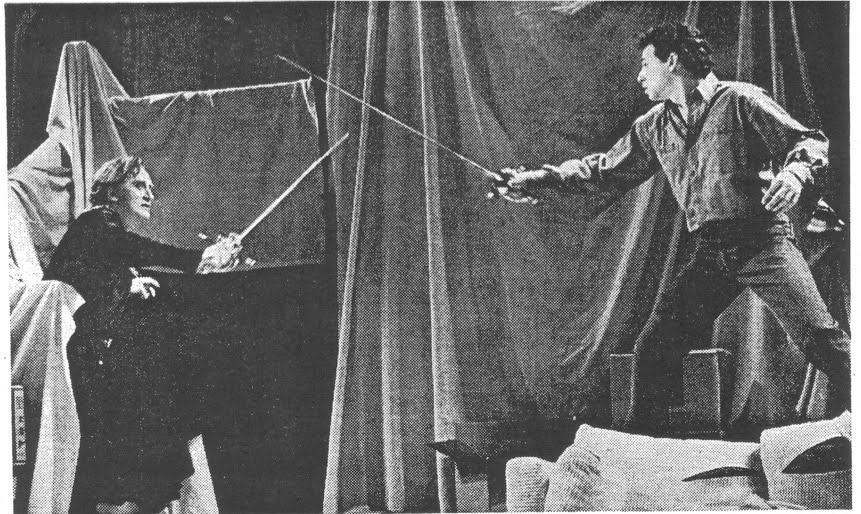
Whenever he was back in the city, Barrymore would sneak a peek at the place he may have felt most at home, and dream of the old days. And he stayed in touch with his benevolent landlady, a kindred spirit if ever there was one. “I was rather a strange, lost creature in the days when we knew one another,” he wrote to her in 1926, years after leaving his lair but likely still longing for it. “And you were unfailingly kind and sweet and wise.”
At the Capitolfest, Mickey Rooney Mixes It Up with Cowboys in MY PAL, THE KING
Have you ever wished you could watch a 1930s movie in the 1930s? I kinda had that chance last weekend at CapitolFest, a weekend of silent films and early talkies screened at the old Capitol Theatre in Rome, N.Y.
The 1788-seat movie palace looks much as it did when these films first flickered to life on its 20-by-40-foot screen, while the lively strains from the deco-style Möller organ welcomed well-dressed patrons to their seats for a Saturday-night date.

For most of the movies during CapitolFest weekend, I sat downstairs, cocooned under the massive domed ceiling. But for one film, I sneaked up to the balcony. It just felt right somehow. And while they’re doing a fabulous job renovating and restoring the entire place, a few old seats in the back of the theater were calling my name. And if anything was needed to make my trip back to the 1930s complete, this was it: there were metal braces to hold hats on the underside of the cushions.

I sank into one of the creaky seats, hoping I wouldn’t become so intimately familiar with the springs that I’d feel like I should light a cigarette afterward. Then I closed my eyes, imagining I had a straw hat tucked under the cushion and a cold bottle of Nehi Cola in my hand. And the curtains parted…
Onto the screen rode Tom Mix, co-starring with Mickey Rooney in Kurt Neumann’s My Pal the King (1932). Shot in just 12 days, this movies was way more fun that it had any right to be. I have to admit I’d never seen a Tom Mix movie, or any of the other old oaters. But boy, was he likeable. Already in his 50s by the time this was made, he was as sturdy, comfy and well broken in as an old rowboat. And just about as wooden. But his ropin’ and rasslin’ skills, and just plain aw-shucks-ness, more than made up for that. And Mickey, playing a boy king in one of his earliest full-feature roles, was just about the youngest and cutest I’ve ever seen him—12 going on four.

In the film, Mickey plays 10-year-old King Charles, the royal head of a mythical European country. Lonely, bored, and eager to be a real kid, he sneaks away to the town square (the same one used earlier in Frankenstein, minus the villagers in lederhosen), where he spies a fabulous traveling Wild West show headed by cowboy Tom Reed (Mix). Charles then invites him to perform at the palace, where he becomes a much-needed counterweight to the graspers and schemers surrounding the boy—including the treacherous Count DeMar (you knew there’d be an evil count, right?), played with moustache-twirling glee by James Kirkwood.

Fearing that the cowboy is becoming too darn good an influence on Charles—who’s relying less and less on his official advisors—the count and his band of evildoers kidnap the king and imprison him in the dark, damp catacombs of the count’s castle, where steadily rising waters threaten to engulf him. Mercifully, the waters only rise until they get to his shoulders, and then pretty much stay there for 10 minutes or so until Tom rides to his rescue. Formulaic? Maybe. But thrilling? Oh my, yes! I suddenly realized for the first time what my Dad felt like when he ran around the corner to the Stanley Theater in Brooklyn as a kid, with a quarter in one hand and his eyeglasses in the other.
“I try to make the pictures so that when a boy pays, say, 20 cents to see it, he will get 20 cents worth, not 10,” Mix once said. “If I drop, you see, it would be like putting my hand in his pocket and stealing a dime.” I can safely say that no money was stolen at the Capitol Theatre that day. It was a wonderful ride…
THE MAN I LOVE: Ida Lupino Rides to the Rescue of, Well, Everyone
In The Man I Love, Ida Lupino enters smoking.
She’s also got a cigarette.
If, after this, you wouldn’t want to stick around for the rest of the movie, just please don’t ever speak to me again.
It’s clear that for Petey Brown, the man she loves has come along… and come and gone. And like most of Lupino’s ladies, this one’s in deep.
Seeking some sort of sanctuary, Petey flees New York to spend Christmas with her family back home in California, where things seemed so much simpler. But they’re not so simple any more.


Her sister Sally (Andrea King) and brother Joey (Warren Douglas) are knee-deep in sleaze, working at a local dive owned by a shady hustler, Nicky Toresca (Robert Alda). Nicky has eyes for Sally, who’s got enough trouble tending to her shell-shocked, hospitalized husband (John Ridgely). Little sister Ginny (Martha Vickers) isn’t in trouble yet: she’s too busy babysitting for Gloria (Dolores Moran), the floozy next door, while the not-so-doting mother is out making time with Nicky. But Ginny’s starting to feel something more than pity for Gloria’s husband Johnny (Don McGuire).
Sorry you came home yet, Petey? Actually, no—she’s thinking she got there just in time. Petey, who was probably mothering this brood even when they still had a mother, is a rescuer in search of a mission. And boy, has she found one.


First order of business: pouring herself into the slinky gown the predatory Nicky had sent to Sally and sashaying down to his place to land a job as a singer, so she can keep an eye on the boss and distract him from her baby sister. Mission accomplished, with relative ease. What she wasn’t counting on was San Thomas (Bruce Bennett), the jazz pianist with a troubled past…
And just like that, Petey has another rescue on her hands—but this one’s not so eager to be saved. “I’d make you sing the blues, honey,” San warns her. “I’ll take that chance,” she murmurs back, and she means it, whatever the cost. San is broken, bruised and brooding from a bad marriage, and certain he has nothing left to give. Petey thinks otherwise, and when you see them together, in scenes so intimate you feel like you’re eavesdropping, you know she’s right.
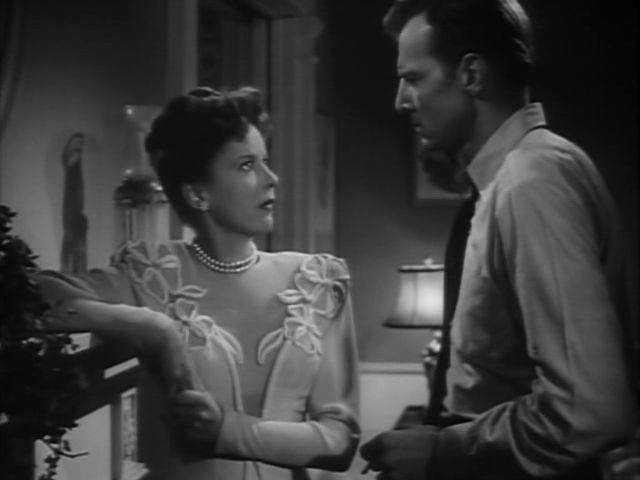

And if you think of Bennett mainly as the helpless prospector in The Treasure of the Sierra Madre or the hapless husband in Mildred Pierce (where he somehow manages to look like the victim even though he’s the one cheating), take another glimpse. This is a man in pain, whose sensitive soul has brought him nothing but misery. His music was his refuge, until he met a woman as wounded as he is, who won’t let him hide in there alone any more. Watch him at the piano, playing the title song as Petey looks on tenderly, falling in love with him and the music and the idea of maybe even being happy again. I dare you not to fall right along with her.
This was director Raoul Walsh’s fourth film with Lupino, after Artists and Models, They Drive By Night and High Sierra (where yes, Bogart was a thief and a murderer, but the real crime was the way he treated Ida). The director and his favorite star were both alchemists who could strike the perfect balance of tough and tender. They had a great rhythm together, and he later mentored her when she took her place behind the camera. Lupino’s co-star Andrea King said they reminded her of father and daughter.
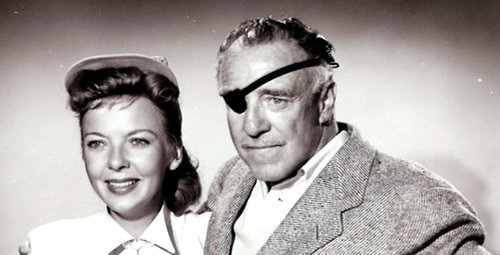
Like Walsh and Lupino, The Man I Love is impossible to pigeonhole. Is it a noir? A semi-musical? A crime drama? A dreaded “woman’s picture”? Variety labeled it a “brittle sex romance.” Which actually sounds kinda painful. Maybe Martin Scorsese, who calls the film one of his favorites, sums it up best: “The Man I Love is dark—it’s a film noir musical, and it’s what I was going for in New York, New York.”
But whatever you call it, with Walsh firmly at the helm, the film never founders. It just works. And Walsh was every bit as forceful about playtime: when he was happy with what he’d shot, he’d boom “Cut! Print!” followed quickly by “Now it’s time for the cooking sherry!”
But there wasn’t enough sherry in all of Spain to make The Man I Love a happy set. Shortly before production began in the summer of 1945, Lupino—already exhausted from her wartime duties touring hospitals and selling war bonds on three continents—strained a stomach muscle while moving a heavy trunk and was ordered to bed to recuperate. Just four days into the shoot, her injury flared up again. “Sorry, I am laid up,” she explained in a telegram to Walsh. “Wanted to come to work but doctors said absolutely no. The hypos are helping. The dogs are barking. The cooking sherry does not do any good and I just shot my aunt Kate. Will do my best to make it Saturday.”

Still fatigued and in pain, Lupino returned to work during a blistering July heatwave, and production ground on, punctuated by the star’s frequent, if unavoidable, latenesses and absences as her health failed to improve. During one scene, she fainted—with only Robert Alda’s quick reflexes coming between her and the concrete floor—and had to be snipped out of her skintight evening gown to be revived.
Adding to the tension on the set were the daily war bulletins, constant complaints about cost overruns from the front office, and endless memos from the Breen Office bleating about the film’s “low moral tone…of adultery and illicit sex,” which forced countless rewrites. When the production mercifully wrapped in mid-September, it was 19 days behind schedule and $100,000 over budget


Ida being Ida, she took the weight of the entire fiasco onto her own slender shoulders, throwing a huge party for the entire cast and crew of more than 200 and insisting on dancing with every man at least once. She promptly sprained her ankle, hobbling off the bedeviled set for the final time on crutches.
Guilty Pleasures, Sleepers and (Way Too Much) Stuff About Me: It’s Liebster Time
The wonderful Lea at Silent-ology has tapped me for a Liebster Award! Liebster, by the way, is from the German for dear, sweetheart or darling—three words that perfectly suit Lea, and that show up in old movies a lot. The award is sort of a way to celebrate kindred spirits in the online community and help us all get to know one another a little better, since, sadly, a humongous afternoon tea party or a night out at a local bar is not an option. And it means so much to me that Lea invited me to this online party.

When you receive a Liebster, here’s what you do:
(1) Answer 11 questions from the blogger who nominated you;
(2) Reveal 11 random facts about yourself; and
(3) Nominate other bloggers for the award, and give them 11 questions to answer when they post their nominations.
Here are Lea’s questions:
- You are given the opportunity to make a movie. Money is no object. What’s it gonna be?
I’d love to do a fictional rewrite of Hollywood history, where all the fabulous actresses who got the shaft from the studio bosses get to win out in the end. Kind of an anti-The Women, with everyone teaming up rather than lungeing for one another’s throats. It would feature deco divas like Kay Francis and Ann Dvorak, whose careers were scuttled when they were deemed “difficult;” powerhouses like Bette Davis and Joan Crawford, who were disrespected when they dared approach forty; and fragile souls like Judy Garland, who suffered wrongs at the hands of the studio bosses that were literally criminal. (Also, Joan and Bette would be friends in my film, as it should have been; more on that here!)



The tone would be lively, candid and Pre-Code, with happy endings for all the actresses and suitable comeuppance for the Jack Warners and Louis B. Mayers of the world. (I’m thinking maybe they can clean the ladies’ dressing rooms with a toothbrush? “Oops, Louis! Missed a spot in the loo!”) The most challenging part would be the casting! So my biggest expense may be creating some sort of super-realistic CGI holograams of all those fabulous women.


- You have the choice between two superpowers: learning any language in seconds, or being able to fix any car problem instantly. You must choose!
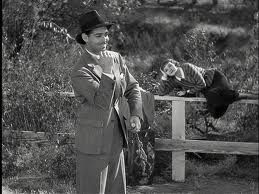
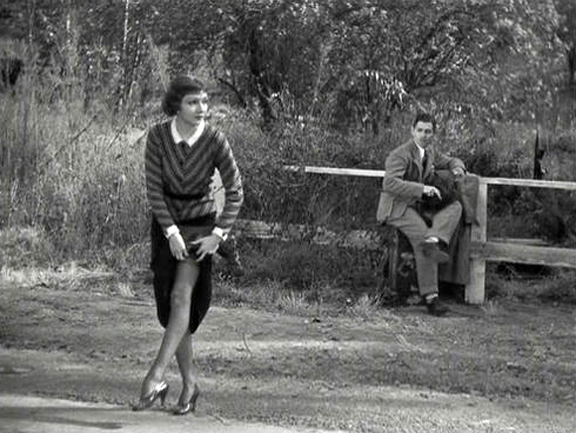
Oh language, definitely. I would love to know how to speak Italian and French, and roam the countrysides of Tuscany and Bordeaux, eating and drinking and chatting merrily with everyone I meet. And if the car broke down I’d just fall back on what I learned from Claudette Colbert. (Sorry, Clark!)
- Which three places/countries must you visit?
1) Ireland, where much of my family is from and which seems like home even though I’ve yet to go there. (I’m dreamy, romantic, moody, prone to depression, and incapable of telling a story in fewer than several thousand words—how I ever manage on Twitter is a minor mystery.)
2) France, where most of the rest of my people are from, and which is my second-favorite moviemaking place. There is so much I’d love to see, from the streets of Paris to the churches and museums to the rolling hills of the country. I would also like to visit the resting places of the directors, actors and actresses I love, and I wish Jean Gabin’s ashes had not been scattered at sea.
3) The Serengeti. One word: meerkats. And I have a thing for warthogs, and love them even more since learning about their crack defensive technique when faced with imminent danger. (They just run like hell.) Also I really need to see giraffes. I think if I went there, though, you’d have to drag me back to the plane, as I’d be hunkering down in a hut somewhere to stay with the animals forever.
4. You can go back in time to witness one historic event. Just one. What is it?
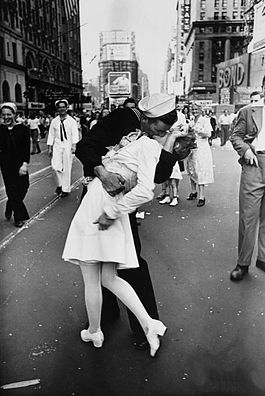
Is it horrible that the first things I thought of weren’t, like, the founding of our country, but movie-related? Like watching Buster Keaton film the house-falling scene in Steamboat Bill Jr.? But from a historical perspective, I’d love to have been in Times Square on V-E day, which seemed like the most joyful place on earth ever, and with good reason.

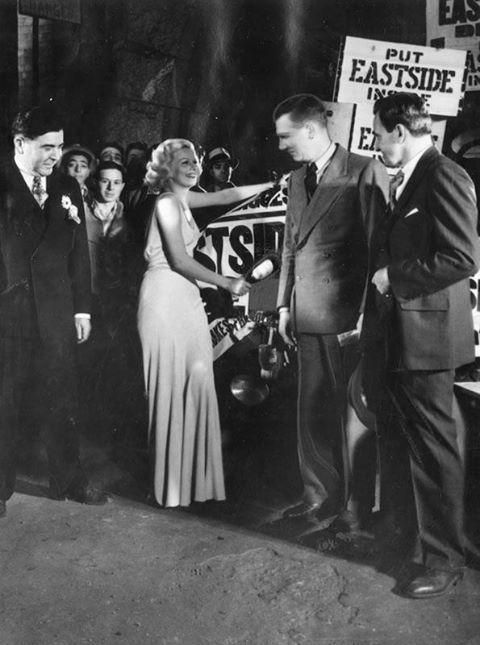
Or maybe the end of Prohibition, if I could hang out with these two (Jeez, Jean hasn’t even cracked the bottle open yet and Walter’s already looking a little blurry):
- What is one very obscure or off-the-wall film you would recommend?
I feel I should pick something people can watch, so I’m going with one—no, two—available on YouTube:
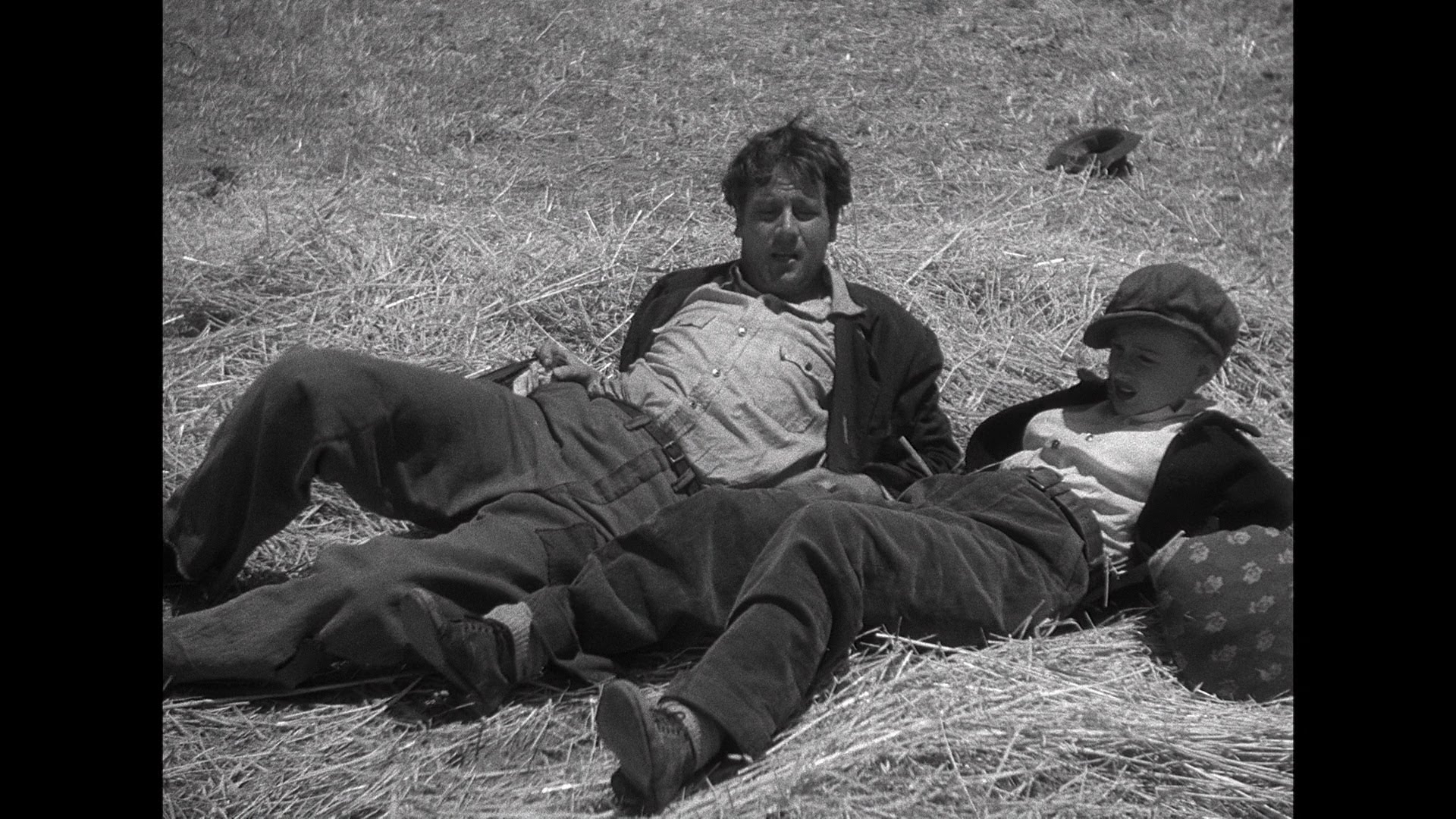
- The Young in Heart (1938): A little gem about a family of charming grifters—and I do mean charming: We’re talking Roland Young (one of my movie boyfriends), Billie Burke, Janet Gaynor and Douglas Fairbanks Jr. Also featuring an insanely young Paulette Goddard and Richard Carlson (in his film debut).
- Late Extra (1935): A neat little mystery starring James Mason in one of his earliest roles, Virginia Cherrill (then Mrs. Cary Grant) just a few years after City Lights, and Alastair Sim letting his Scottish flag fly, burring away—and so young he actually has some hair. Watch for the pivotal scene of James shaving in his undershirt. (Okay it’s not central to the plot; he just looks especially fabulous.)
- Which decade of film do you appreciate the most?
Aaagh!! Why not just ask me which limb I’m fondest of?!? Right now, I’m in 1930s mode, bingeing on high drama, screwball comedies and madcap musicals and marveling at how ridiculously young everyone was. (Though actually, I like a lot of these stars better in the 1940s, when their faces had a little more mileage on ’em.) I love the energy, the Pre-Code daring early in the decade, and the feeling that—even though movies (including some of my favorites) had been around for a while—Hollywood was still just finding its feet, with so many possibilities to explore.


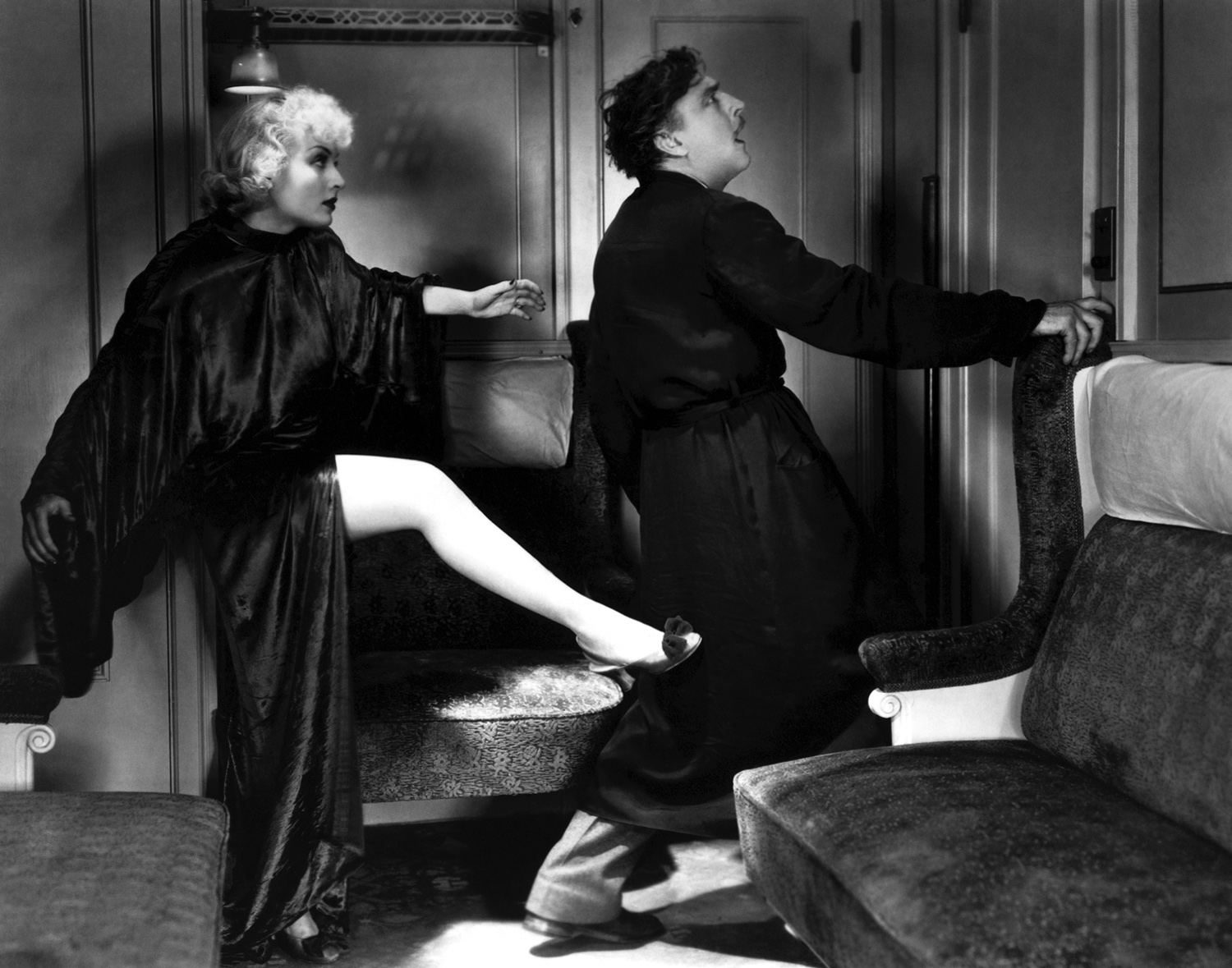
But the decade I fall back on the most is the 1940s, and where to even begin? Hitchcock’s crazy-great run of Hollywood films, building on his amazing work in England; John Huston, Preston Sturges and Billy Wilder writing and directing more brilliantly than most mortals could do either; the rise of film noir; the honest, unflinching post-War films (and I’d include It’s a Wonderful Life here, by the way), the fabulous British studios, and the work of directors like Carol Reed and David Lean; and the movies made during and about the war—from haunting films like They Were Expendable and Battleground to morale boosters like Hollywood Canteen. (I am mildly obsessed with the Canteen and how Hollywood threw itself into the war effort.) I could go on and on (but you’ve probably already noticed that.)… I have a feeling that in my DVD and VHS collections, the 1940s probably edge out any other decade.
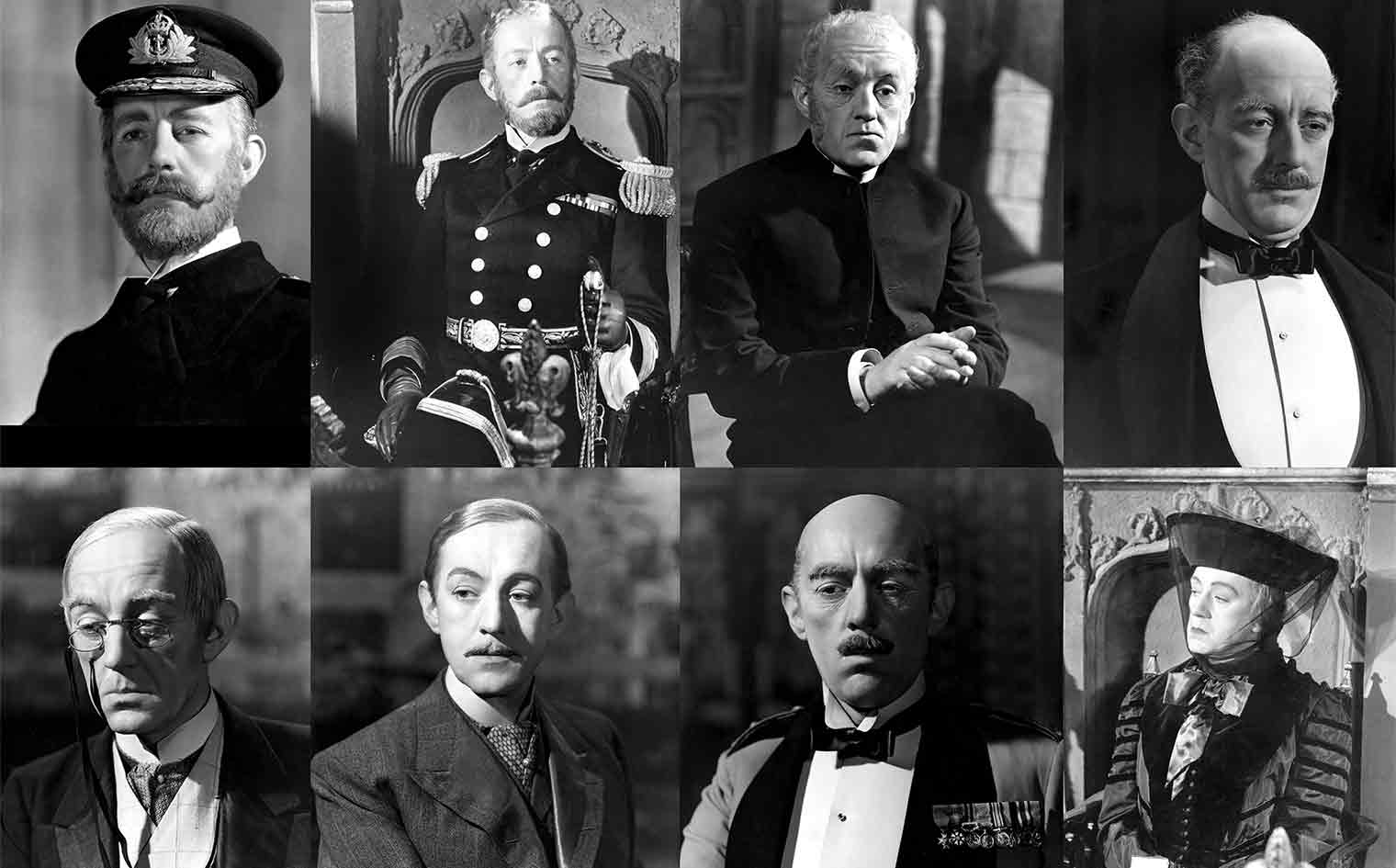
- If someone handed you a million dollars, what frivolous thing would you buy first?
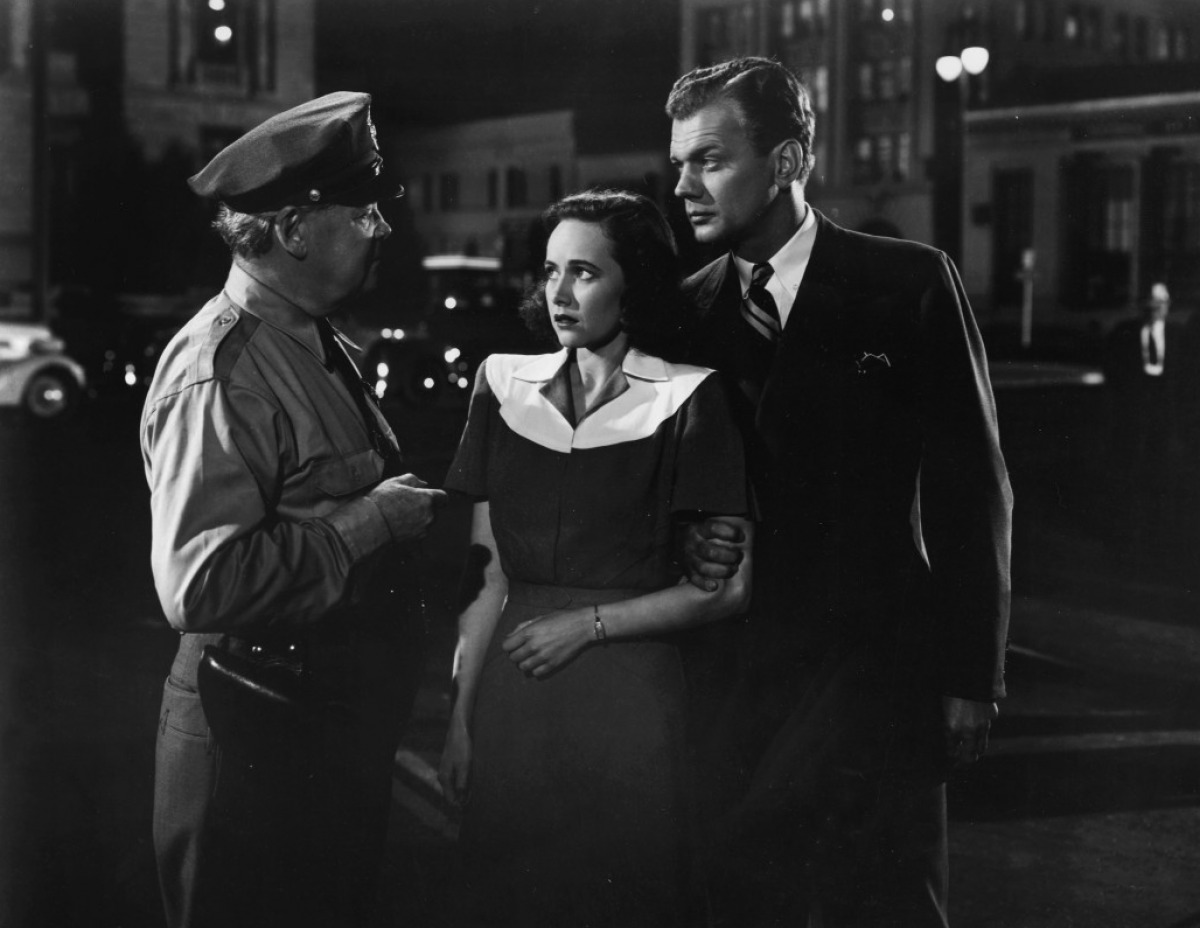
An armload of vintage dresses for a trip on the Orient Express. Preferably with these people, but without the whole homicide thing. (I’ll take the bunk next to—okay fine with—Richard Widmark):
 I am crazy about trains—the gentle rocking, watching the world go by outside the window, the slower pace, the room to roam around, the feeling of going back in time even as you go forward. And to be on a train steeped in such elegance and history, traveling through those wonderful countries, would be like stepping into a dream.
Speaking of the Orient Express, it’s also featured in a great movie with my beloved John Hurt, Night Train. However there are several truly disturbing scenes in an abbotoir, so I suggest watching the movie with some charitable soul who has a strong stomach and can tell you when it’s safe to uncover your eyes. (I just realized this whole paragraph is totally off-topic, so that’s another thing you’ve learned about me: I go off on tangents…)
- Which book do you wish you had written?
Anne of Green Gables. Lucy Maud Montgomery (whose birthday I share!) created a world both magical and incredibly real, with wonderful, complicated characters I will love forever. My mother actually forced me to read this book as a punishment because she felt I was so much (too much?) like the title character. I promptly fell in love with Anne, Gilbert, Marilla, Matthew, Diana, and of course Prince Edward Island, where my Dad’s mother came from and where I’ve since visited. Once there, I couldn’t imagine why anyone would leave. My Grandma and her sister Emma (yes, I had an Auntie Em!) emigrated to Brooklyn, New York, and there is a Brooklyn in PEI. Maybe they just got lost?
- What are your three guilty pleasure movies?
Okay these are the first three that came to mind, in a cast of thousands:
- Rome Adventure. Cheesier than a heaping helping of lasagna, and just as satisfying! Gorgeous scenery, a lovely Max Steiner score, a thoroughly predictable plot you don’t have to think about, and a genuinely sweet love story at its heart. Plus Suzanne Pleshette, whom I’d watch in anything. (Pleshette and Troy Donahue took their roles so much to heart that they married soon afterward. That lasted about as long as this film was in theaters.)

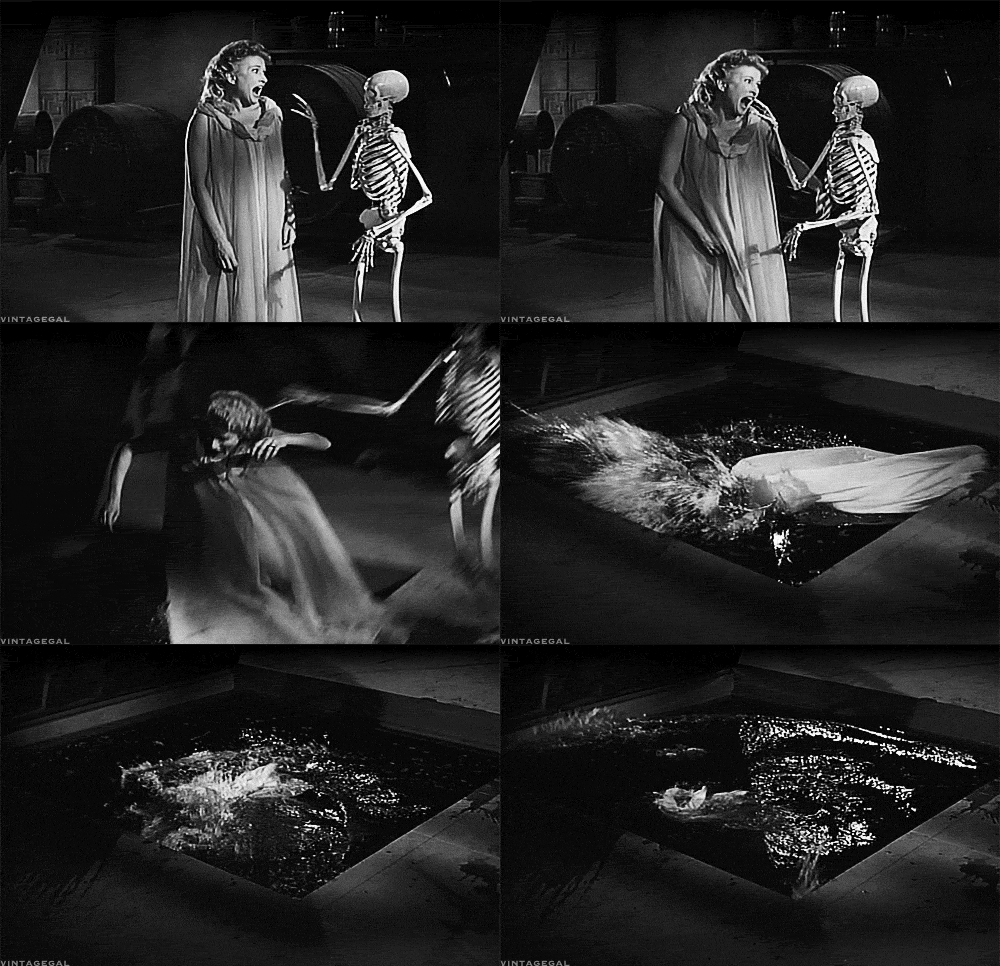
- House on Haunted Hill. You really can’t go wrong with Vincent Price, Elisha Cook Jr., and a dancing skeleton you can pretty much see the strings on. There’s one scene where Price is trying to get his sort of vaguely slutty wife to come down and meet his creepy guests and she refuses—and he grabs a hank of her bleached-blonde hair and snarls, all Vincent Price-y, “Will you come down now?” And she shrieks, “Yes, damn you!” The first time I saw this, with my high school friends late one Saturday night, we just howled at that, and spent the next God-knows-how-long answering every question with “Yes, damn you!” It never got old…
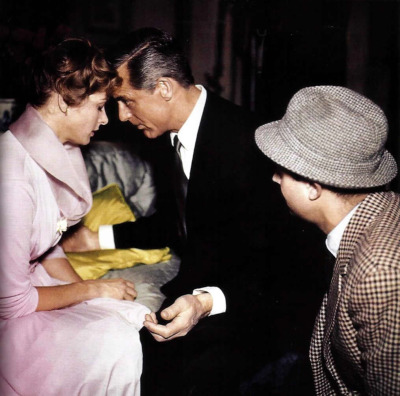
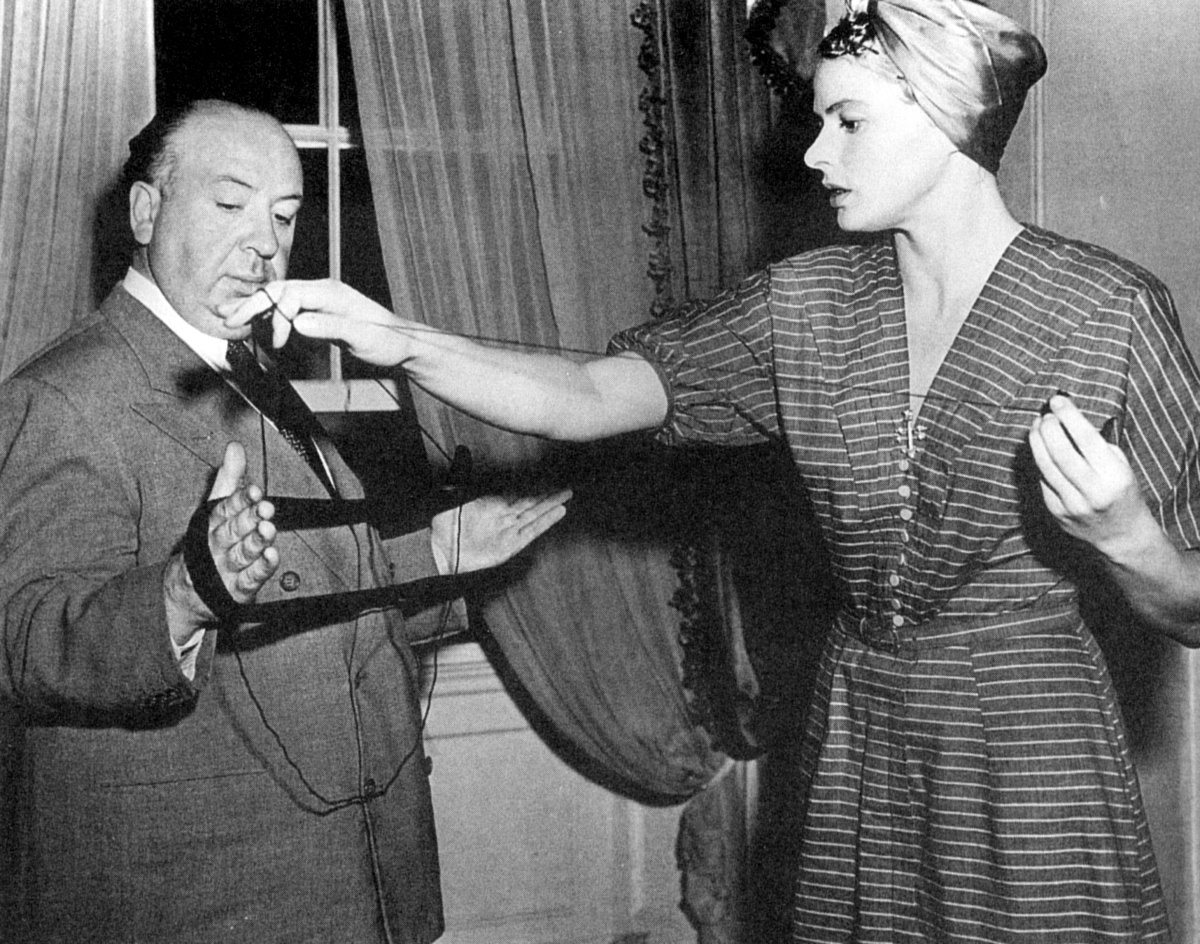
- Under Capricorn. Or as Joseph Cotten called it, Under Corny Crap. This movie is pretty bad. And not just for Hitchcock—for anyone. But I love everybody in it. In an abrupt about-face from Gaslight, Cotten is Ingrid Bergman’s ne’er-do-well husband this time around. Scheming scullery maid Margaret Leighton tries to drive her insane, while the dashing Michael Wilding valiantly attempts to rescue her. (Years later, Wilding and Leighton married, making them one of my all-time favorite couples.) I just love hanging out with these people, even in this soggy pudding of a film. But if you don’t adore the cast, well, in the words of Addison DeWitt, the minutes will fly like hours. Still, if nothing else, it gave us this fabulous behind-the-scenes pic (Alfred was putty in Ingrid’s hands):
- What is the one tip you would give to a beginning blogger?
Don’t try to imitate anybody. Like the old saying goes, “Be yourself. Everyone else is already taken.”
- Okay, Keaton or Chaplin?
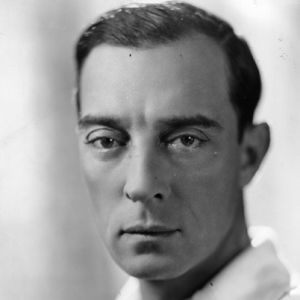
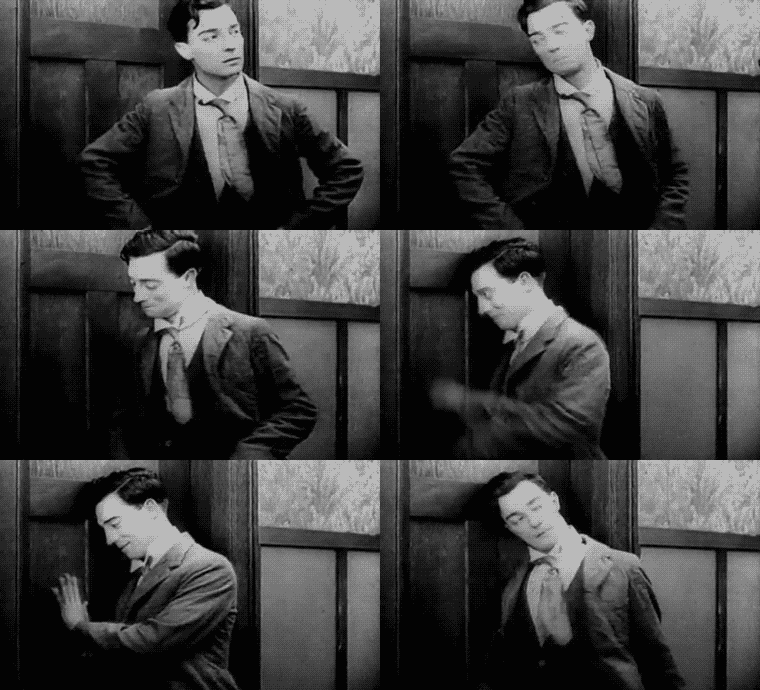
If I were objective, this would be a difficult one, as they’re both so brilliant and so different. It’s like asking which you like more: breathing out (Charlie) or breathing in (Buster). But I’m not objective. For me it’s Buster, one of the true loves of my life, who came to my rescue when I needed him most. He’s also done that for other people, who emailed me or commented when I wrote this remembrance for Lea’s First Annual Buster Keaton Blogathon at Silent-ology earlier this year.
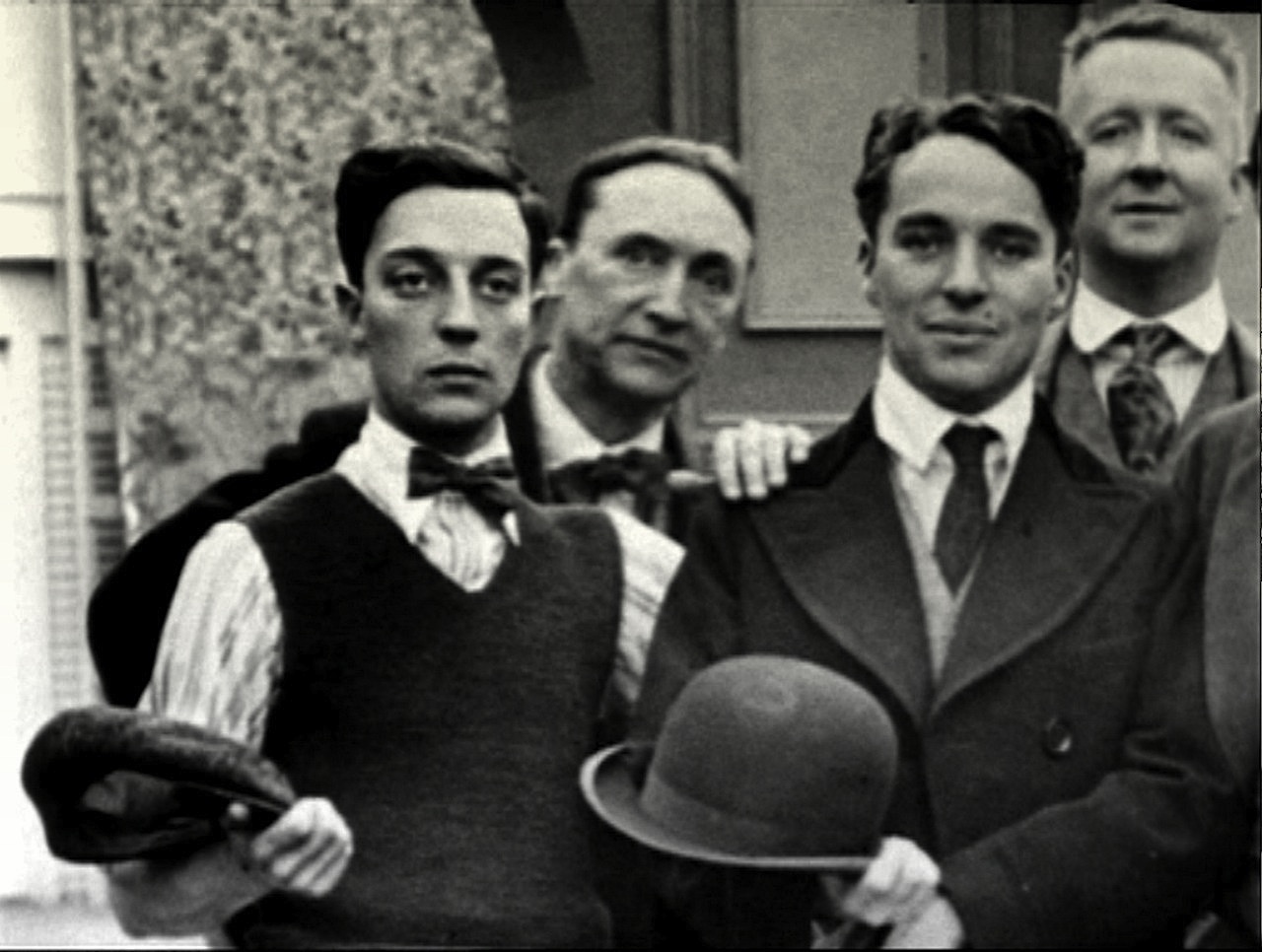

Of course movies, and the people who make them, can soothe us, amuse us, distract us from our problems, and make us feel less alone. But somehow, Buster has done more than that. He’s been there for people in a way I can’t really describe. And I don’t mean some supernatural thing; I mean just by being who he was and doing what he did. There’s something magical about him I wish I could put into words. But he never did, so I guess it’s not really necessary. And those of us for whom Buster showed up just in the nick of time already understand.
11 Random Things About Me:
- I cherish my husband and friends, even more so because my family life was pretty harrowing. One of my favorite lyrics is from Elton John’s Mona Lisas and Mad Hatters: “I thank the Lord for the people I have found.” Amen.
- I still bite my nails. I tried putting icky-tasting stuff on them, but that just made it really unpleasant when I needed to bite my nails.
- I have way too many shoes and pocketbooks. At least that’s what shallow, awful people who don’t appreciate shoes and pocketbooks tell me.
- I am a huge fan of St. Francis. That may be kind of a clunky way to put it, but St. Francis understands. Also of the Pope who took his name. I love that man.
- I am totally in love with Christmas. If you stand still, you will be garlanded. When my husband Tim first saw my apartment at Christmastime and didn’t run screaming, I knew he was a keeper. I also have Christmas carols mixed in on some of my iPod playlists, because they’re too beautiful to listen to just one month a year. (Tim as he passes me on the screenporch, listening to music one balmy June afternoon: “Is that Silent Night?”)
- I am on the board of directors of my local no-kill animal shelter. We adopted our dachshund from a shelter when he was three; he’d been rescued from an awful abuse situation. When he first climbed into our laps, I said to Tim, “Why don’t we call him Linus?” because he reminded me of my favorite Peanuts character; he was small and sweet and seemed to have a lot on his mind. Then when we got him home, the first thing he did was stick his head into his carrier and pull out his blanket. So we knew we got the name right… He’s 13 now and very much safe and sound and loved. And spoiled. (But he doesn’t really get cocktails. Though he does get gloves.)


- I cry ridiculously easily when I’m happy or when I’m sad—that feeling where your heart is so full you could explode. Which is kind of what crying is, I guess—a little explosion… Suffice to say I’m never without a hankie, if you need one. Or if I do.
- I once rescued a box of pigeons from a woman on the subway who told me she was taking them to her restaurant to cook them. Just before the doors closed, I grabbed the box and jumped off the train. Then I went upstairs and untied their feet, which had been tightly bound with twine. At first they tottered around inside the box, but then they took flight. I felt this wonderful “whoosh” inside, watching them fly away into the night. My heart went right along with them.
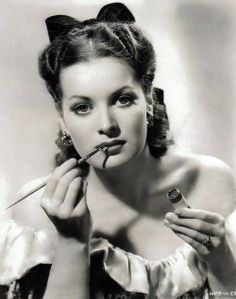
- I’m really good at applying lipstick without looking. Everybody needs a talent; that’s mine.

- I don’t believe in “closure.” I don’t know anyone who’s ever “gotten over” losing someone they loved. There’s no nice, neat period at the end of that sentence. The sentence doesn’t even end, it just changes.
- I’m still afraid of the dark. And I won’t go into the basement or the attic when I’m alone at night, but I’ll do it if I’m on the phone with someone, even if they’re hundreds of miles away and couldn’t help if some raving maniac was there. Imagination is usually a good thing, but sometimes, not so much. Maybe I watch too many movies… you think?

Thank you again, Lea, for this award! It really does mean so very much to me. Now I’m sending the honor along to Pettibloggery, Sepia Stories, B Noir Detour and Writers Rest. I tried to pick great people who hadn’t received the award before, but if any of you have already participated and prefer not to do it again, that’s okay, though I’d love to see your answers!
- Your classic movie dinner party. Six guests. Go.
- If you could live anywhere, where would it be and why?
- Who’s your classic movie kindred spirit? Not necessarily your favorite, or the one you look like the most—but the one who seems the most like who you are.
- Who would direct the movie of your life and why?
- What book or books have you read more than once (or wish you had time to) and why?
- If you could interview anyone in history, who would it be and why?
- What’s the best piece of advice you’ve ever gotten (or read)?
- What’s your biggest vice (assuming it’s not an actual crime) and what’s your best virtue?
- What movie, actor, actress or director do you loathe that others love, or vice versa?
- If you could change the ending of one movie, which would you pick and how would it change?
- What one great talent would you like to have?
Have fun with it, kids! l can’t wait to see your posts.
And thank you all for reading mine, and for making a relative newcomer feel so welcome!
Three Cheers for Eva Marie Saint! (And Happy Birthday!)
Happy 91st Birthday, Eva Marie Saint!!
I’m trusting that tons of vintage photos of this luminous star are all over the intertubes today. But here are some I needed to share with you. Please forgive the blurriness—I was in the bleachers with my little Brownie camera!
On the opening night of the TCM Film Festival, the stars who’ll be featured over the next few days walk the red carpet into Grauman’s Chinese Theater for the premiere film. Many stop and chat with reporters and the TCM interviewer, and wave to the crowd in the bleachers set up for the occasion, stopping to chat if there’s time.
This is what Eva Marie Saint did in 2013.
She paused along the way to talk to everyone. Not just other stars, but fans, reporters, anyone who wanted a moment with her—prompting audible harumphs and frustrated sighs from the trained professionals trying to get her to move it along already. And she had a very animated girl-chat with the lovely Anne Jeffreys, about what I don’t know, but she looked about 16 at the time.


Then she got to the bleachers—and as she reminisced about her early years, she suddenly broke into a cheer from her old high school days. Then she laughed out loud—she may be the only woman in the world who can guffaw elegantly—and said, “I have no idea what made me do that!”



Later in the Festival, Saint spoke after a screening of A Place in the Sun, taking the stage while still sniffling. “It always gets to you, doesn’t it?” she asked the crowd, and, spotting me in the first row face-first in my hankie, pointed to me and said, “There’s a girl after my own heart!”
During her interview with Robert Osborne, she confided she’d planned to be a teacher, and then showed us how wonderful she would have been at it—pausing between memories of her amazing career to dish out advice directly to the audience. Recalling her days as a model in a cold-water flat in Manhattan, with few acting prospects, she told us to never give up and always hang onto our sense of humor. When Osborne asked her the secret for staying fit, she leaned away from her host and toward us, and, with the zeal of a preacher, threw her arms out wide and said, “Walk! Walk a lot, every day. It also helps you think.” You got the feeling she was genuinely worried about us not getting out there enough. And when the interview was over, she applauded the crowd, genuinely overwhelmed by the waves of love sweeping her way.


In short, she was an absolute doll. No one wanted the interview to end, and if we weren’t all so damn law-abiding, we would’ve locked her in the theater and not let her go home.

And so I couldn’t let this busy holiday weekend pass without sharing these memories and pix with you, and wishing this wonderful woman a happy and healthy 91st. And hoping she’s out there walking, a lot.
The George Sanders Touch: Even More Fabulous When He Sings
Reposting so we can all sing Happy Birthday to George Sanders — while he sings love songs to us!!

Need a little warmth to soothe you through those chilly nights? Wrap yourself in The George Sanders Touch….. Songs for the Lovely Lady.
He had me at the over-long ellipses…
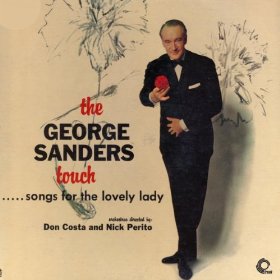
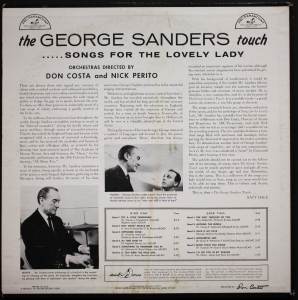
And you needn’t be content just to gaze at the cover of this hard-to-find album, where a slightly sleepy George, who always wakes up in a dinner jacket, slyly hands you a… carnation. (Can’t you just hear him at the photo shoot? “A single red carnation? Really? For God’s sake I give roses to the lovely lady who delivers my laundry!”)
Every song is right here…
One number simply flows into the next—you don’t even have to get up to turn the album over! (You can also buy this in MP3 format from a number of sources, including Amazon UK, but then you don’t get the fabulous visual of George.)
“To the millions of motion picture fans around the world, George Sanders exemplifies nothing so much…
View original post 886 more words
 Sister Celluloid
Recent Comments