STAGE FRIGHT: Hitchcock Goes Home
As the 1950s rolled in, Alfred Hitchcock needed a change of pace. And a hit.
One out of two ain’t bad.
Stage Fright was certainly different: much lighter, for the most part, than most of his films and a return to his home turf, with an almost entirely British cast. But it was also a resounding flop—his fourth in a row, as filmgoers craved his more conventional thrillers and seemed impatient with movies that were harder to categorize, even if they were fabulous.
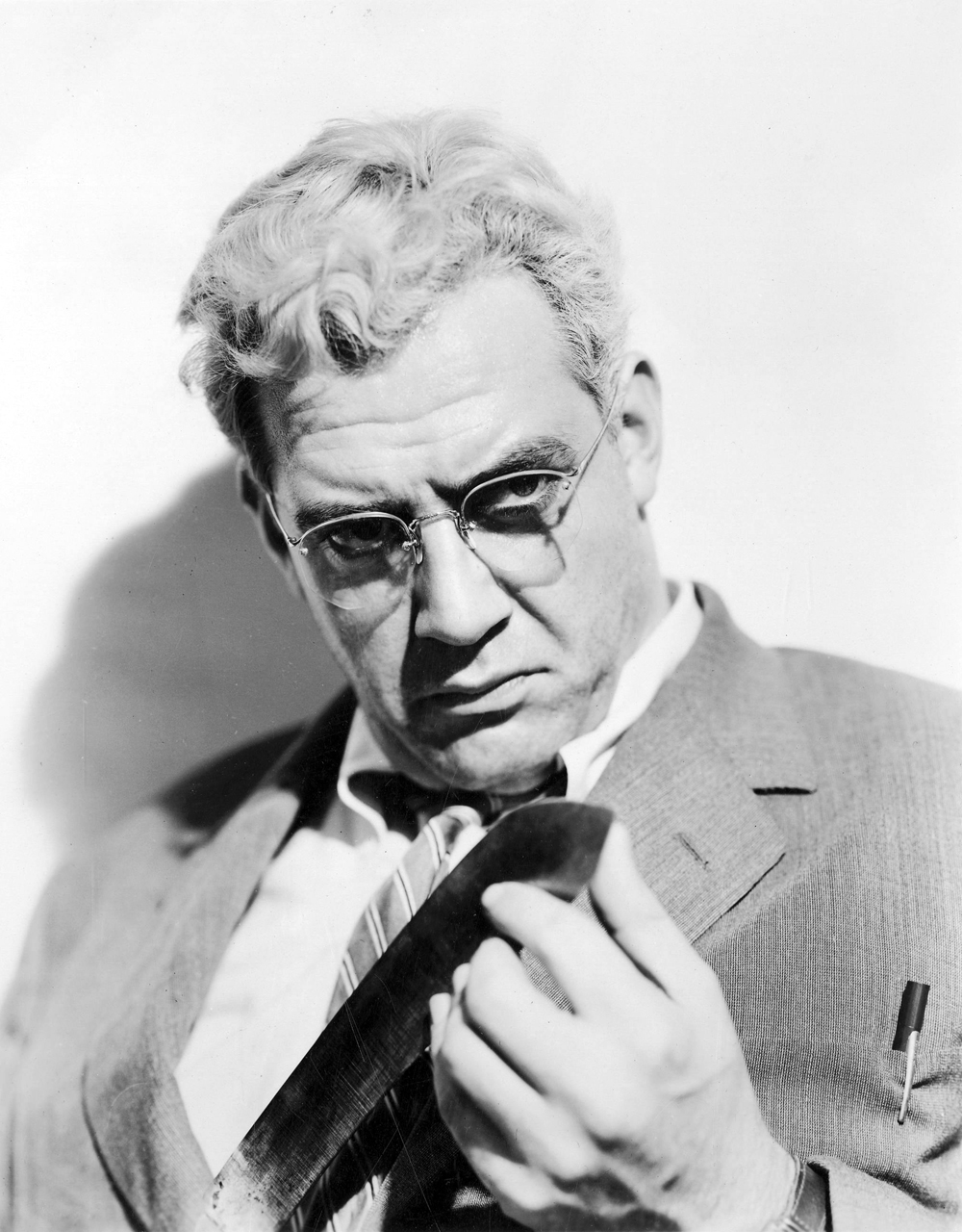
The previous decade had featured a string of classics that most directors would give their fortunes and families for: Rebecca, Suspicion, Saboteur, Lifeboat, Shadow of a Doubt, Notorious, and the criminally underrated Mr. and Mrs. Smith and Foreign Correspondent. In their first collaboration, Hitchcock had mostly managed to keep Rebecca out of the clammy clutches of David O. Selznick. (According to director/film historian Peter Bogdanovich, Hitchcock recalled that as a climax, the producer wanted the smoke from the chimney to curl into the letter R. “Can you imagine?” he shuddered, even decades later.) But in their other two films together—Spellbound in 1945 and The Paradine Case in 1947—Selznick, who never met a thumpingly obvious flourish he didn’t like, had the gears more firmly in his grasp, with predictable results.
Hitchcock grew to loathe Selznick so much that he was still seething seven years after they parted. Does the uber-creepy wife-beheader in Rear Window remind you of anyone?
Smarting from his servitude with Selznick, Hitchcock cut loose with his own production company, Transatlantic Pictures, closing out the decade with the experimental Rope, which played with extended takes and fluid camera movements, and Under Capricorn, which used many of the same techniques, though less boldly. But neither made much headway with fans or critics, and together, the two financial failures sank his fledgling firm. Still, Hitchcock had reached a turning point: for the rest of his life, he would produce his own movies, under the auspices of larger studios.
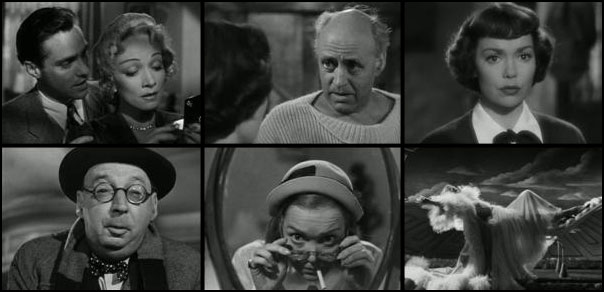
Eager for a break from Hollywood, the director talked Warner Bros. into letting him make Stage Fright across the Atlantic. Shrewdly, he took along one of the studio’s biggest new stars, Jane Wyman—fresh off her Oscar win for Johnny Belinda—in the hope of boosting the box office.
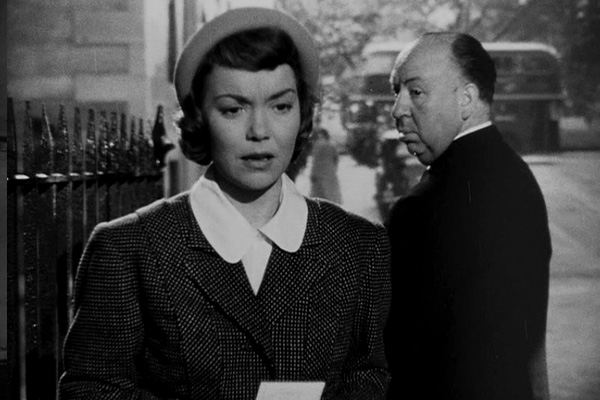
Wyman plays Eve Gill, an aspiring actress at the Royal Academy of Dramatic Art (where Hitchcock’s daughter Patricia, who made her film debut as Eve’s friend “Chubby” Bannister, was studying at the time). Eve’s in love with Jonathan Cooper (Richard Todd), a young actor who’s having a secret affair with Charlotte Inwood (Marlene Dietrich), a flamboyant stage star. As the film opens, Jonathan breathlessly bursts in on Eve’s rehearsal and begs for help; we learn, via his flashback, that Charlotte came to see him after killing her husband and asked him to hide her bloodstained dress, and that when he went back to fetch her a change of clothes, he was spotted by Charlotte’s dresser, Nellie (Kay Walsh). And now he’s on the run from the police.
Eve spirits him off to the coastal cottage of her father, the Commodore (Alastair Sim), who notices that the blood seems to have been deliberately smeared on the dress. He warns Jonathan that Charlotte may be trying to frame him. Angry at the accusation against his lover, Jonathan throws the crucial evidence into the fireplace. And Eve is knocked a bit backward by his intensity.
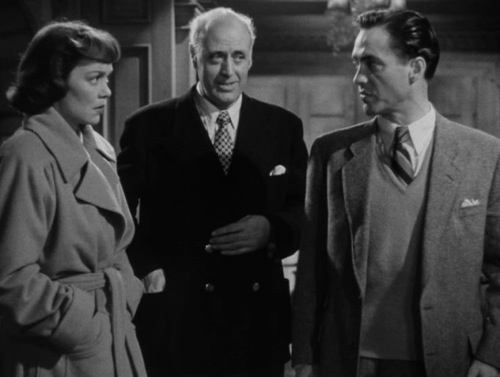
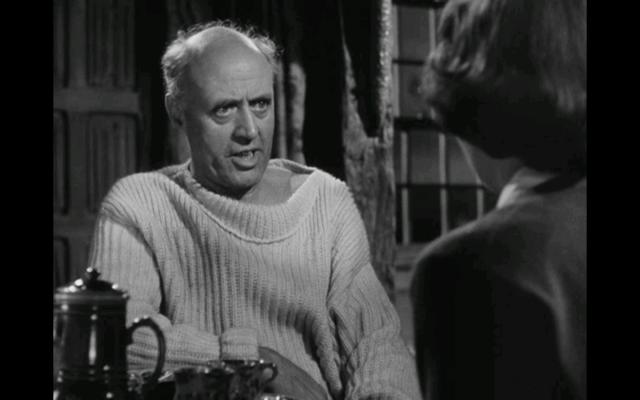
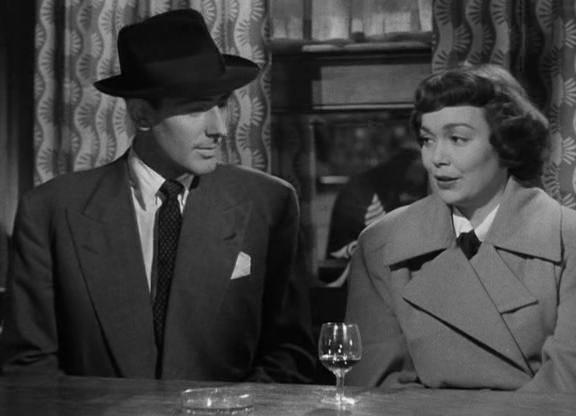
With Jonathan parked safely if crankily with her father, Eve heads back to London, still determined to clear the man she perhaps loved a bit more an hour ago than she does now. When she stumbles across a detective (Michael Wilding, as “Ordinary” Smith) in a local pub, she feigns a fainting spell to get his attention—but this actress is just getting started. She tells Smith she’s a reporter working on the case, and later finagles her way into the role of Charlotte’s dresser, after paying Nellie off to disappear for a while…
The romantic sparks between the wide-eyed Eve and the shyly wry detective are clear from the moment he waves a brandy under her nose. During one scene in a taxicab, they stammer and stare and swoon until you’re practically screaming at the screen, “Oh for God’s sake, just kiss!” So now, Eve has to lie to the man she’s falling in love with to save the one she’s pretty much gotten over.

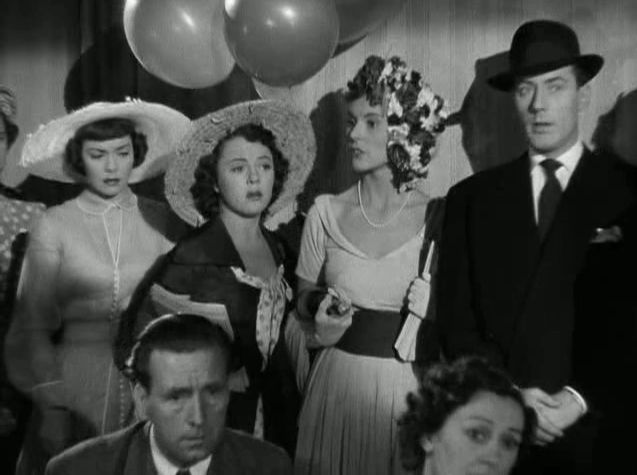
At one point, when Eve’s volunteering at a local fair, she’s shuttling among Smith, Charlotte and her schoolmates, playing three different roles. Meanwhile, her father, who’s now neck-deep in his daughter’s quest to help Jonathan (who, as far as he knows, she’s still in love with), is cheating some skinny little schnook at the shooting gallery, in order to win a doll whose dress he can smear with blood; he’s hoping to unnerve Charlotte—who’s performing at the fair—into confessing. The whole thing is hilariously nerve-wracking—and as if that weren’t enough, Joyce Grenfell is on hand to run the shooting gallery, urging everyone within her (very wide) earshot to try their luck with the “lovely ducks!”
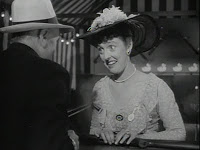
Eventually, of course, Smith discovers Eve’s true identity and her motives, but sets aside his battered ego long enough to help her trap Charlotte. Still posing as the diva’s dresser, Eve tells her she has the bloodstained dress, suggesting she’d part with it for a price. Charlotte confesses that she did plan the murder but that Jonathan carried it out, and offers Eve £10,000 to keep her mouth shut. All of this is being picked up by hidden police micophones in the theater, and soon Charlotte is arrested, but Jonathan, who’s long since bolted from the Commodore’s cottage, slips the police net. Eve is certain Charlotte is lying about Jonathan’s involvement, and sets out to save him once again…

Caution: Spoilers Ahead…
This is just about the only Hitchcock film you’d need to do a Spoiler Alert for, since you usually know who the bad guys are right from the jump. But here goes. Remember Jonathan’s desperate recounting of how Charlotte showed up in the bloodstained dress, and all the flashbacks that followed? Yeah. Those were all humongous lies. Which Eve finds out the hard way—that awkward moment when the cute guy you had a huge crush on turns out to be a raving homicidal maniac…
Eve catches up with Jonathan in the trenches of the theater, and once they’re hidden away there, he tells her that Charlotte goaded him into killing her husband, and he’s the one who smeared the blood on her dress. He also confides his cunning plan to get away with it: kill Eve for no reason, to shore up an insanity defense. Suddenly things get much more Hitchcockian: victim and killer are thrown into sharp, shadowy relief, and it almost becomes a different film—in keeping with the sense that everything that has gone on before was mere artifice and now we, like Eve, are face to face with the dark and dangerous reality.
After several excruciating minutes, Smith and the police arrive and flush out the killer, who, attempting to flee, is caught and crushed under the stage’s (ironically named) safety curtain.
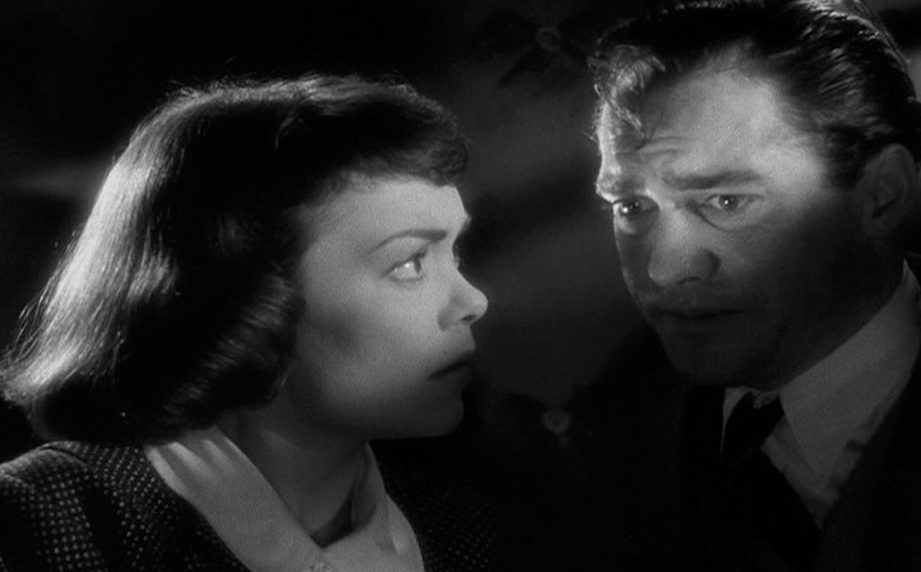
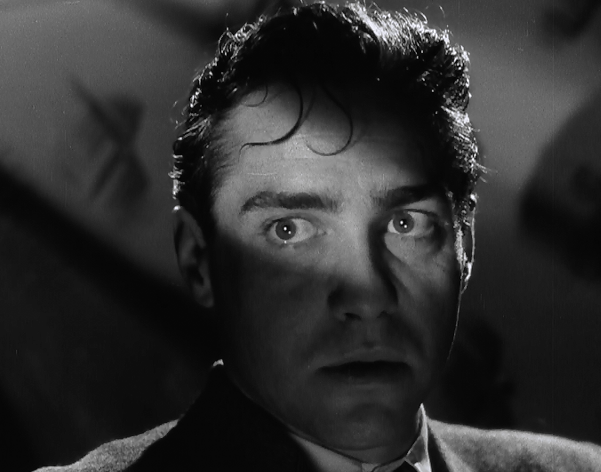
Critics and audiences came at Hitchcock with everything but pitchforks for the “lying flashbacks” from an unreliable narrator; the director countered that this was simply one character’s version of events and needn’t have been taken as gospel. But he later called it one of the biggest missteps of his long career.
I like his first take better. Over the years, moviegoers had grown to care deeply for Hitchcock’s wrongfully accused victims, and I understand how they might have felt betrayed. But it’s not a director’s job to spoon-feed people the same formula in film after film. I loved the surprise—and that, in a movie rife with deception, we were as fooled as Eve was. It put us right there with her in that dark corner, deepening our sympathy and adding another layer of emotion to a finale that’s as creepy and suspenseful as almost anything Hitchcock ever put on the screen.
…End of Spoilers
Stage Fright also has just about as much sheer chemistry as any of Hitchcock’s films. Wyman and the always-brilliant Sim are in perfect rhythm as father and daughter—quirky kindred spirits caught in the middle of a murder mystery. (Have you ever watched an Alastair Sim movie and tried to picture anyone else in his part?)
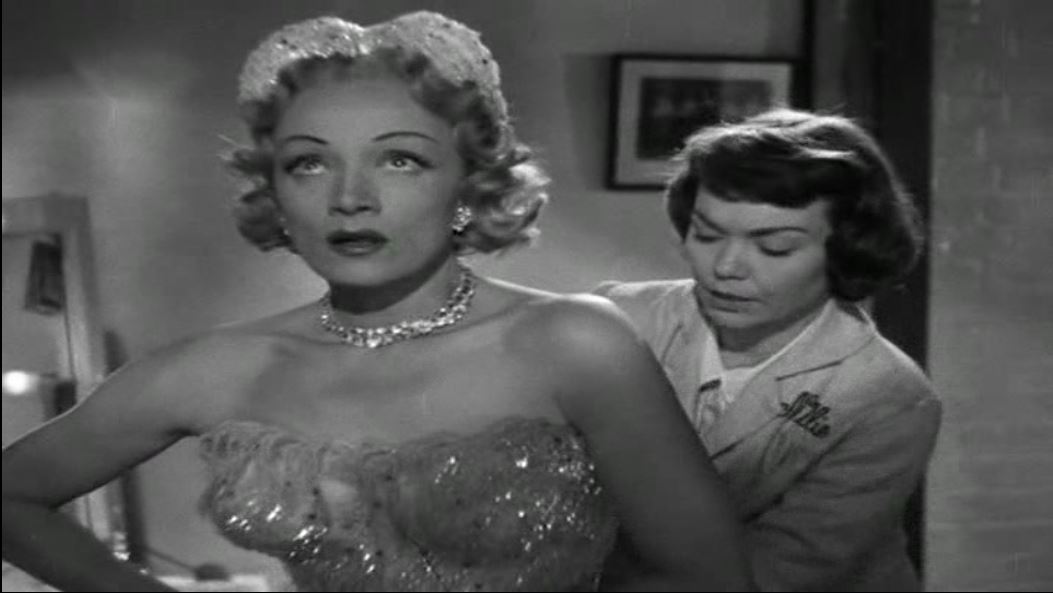
And Dietrich and Wyman play beautifully off each other as the glam goddess and the modest maid she takes under her wing, somewhat mirroring their relationship offscreen, which got off to a shaky start but ended with Dietrich insisting on retakes when she felt Wyman wasn’t lit properly.
Draped in Dior from start to finish, Dietrich is beyond fabulous, even when she’s being fitted for her widow’s weeds. “This is very nice, if you can call mourning nice,” she confides to her maid, “but isn’t there some way we could let it plunge a little in front?” (Dietrich’s own bracelet sets off every gown; the modest little bangle, made for her out of some stray diamonds and rubies she had lying around, sold for almost a million dollars at Sotheby’s in 1992.)
And finally, how many Hitchcock movies feature Dietrich purring through a Cole Porter song…
…which I’m pretty sure was the inspiration for this:
All in all, Stage Fright is Hitchcock’s most fearfully underrated film.
The “…And Scene!” Blogathon Is Here! Time to Relive Some Favorite Movie Moments
Breathes there a classic movie lover who has never burst forth with those immortal words…
“I LOVE THIS PART!!”
Well, read on, my kindred spirits!
The “…And Scene!” Blogathon has arrived!!
Twenty-five fabulous bloggers and I go into passionate detail about our favorite classic film scenes—the ones we replay over and over, so the DVD (or VHS tape—c’mon, some of us still have them!) has a little groove in it. The ones we catch ourselves mouthing the words to. The ones where our loved ones tiptoe out of the room because they know we’re going to get all weepy or crazy or giddy again. Yeah. Those scenes…
And what a great assortment of movies, spanning five decades from the silents to the psychodelic ’60s, crossing two continents, and celebrating just about every genre. As articles are posted, I’ll be adding the live links to the roster below. So please join us in reliving these wonderful moments. And a humongous thank you to every writer who made a scene!
The Roster:
Sister Celluloid The love scene in D.O.A.
Back to Golden Days The gin rummy scene in Born Yesterday
Writer’s Rest The porch scene in It’s a Gift
Second Sight Cinema The stoop scene in The More the Merrier
Caftan Woman The “silent farewell” scene in The Searchers
Old Hollywood Films The filibuster scene in Mr. Smith Goes to Washington
MovieFanFare The Maharaja scene from Three Little Pirates
Another Old Movie Blog The bathtub scene in Katie Did It
Vienna’s Classic Hollywood The “Maida revealed” scene in In Name Only
Movie Movie Blog Blog The Looking for Trouble scene in The French Line
Defiant Success The party scene in Seconds
Love Letters to Old Hollywood The Ballin’ the Jack scene in On the Riviera
Cary Grant Won’t Eat You The courtroom scene in I’m No Angel
Sepia Stories The “getting ready for dinner with the boss” scene in It
Movies Silently The fight scene in Tol’able David
Critica Retro The funhouse scene in The Lady from Shanghai
Wide Screen World The “Barton gets suspicious” scene in Double Indemnity
Back to the Viewer The grapefruit scene in Public Enemy
Litlover12 The drunk scene in The Philadelphia Story
Wolffian Classic Movies Digest The shower scene in Psycho
Nitrate Glow The “descent into the lair” scene in the 1925 version of The Phantom of the Opera
Girls Do Film The “bumpy night” scene in All About Eve
The Wonderful World of Cinema The opening scene in To Be or Not to Be
Phyllis Loves Classic Movies The “house plan” scene in Blandings Builds His Dream House
Reel Distracted The heist scene in Rififi
Melanie Surani The kidnapping scene from The Cabinet of Dr. Caligari (click here for the link: http://melsurani.tumblr.com/post/122535929145/ive-been-a-silent-film-junkie-for-almost-as-long)

D.O.A.: A Love Story
Ah, classic movie love scenes! Scarlett and Rhett on the bridge in Gone with the Wind. Rick and Ilsa on the tarmac in Casablanca. Kathy and Heathcliff on the moors in Wuthering Heights. Frank and Paula on a seedy street corner in D.O.A.
Wait, what?
Oh yes, people! Tucked amid the sleazy bars, poisoned cocktails, glowing toxins and creepy villains is one of the most romantic scenes in all of film—filled with more longing, love and loss than you’ll find in a hundred bodice-rippers.
When first we see Frank (Edmond O’Brien) and Paula (the approachably gorgeous Pamela Britton), the setting couldn’t be less romantic: an accountant’s office. But right away, we know at least one of them is in love, when Paula throws the fish-eye to the chippy who’s draped herself across Frank’s desk as he’s eyeing her deductions.
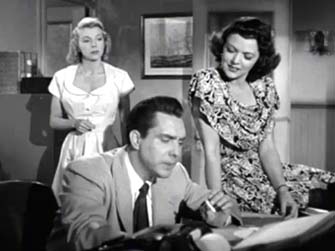
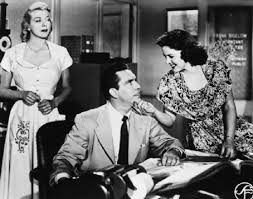
Frank is wrapping up some work before heading to San Francisco on vacation—alone. Seems that although he and Paula have been seeing a lot of each other, he’s still burned and bruised from a bad marriage, and she’s, well… I hate the word “needy” because really, who among us hasn’t been desperately in love and grasping at any shred of reassurance we can get our hands on? But yeah, she’s a little clingy.
Later that day, over drinks at the pub downstairs, Paula’s trying to be brave. “I’m not going to crowd you any more, Frank,” she says, fighting her impulse to handcuff him to her handbag. “Go to San Francisco.” (Then she calls and leaves a message at his hotel literally before he arrives.)

Frank gets to the St. Francis just in time for a hoppin’ convention—it’s the Market Week Summer Shindig!—and leaps into the spirit of things pretty damn quickly: no sooner has he checked in than he’s checking out the local talent. He’s even scoping out skirts while he’s on the phone to Paula back home.
But a classy hotel is no place to rumba with complete strangers, and soon the conventioneers, with Frank in tow, high-tail it to a dive bar on the wharf to take in some bad jazz and worse drinks. Frank’s bourbon tastes especially funny…
The next morning, he feels so hung over he heads for a doctor’s office, where tests reveal he’s ingested iridium, a “luminous toxin” with no antidote. A second doctor confirms the poisoning—and when he learns that Frank has no idea how it happened, says it must have been deliberate.
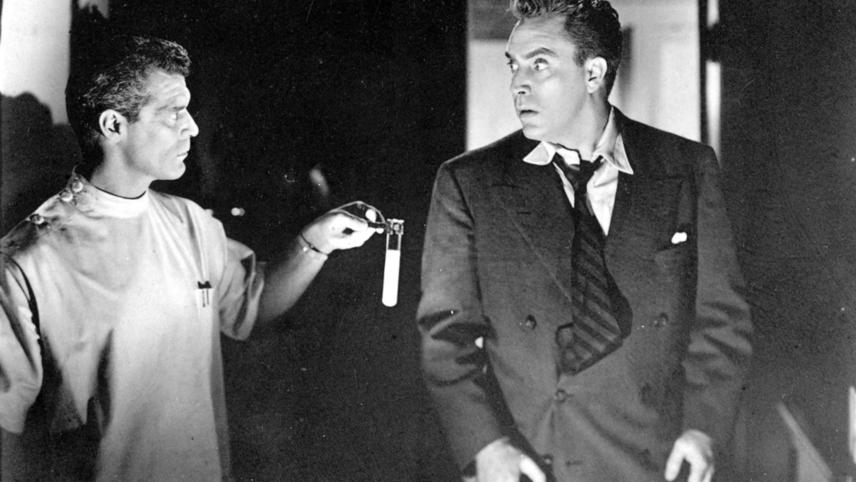
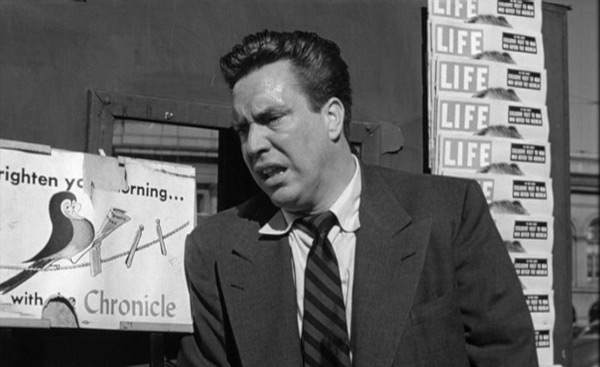
Desperate and devastated, Frank sets off on a frantic search for his killers that leads him up and down San Francisco and finally to Los Angeles. And Paula, frightened at how he’s sounded on the phone, follows him there.
When she steps out of the shadows onto the street, it’s as if he sees his whole life before him—a life that was his for the taking just yesterday.
“Look at you, you’re a sight! Your clothes look like you’ve slept in them! Are you ill? You are—you’re feverish!” Paula cries, gently dabbing his brow with her handkerchief. “What is it, Frank? If you’re in any kind of trouble you certainly can trust me!” He could trust her with his life, and now realizes, too late, that he should have. If he hadn’t left her… if he’d stayed home… he would have gotten the phone call that would’ve warned him…
“Frank, I know that you’re in trouble, that something is wrong, that you’re in serious trouble!” she says. “You frighten me, Frank!”
“Oh don’t be frightened Paula!” he tells her, pulling her even closer. “Don’t ever be frightened of anything again, will you promise me that?”
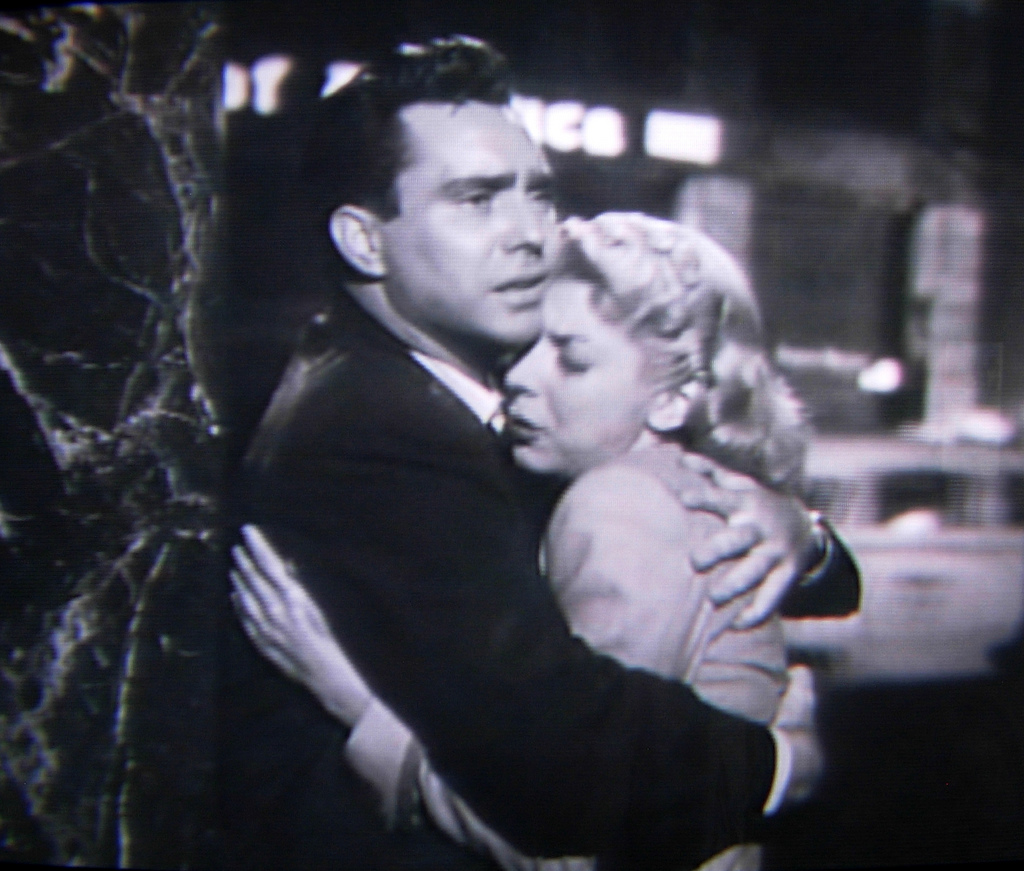
Suddenly everything comes spilling out, everything they should have said before, everything that could have saved them both.
“I love you so much, darling, more than you seem able to understand!” she says, fervent as a prayer. “I never really knew happiness until I loved you. Sometimes when I used to be afraid that you weren’t sure how you felt, I tried to hold back, but I couldn’t. Losing you would have meant losing everything! There would have been nothing left!”
“Don’t, Paula, don’t!” says Frank, all but collapsing under the weight of regret.
“Now I’m afraid again! Somehow I feel that I’m going to lose you but there’s nothing I can do about it! I feel so helpless—you’re leaving me out of something! Tell me Frank, what is it?” she pleads. “Give me a chance to fight back, just give me a chance, please! You do love me, don’t you?”
Almost before she can finish the question, he cries,”Oh yes, Paula, I love you! I never was more certain of anything in my life! I wasn’t sure before, I was a little blind, I guess, but believe me, I’m sure now, can you understand that Paula?”
“I understand,” she says softly. And she looks so relieved—as if this were the breakthrough that would finally make everything okay for them. As if this were the beginning.
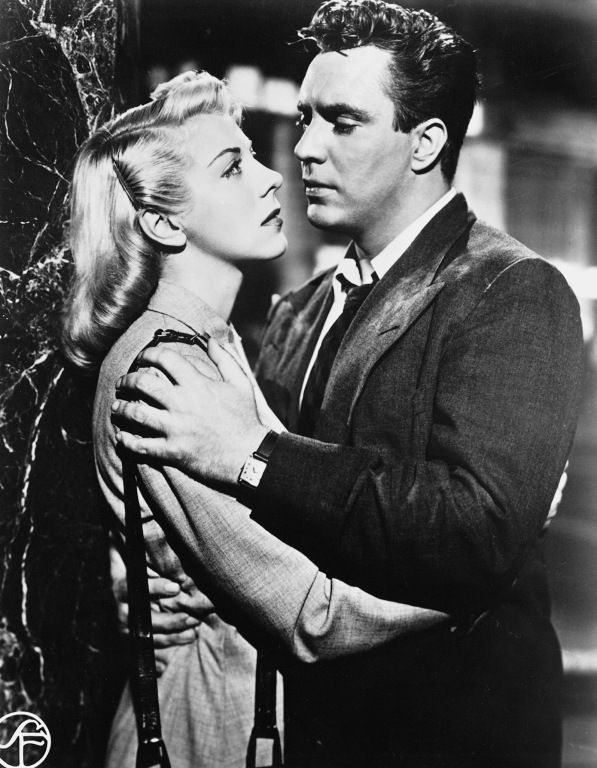
“A man can be like that, Paula, something has to happen, it can be a big thing or a little thing, but it can make him realize how much someone means to him, how much he really loves her,” he says, reassuring her even as he tortures himself. “Oh and I love you Paula—more than I ever thought it possible to love anyone in the world, I love you.”
He urges her to go home, but she refuses, and he promises to meet her later in the lobby of the nearby hotel.
“You’re sure, you promise?” she asks. And he does.
Then in his last moment of anything approaching normal life, he asks, like any good husband, “Is that a new outfit?”
“Yes,” she beams.
“Well it’s beautiful,” he smiles. He takes her head in his hands and kisses her, and wraps her up in his arms.
“You’ll come back to me, won’t you Frank?” she asks.
“Yes Paula I’ll come back, I promise,” he tells her, wishing it were true.
“Please hurry, darling,” she pleads. “Oh, I love you!”
Seeing everything he’s lost, everything that could have been, standing right in front of him, he holds her one last time.
“I love you, Paula!” he cries. “Goodbye, Paula.”
One final kiss, and he frames her face in his hands and turns to walk away. But he looks back, and looks back again, before leaving her for the last time.
You know the rest, or you can guess. And Frank’s last word as he collapses in the homicide detective’s office? Paula.
D.O.A. was produced by Leo Popkin’s ill-starred Cardinal Pictures, and because its copyright was never properly renewed, it’s fallen into the public domain. Here’s one of the better YouTube prints. The love scene starts at the 1:08:51 mark, though you’ll want to watch the whole thing…
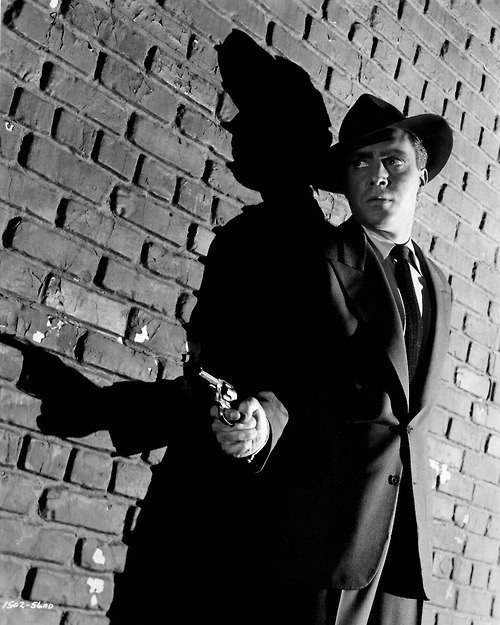
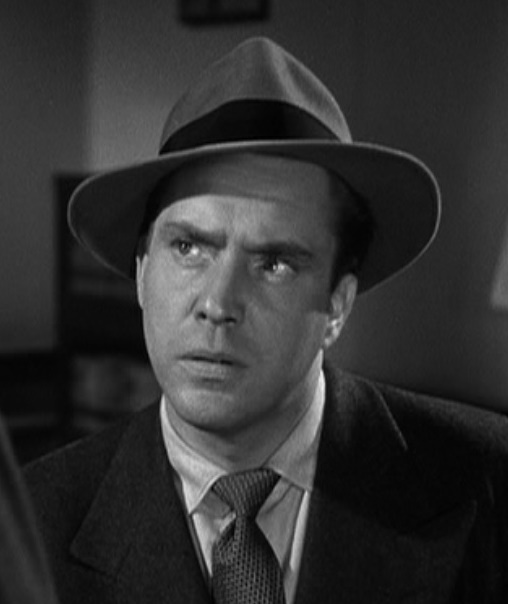
By the way, there’s another reason that this movie, and that scene, are especially close to my heart: I adore Edmond O’Brien. It’s not just that he’s an incredibly natural actor who can do anything, and whose deep, tender voice is an instrument of the gods. It’s that I think he’s a total heartthrob.
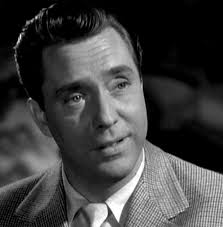
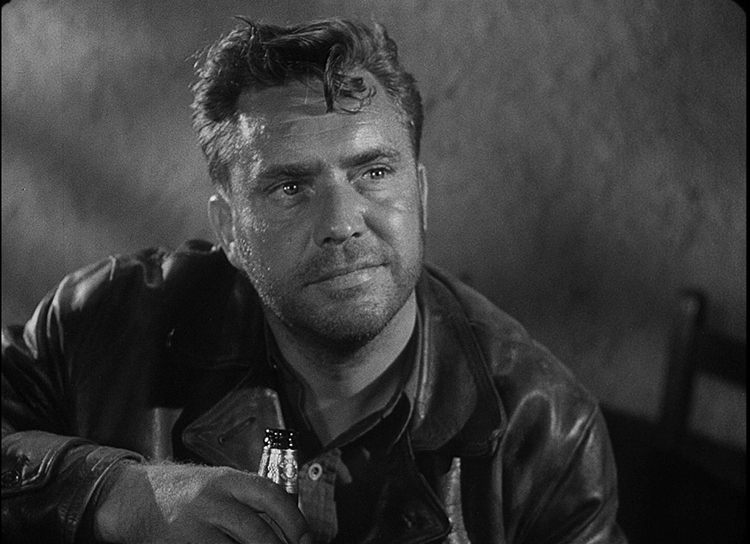
A skeptical friend and I recently saw him in The Hunchback of Notre Dame on the four-story-high screen at Grauman’s Chinese Theater, and she said afterward, “Ah, now I get it.” But no. I don’t mean when he was gorgeous. I mean when he was chunky and craggy. Doughily hot! The Edmond O’Brien of the ’40s and ’50s—oh my God I just want to lock him in a room. If I were Paula, he never would have made it to San Francisco. He wouldn’t have gotten as far as the door.
This article is a sneak preview of the “…And Scene!” Blogathon, hosted by Sister Celluloid. Starting on Thursday, June 25, read all the fabulous entries here!
The Real HORROR OF PARTY BEACH Is the Actual Movie
The Horror of Party Beach! Hey, what classic monster movie doesn’t begin with bongo music?
Cruisin’ down the highway to the beat of those groovy tom-toms are Hank (James Franciscus wannabe John Scott) and Tina (Marilyn Clarke), who may be the most mismatched couple since Ethel Merman and Ernest Borgnine.
When they arrive at the beach, Hank warns his booze-swilling girlfriend that she needs to grow up. “Times have changed—we’re not a bunch of kids anymore!” the roughly 35-year-old college student lectures Tina, who’s clearly a drunken ho-bag—so she might as well have “Monster’s First Victim” tattooed on her forehead. 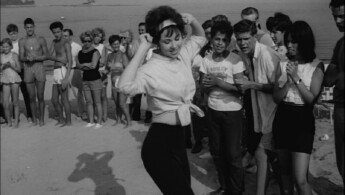
“You go your way and I’ll go mine—we’ll see who gets the most out of life!” she slurs defiantly. “Oh brother you ain’t seen livin’ till you’ve seen Tina swim!” And off she flounces to the beach party, straight into the pasty arms of one of the “toughs” from the local motorcycle gang. This is where the action really begins! Tina’s nonstop butt-waggling incites a rumble between Hank’s crowd and the vicious gang, who apparently travel with their own choreographer—at one point a guy actually somersaults off another guy’s chest toward his intended prey. (To play the villains, producer/director Del Tenney cast a real-life biker gang from—wait for it—Riverside, Connecticut.) 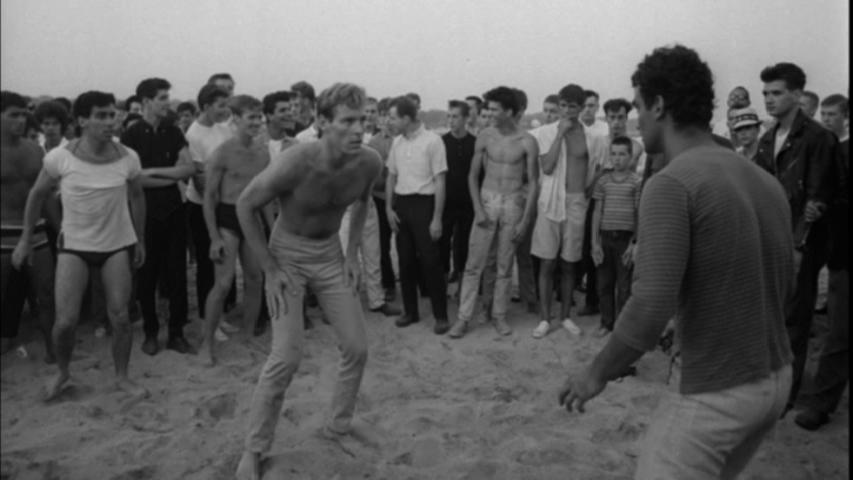
Watching forlornly from the sidelines is Elaine (Alice Lyon), the wholesome girl who’s secretly in love with Hank. Elaine—who we know is a good girl because her idea of beachwear is a sleeveless turtleneck—assures Hank that Tina will come back because “she must realize what she has in you!” But you know she’s secretly hoping that Tina will be mauled and killed by a giant radioactive lizard. And while most of us never get to see that fantasy about our romantic rivals actually realized, Elaine is in luck! Because suddenly we cut to a guy who looks vaguely like Satan, casually tossing barrels of nuclear waste off a cargo ship. What could possibly go wrong?!? 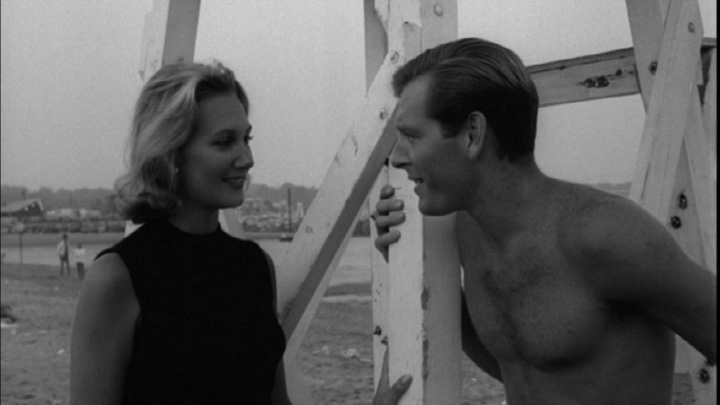
Now here’s where the movie really paid off for me: As an English major, I took as few science classes as humanly possible—but this one scene filled in so many gaps in my education. I had no idea, for instance, that when nuclear gunk oozes out of a container in the ocean, it immediately gloms onto whatever human skull happens to be lying around just offshore. (Nice town ya got there, people!) It will then form an eye, then a head, then a mouth full of wieners, and finally an entire amphibious body—emerging from the water to kill the first hussy it can lay its slimy fins on.


Poor Tina. It was her tough luck to be The Whore of Party Beach. And no sooner does she sun herself on a giant rock, shaking the sea spray from her hair and thrusting her pointy bikini top upward, than the monster emerges from the surf. Now most of us would jump back into the water and swim like hell—but not our Tina! She covers her mouth in horror, screams, and just… kinda… backs up a little. Does that sort of lameness sound strikingly familiar? Like something you’ve seen in just about every cheesy horror movie ever? Well, when it comes to racking up the clichés, this is “The Little Movie That Could”:
- All the tarts get eaten.
- Ditto for all the drunks. (It’s a wonder that Tina, a drunken tart, didn’t get eaten twice.)
- The “good girl,” having sworn off anything remotely fun-sounding, makes it triumphantly to the final credits.
- Every potential victim backs away slowly, often into a corner or a wall, instead of running like a crazy person for the nearest exit or safe shelter. Sometimes they huddle in groups, so the monster can enjoy a nice buffet.
- An unlikely character does something that inadvertently saves the day.
- The star of the film gets trapped somewhere as the monster approaches. (And after having quickly dispatched countless victims, the monster, for some reason, now moves roughly at the speed of wet cement.)
- Scientists come up with a Totally Plausible Scientific Explanation that sucks away several minutes of the film—and your life.

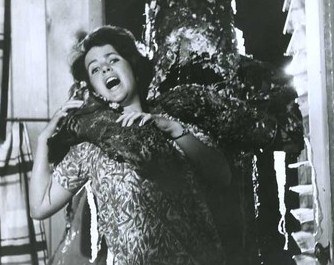
After making quick work of Tina, the monster multiplies just in time to bump off literally every guest at a teen pajama party. When last seen, they’re swaying and strumming to the creaky old folk tune The Wagoner’s Lad—making you wish the hulking aquatic beasts would just get a move-on already. “How hard is the fortune of all womankind,” the girls croon, before finding out just how hard. Especially when you don’t, you know, just jump out the window when monsters come through the door.
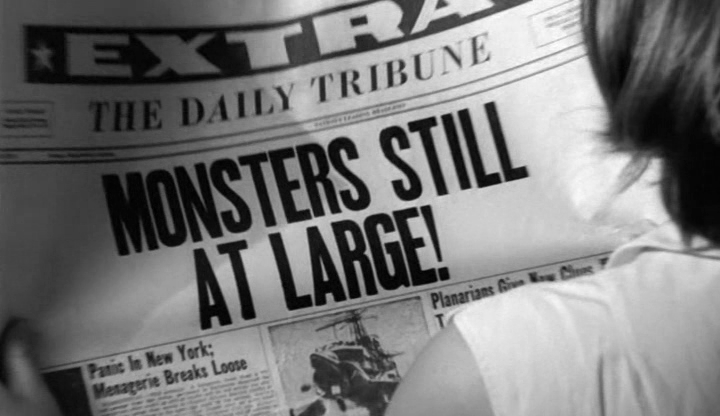

Luckily for her, Elaine skipped what was shaping up as The Worst Pajama Party Ever even before the monsters arrived. She was home feeling guilty about lusting for Hank so soon after Tina being eaten and all. “I have such feelings about him!” she confides to her father, Dr. Gavin (Allan Laurel). Because there’s nothing a teenage girl enjoys more than discussing her most intimate romantic yearnings with her Dad. But he’s got bigger things on his mind: as the community’s leading doctor/scientist/something vaguely technical, he’s got to figure out how to kill the monsters before they devour the entire slow-moving town.
The family’s African-American maid, Eulabelle (Eulabelle Moore), who was flown in directly from the Department of Hideously Offensive Ethnic Stereotypes, has her own theory: “It’s the voodoo, that’s what it is! I’m double-lockin’ and triple-lockin’! Ain’t no monster gonna get in here tonight!”

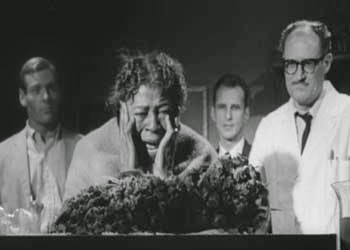
As is often the case in real life, shopping proves to be the monsters’ downfall, when one of them smashes a store window to grab a mannequin and loses an arm in the process. After he gets hold of the loose limb, Dr. Gavin convenes a high-level meeting of police and biologists in his unfinished basement. But before they can crack the case, Eulabelle barges in. “Them zombies, they comin’ at me tonight—I just know they will!” she cries, scrambling her sentence tenses like nobody’s business. Then, seeing the monster arm, she flails wildly—knocking over a glass of highly volatile, explosive sodium, which for some reason was perched casually on the edge of the table. It immediately dissolves the limb—Eulabelle has saved the day! (And if there were any justice, her reward would be a one-way ticket out of this movie.)
After a bit more theorizing and dithering—they seem to have forgotten they’ve already found the answer—Dr. Gavin sends Hank on an intrepid search for a massive quantity of sodium. After a gripping scene where he rifles through the phonebook, he eventually finds a huge supply in Manhattan, which is apparently closed on Sunday, giving our young hero a chance to motor lazily around the empty streets from uptown to Washington Square. I mean really, what’s the hurry? Hank makes it home just in time to rescue Elaine—who has skillfully managed to wedge her ankle between two rocks at the town quarry—from being the monsters’ last victim. The whole scene has kind of a Day for Night quality—not because it in any way resembles the Truffaut classic, but because the light changes from day to night to day to night again over the course of about 30 seconds.

Finally, in one of the creepiest endings this side of Tod Browning, Hank drops by to check on Elaine the next morning, and a grinning Eulabelle takes him straight up to her bedroom, where they make out in a blonde-people-in-the-’50s kind of way.
Stephen King has affectionately called The Horror of Party Beach “an abysmal little wet fart of a film,” marveling at how Del Tenney tried to capitalize on a host of popular movie themes—beach parties, monsters and radioactivity—without making the slightest attempt to meld them in any cohesive way. And it’s true: he pretty much just plopped a bunch of genres into the Veg-O-Matic and didn’t much care what came out the other end.
Tenney shot the film on Long Island in three weeks during the spring of 1964, with a budget of $60,000. He sprang for two monster suits, but when the rubbery fabric dried, one was too small for the stuntman, so the 16-year-old son of a production assistant played one of the monsters. (Shades of Ed Wood Jr. hiring his wife’s chiropractor to step in for Bela Lugosi in Plan 9 from Outer Space.) And in the film’s one and only nod to Hitchcock, chocolate syrup doubled for blood.
Tenney also stole a page (but sadly, nothing else) from William Castle: Before taking their seats, moviegoers had to sign a “Fright Release,” absolving the theater of responsibility if the film was so terrifying that it killed them.

Mercifully, all the actors promptly disappeared after this film—and one kind of disappeared during it. Alice Lyon, who played Elaine, was dubbed for the entire movie—and if the maddeningly hammy voiceover was an improvement, her actual voice must have made the paint peel. When she made this film, Lyon, the wealthy daughter of a diplomat, was married to Hugh Auchincloss III, the stepbrother of Jacqueline Kennedy Onassis. But perhaps even more shocking than the fact that someone appeared in this thing without needing the money is that the Del-Aires, whose white-bread whines pierce the salty beach air, were a real band. Give them credit, though, for being bold enough to open a song with the line “Everybody’s doin’ it, doin’ it, doin’ it…” (No, they’re not doing that—they’re doin’ the Zombie Stomp!) 

And finally, in the role (roll?) most people remember best: the monsters’ teeth were played by actual frankfurters.

If you’d like to see this movie, here are Mystery Science Theater‘s takedown of it, and, if you have the stomach to take it straight, the (four-part) version introduced by Sammy Terry, a one-time horror-movie host from Indiana.
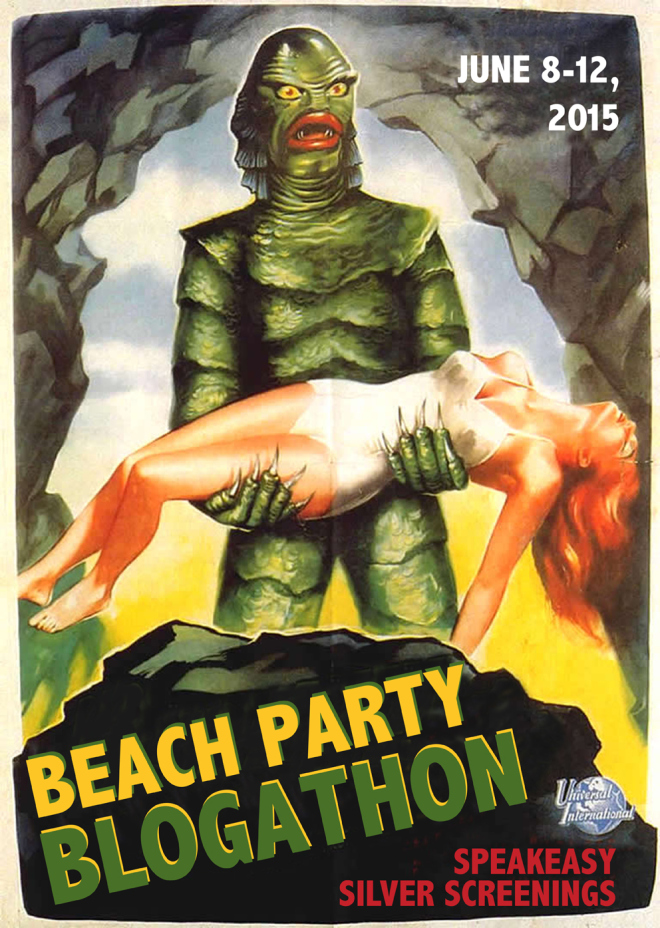
This article is part of the Beach Party Blogathon, hosted by two fabulous dames: Ruth from Silver Screenings and Kristina from Speakeasy! To see the other posts, click here!
Buster and Fatty Vamp and Camp It Up in THE COOK
The fabulous Fritzi over at Movies Silently is hosting A Shorts Blogathon! You can find all the entries here.
I chose Roscoe “Fatty” Arbuckle’s The Cook, co-starring Buster Keaton, which was a dangerous assignment, as it meant I had to watch it again—running the risk of disappearing into the TV, hitting the Play button over and over as work went undone, meals went uneaten, calls went unanswered, and pages flew off the calendar…
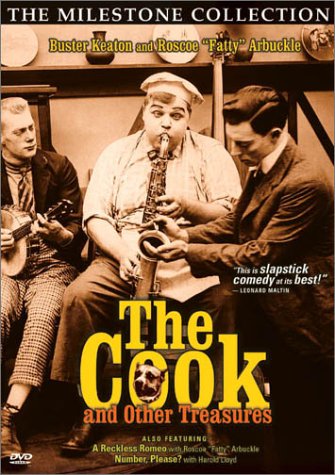
If you first fell in love with Buster Keaton in the films he wrote and directed himself, seeing his early two-reelers with Fatty is a bit like stumbling across old home movies of your Dad as a teenager, goofing around in the basement with his friends.
In his films with Fatty, Buster’s the same as ever, but… different. More relaxed and loosey-goosey—and even more rubbery, if that’s possible. He’s sharing the weight with Arbuckle and Al St. John instead of carrying it all on his own fabulous shoulders, and it shows. The Cook was the last film Buster made before shipping off for France with the Army during World War I, but you’d never know it watching these guys. It not only looks like the most fun anyone ever had making a movie; it pretty much looks like the most fun any humans had, ever.
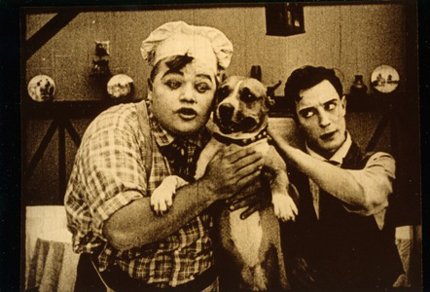
The Cook was the eleventh short Buster and Fatty made in less than a year and a half, and even Rogers and Astaire would’ve killed for this kind of rhythm and chemistry. The day these two met, the movie gods were working overtime.
The setting of the film—like it matters—is a seaside café called The Bull Pup, where Buster is The Pest Waiter and Fatty is The Cook, pulling everything, including the ice cream, out of the same giant, steaming vat. (Honestly, between that and the way he chops food with the same cleaver he almost cuts Buster’s head off with, there’s some serious health-code stuff going on in this dump.)
While Fatty pirouettes around the kitchen, Buster shouts out the dinner orders when he’s not dusting off dowagers or sidling up, without success, to a lady diner. (I love how, in just about every Buster Keaton movie, there’s at least one obviously clinically insane woman who dismisses him with utter boredom, as opposed to, you know, giving him her house key, writing down her address and spelling out the fastest way to get there. But perhaps I’ve said too much.)

Later, inspired by the exotic dancer performing the floor show, Buster works some snake-dancing into his serving technique, and Fatty responds with riffs on Cleopatra, with sausage links standing in for the asp, and Salome, with a cabbage doubling for John the Baptist’s head. And they don’t do it as slapstick (well, unless you count Buster’s casual backflips); they writhe and slither and vamp like serious artistes. (The very dramatic Theda Bara, who’d just opened in Salome, was not amused…)
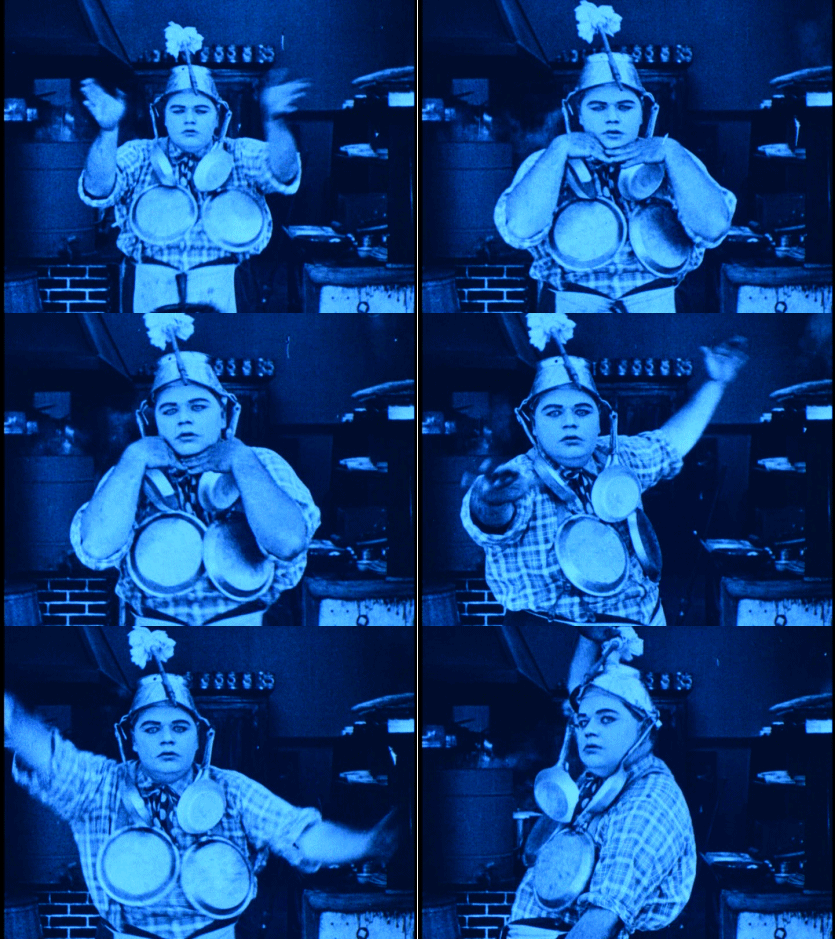
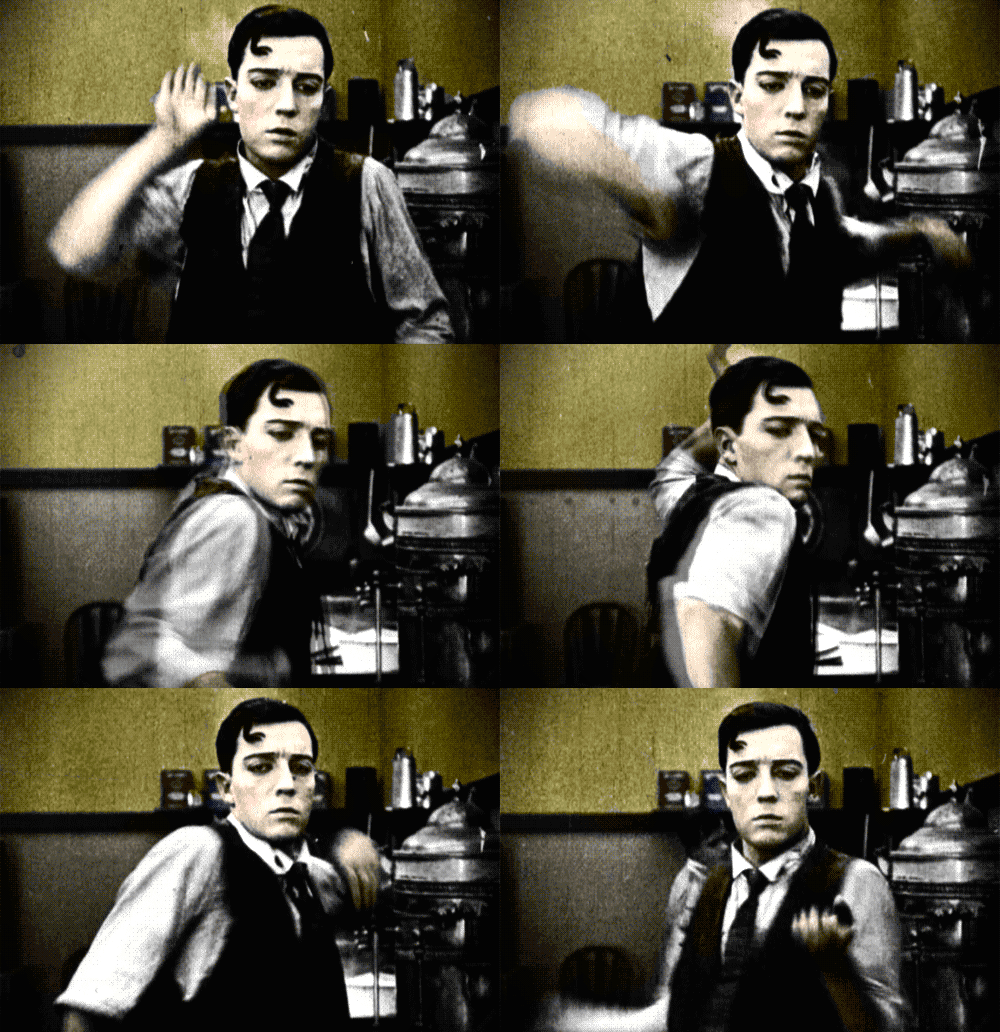
But alas, all great art must end. Soon, The Toughest Guy (St. John) swaggers in and tries to make off with Buster’s girl, The Cashier (Alice Lake). (Watch for the moment when St. John bites the neck off a beer bottle and spits the suds at Buster, who comes close to cracking up.) When all human efforts fail to stop the bully, Luke the Dog takes over, chasing him out the door, up ladders (!) and across rooftops.


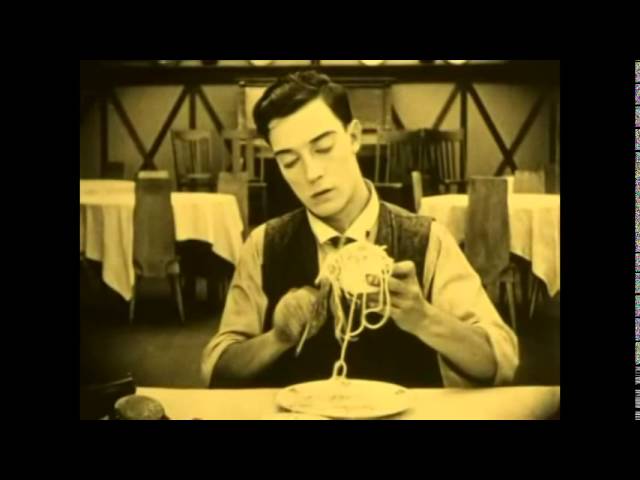
Meanwhile back at the café, Buster, Fatty and two other staffers (Chaplin staple John Rand and Laurel & Hardy regular Bobby Dunn) are grappling with massive plates of spaghetti. Buster wrangles it into a teacup and scissors away the stray bits, Fatty gets his tie into the mix, and one long, elastic strand is strung into a clothesline for the linen napkins…
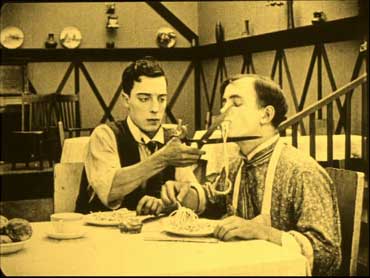
Happily fed and with his girl now safe, Buster rounds up Fatty and Alice and heads for Goatland—an amusement park where goats pull the carts carrying the patrons. But once again, The Toughest Guy turns up to menace Alice, sending Luke back into action. And at the fade-out, all is well…


The slapstick in The Cook is a bit gentler than in some of Buster and Fatty’s other shorts; most of the rough stuff is between St. John and the incredible Luke, who was owned by Fatty and his wife, Minta Durfee. After Minta pulled off an especially harrowing stunt in A Misplaced Foot—hanging by her fingernails from a 300-foot cliff—Mack Sennett told her to drop by director Wilfred Lucas’s house for a “bonus,” which turned out to be a six-week-old pit bull puppy. Feeling she was owed actual cash for putting her life on the line, the actress was annoyed at first—until the pup began teething tenderly on her finger, and the lovefest was on.
A year later, in 1915, Luke (named after Lucas) made his heroic debut in Fatty’s Plucky Pup, rescuing a kidnapped damsel in distress. From then on, he was pretty much a constant presence in Fatty’s films, eventually “signing” a Comique Films contract for $150 a week:
He later freelanced with Buster, doing a memorable turn as “Mad Dog!!” in The Scarecrow:
When Arbuckle and Durfee divorced, Minta got custody, but Fatty got generous visitation rights.
The Cook was considered lost for decades until 1998, when the Norwegian Film Archive found a damaged nitrate print in an unmarked canister along with Arbuckle’s A Reckless Romeo. More footage turned up in the Netherlands in 2002, but the finale has never been found, so the film just sort of abruptly ends. But you can always just hit the Play button over and over again.
No More Mr. Nice Guy! Gregory Peck Swaggers to a DUEL IN THE SUN
There’s always that little extra something when a nice guy plays a villain. Robert Walker as Bruno in Strangers on a Train. Joseph Cotten as Uncle Charlie in Shadow of a Doubt. And Gregory Peck as Smokin’ McHottie in Duel in the Sun. Wait what? Okay I’m being told his name was actually Lewt McCanles. Apparently I didn’t hear it over the sound of my own drooling.


If you’ve ever wondered how Atticus Finch might have turned out if he were born in the untamed West and raised by an absolute bastard, here’s your chance. Everything you love about Gregory Peck is still there—the slouchy sexiness, the languid, easy manner, the casual gorgeousness. Only now, he’s a ruthless killer. But there’s just enough of that old sincerity there to keep a girl hanging in with him long after she ought to hit the road.
Poor Jennifer Jones never stands a chance.
To be fair, she was doomed before the movie even started. After Teresa Wright bowed out due to what may have been the most fortuitous pregnancy this side of the Virgin Mary, Jones was (mis)cast by her lover, David O. Selznick, as “half-breed” Pearl Chavez. Breathlessly snarling from behind hundreds of layers of Coppertone, she leaves you longing for the dramatic realism of John Wayne as Genghis Khan.
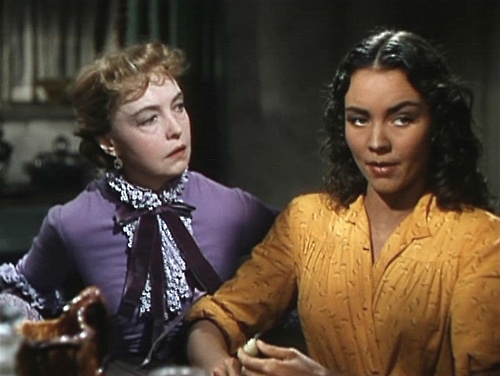

After her father (Herbert Marshall) is hanged for shooting his wife and her lover, Pearl packs up her vast wardrobe of oddly form-fitting peasant dresses and goes off to live with distant relatives: the evil Senator Jackson McCanles (Lionel Barrymore), his stoic wife Laura Belle (Lillian Gish), and their polar-opposite sons, Lewt and Jesse (Cotten at his most earnest and adorable). Almost at once, Pearl upends the whole household: the Senator hates her, Laura Belle dotes on her, Jesse wants to rescue her and Lewt just plain wants her. And he gets her so emphatically that the studio censors were sent scrambling for their scissors.
But that was the least of the offscreen woes. By the time shooting began in 1946, the already-manic Selznick, who was still married to Louis B. Mayer’s daughter Irene but having a very public affair with Jones, had become addicted to amphetamines—and fought so violently with everyone, they could have called the film Duel with the Son-in-Law. For starters, he blew through five directors—Otto Brower, William Dieterle, Josef von Sternberg, Sidney Franklin and William Cameron Menzies—and even briefly appointed himself, before King Vidor finally “won” the job. (Von Sternberg stayed on to help shoot Jones in the most flattering light for her constant close-ups.)


Legendary composer Dimitri Tiomkin also felt the producer’s speed-induced wrath. When Selznick heard Lewt and Pearl’s “love theme,” he reportedly screamed, “You don’t understand! I want real fucking music!” No slouch himself, Tiomkin is said to have shot back, “You fuck your way, I fuck my way!” before storming off the set and threatening to quit. (The score went on to become the first movie soundtrack ever cut as an album, featuring Arthur Fiedler and the Boston Pops—thus adding “musical director” to the long list of roles Selznick never should have tried to assume.)
When the producer bought the Niven Busch novel on which the film is based, he saw it as his next Gone With the Wind—and his ham-handed fingerprints are on every frame. Like GWTW, it’s “presented by David O. Selznick” with a lengthy musical prelude, accompanied by sweeping, gorgeous shots of the red earth of Tara—oops, I mean the red hills of Texas. This segues into a voiceover by Orson Welles that pretty much gives away the entire plot, as a heavenly choir “oohs” and “aahs” in the background. (Because having Orson as your narrator isn’t enough; you really need some backup singers.) Every moment of the film is so DRAMATIC, you get the feeling that if someone said ”Pass the salt,” it would be met with a great swell of trumpets.

Only a steady, veteran cast, rounded out by Walter Huston, Otto Kruger and Charles Bickford, keeps the film from blowing off the screen. In fact there are so many good actors, it’s almost as if every time Selznick showed a director to the door, he roped in another star from the back lot. Peck’s performance as the lethally irresistible gunslinger is especially impressive, since he had to play the saintly father in The Yearling every morning before presumably downing a lunch of rusty nails and rotgut and swaggering over to the western set in the afternoon. “I didn’t do much acting,” he later laughed. “I rode horses, necked with Jennifer, and shot poor old Charlie Bickford.” It’s hard to say what may have upset Selznick more: Peck’s sweaty sessions with Jones or his stubborn refusal to overact.
At the time, Duel in the Sun was one of the most expensive films ever made, weighing in at a bloated $6 million, in part because of the lengthy editing process: the directors and the second-unit team clocked more than 26 hours of film. (Selznick went on to spend the princely sum of $2 million on promotion.)


Shot by Technicolor genius Harold Rosson, the finished product looks gorgeous, and Jones actually garnered an Oscar nod, as did Gish. Audiences liked the film well enough for Selznick to eventually make his money back, but critics derisively dubbed it Lust in the Dust.
Before its release, the preening producer screened the movie for British writer-directors Michael Powell and Emeric Pressburger, who shot their films on paper-thin budgets and were underwhelmed by what the Hollywood mogul had done with his millions. As the closing credits thundered by after the final shoot-out, Pressburger whispered to Powell, “What a pity they didn’t shoot the screenwriter.” Who was, of course, David O. Selznick.
The TCM Film Festival: Shirley MacLaine’s Terms of Endearment—and Otherwise
There are worse ways to spend a weekend than following Shirley MacLaine around Hollywood.
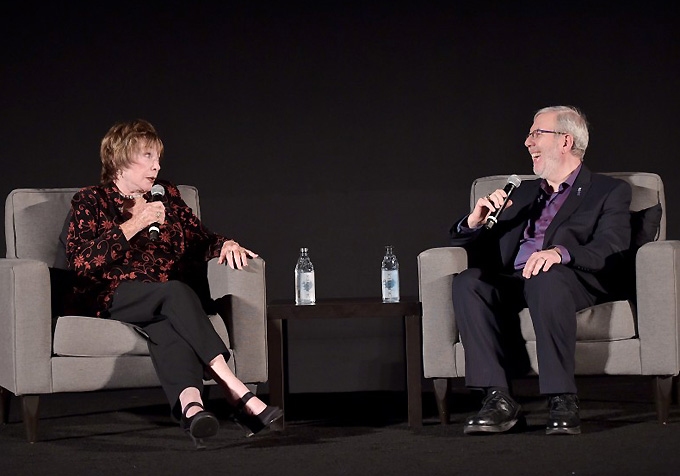
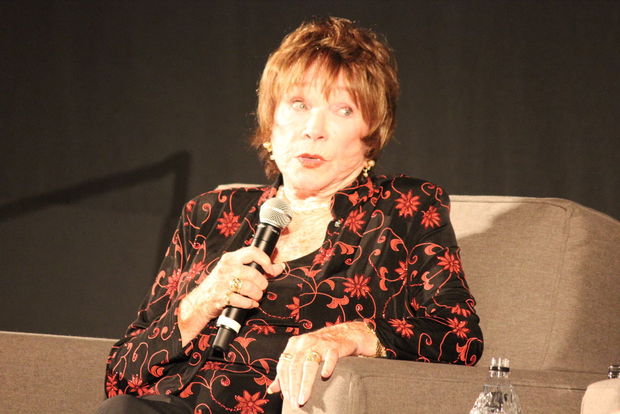
The 81-year-old Oscar winner, whose career stretches back to the end of the Golden Age, was a featured guest at the recent TCM Classic Film Festival. But when she settled into Grauman’s Chinese Theatre with Leonard Maltin to talk about The Apartment, her microphone began screeching like a crazed owl. “We’re getting a lot of feedback here,” she called politely offstage. “Whoever’s in charge of that? Fix it.” Prompting the guy next me to say of the strong, smart, insanely accomplished actress, “Oh wow, she is so sassy!”
Ugh. If “sassy” is here, can “feisty” be far behind?
MacLaine was anything but when she talked about director Billy Wilder, calling on her memories with a reverence tempered by realism.
“I liked him a lot,” she smiled, and suddenly she was Fran Kubelik again. “He was very funny and very sensitive when it came to what he thought would be best for the screen. At times he was very brittle with women, but in the end you were better for it.”
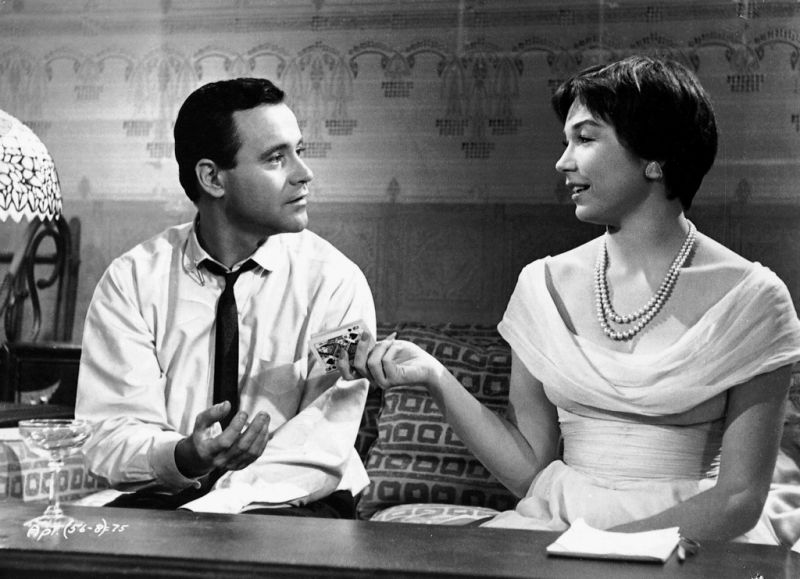

Initially in awe of the autocratic director, MacLaine turned to her co-star, Jack Lemmon, for refuge—and Wilder and co-writer Izzy Diamond, who had started shooting with only a bare-bones script, filled in the blanks as they watched the friendship deepen. They tuned into “every little sigh, and disappointment, and joy and happiness and made little notes,” recalled the actress. “The love affair [between C.C. and Fran]… became basically what they had observed.”
Even the couple’s running card game was inspired by MacLaine’s real life: “I was hanging out with the Rat Pack a lot and a couple of gangsters were teaching me how to play gin rummy, how to cheat,” she laughed. “That’s why Billy put the gin game in—because he was fascinated with who my compatriots were.”
Her heartaches also figured prominently in the script. “Billy and I were having lunch one day,” she confided, “And I was having a love affair that wasn’t working and I said, ‘Why do people have to be in love with people anyway? Why can’t we be in love with giraffes?’ or something to that effect. And he said, ‘That’s it, that’s it!’”
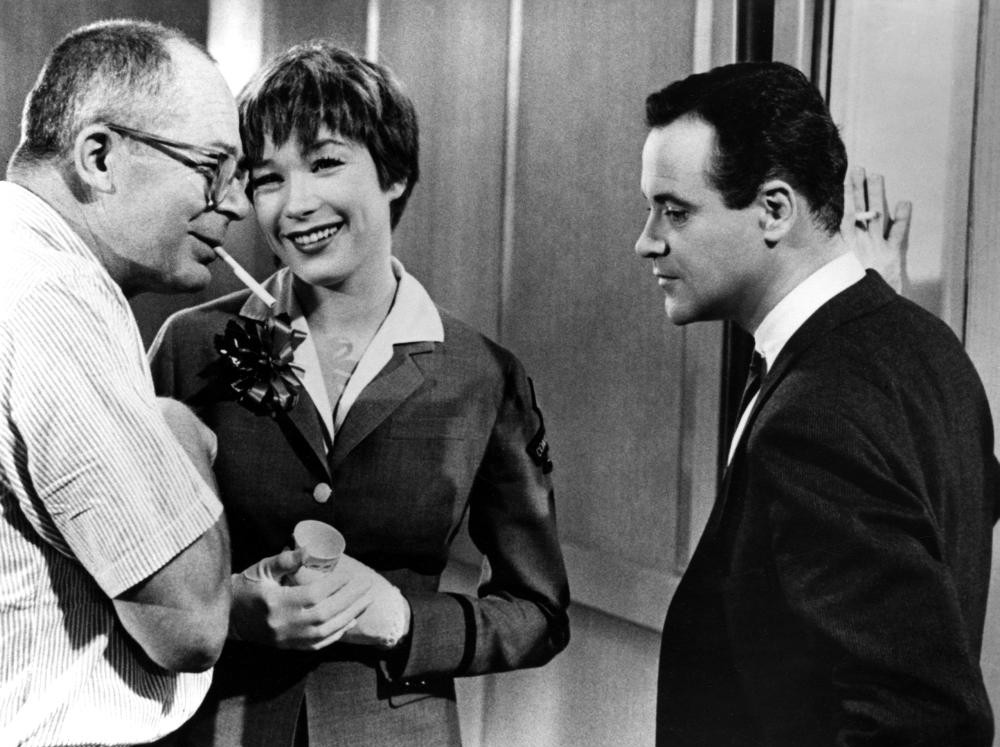
Though they’d already shot a scene where C.C. and Fran swap stories of their failed romances, Wilder ordered the sets rebuilt and rewrote whole the sequence from scratch—starting with the line,”Why do people have to love people anyway?”
The new scene passed muster with the man who mattered most to Wilder: his long-time editor Doane Harris, who was an associate producer on The Apartment. “He was Billy’s secret,” MacLaine revealed. “He would say—and I heard this because Billy didn’t mind—‘Billy, you gotta shoot that whole day over—you did not break my heart today.’ And they would reshoot it. See, that is where trust comes in. Billy didn’t even ask why—he just did it.”
Wilder went on to win three Oscars in one night—as producer, director and co-writer—for the film, which was also the second of seven Lemmon-Wilder pairings. “At that point in his career, Jack needed to be wrangled, so I kind of helped with the rope,” MacLaine smiled. “But those two… Jack was in love with Billy’s genius, and Billy was in love with Jack’s talent.”
The next day, during an interview at Club TCM, MacLaine and Maltin circled back to the pair.
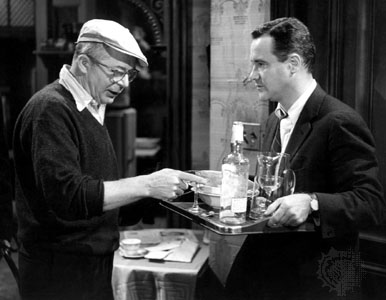

“Jack was a darling, such a good person, kind to other people,” the actress confided. “He was a sweetheart—but Billy pushed him to the limit! He was seeing how far probably the best actor in drama and comedy could go and still be honest with it.”
“And Billy taught me how to be self-reliant and to take criticism,” she recalled, adding that her training as a dancer helped: “Choreographers are made to make you miserable—I was used to that. So when this incredible Austrian came at me, I thought okay, just show me the step.”
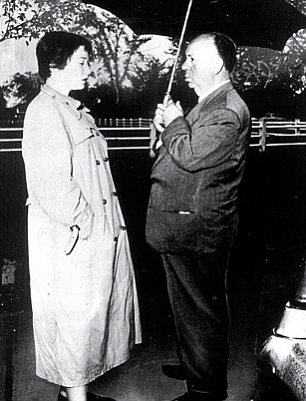

MacLaine’s first director, Alfred Hitchcock, was hardly a pussycat either—though she had an easier time of it than some of his other leading ladies. “When we made The Trouble With Harry, I was his social eating partner,” she recalled with some relief. “With all the beautiful, blonde, tall, willowy actresses that he wanted to jump on, that didn’t even occur to him! I was one of the few! I ate.”
The droll director also loved Cockney slang and wordplay. “’He’d go, ‘Before you say that line, dog’s feet!” she explained as the crowd tried to puzzle it out. “Paws! It meant pause!”
Given the string of the prickly geniuses who’ve directed her, it’s surprising that she saved her harshest words for… Herb Ross: “Annie Bancroft was a little aloof when we worked on The Turning Point, but with Herb, that was the way to go. He could be sarcastic. The women on Steel Magnolias got together against him. He was cruel to Julia Roberts and Dolly Parton—he would say, ‘You know, you should take some acting lessons.’ So we didn’t like that and we basically stuck together and still have—girlfriends from that movie.”

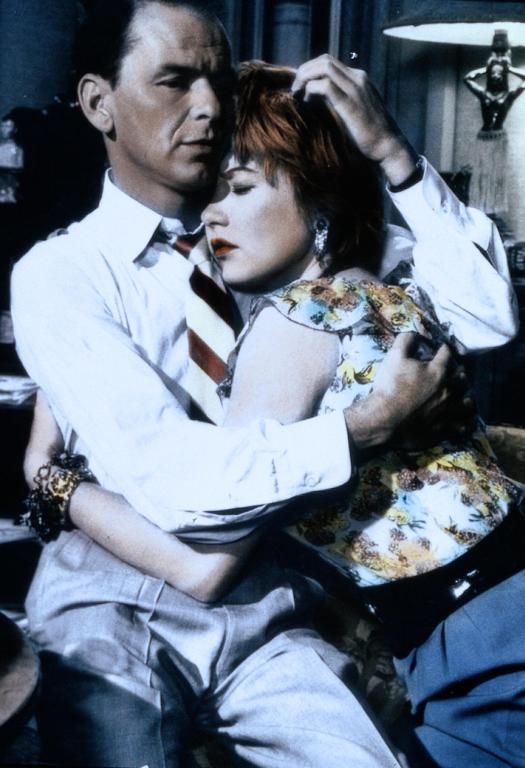
Fred MacMurray (The Apartment): “He never picked up a lunch check… his money blinked when he took it out of his wallet—it had never seen the sun. He was so cheap that [his wife] June [Haver] would make him his lunch in a brown paper bag, so he wouldn’t have to pay at the commissary. We used to tease him for that.” (Though you have to admit, it’s pretty freakin’ adorable.)
Frank Sinatra (Some Came Running and Oceans Eleven): “He loved the spontaneity of not knowing what he was going to do. I think he suffered from the same thing Ernie Kovacs suffered from and which is, ‘If I really rehearse, if I really look like I care and it doesn’t work then it’s my fault.’ So this way he could say, ‘Well, I didn’t have time to rehearse.’ Which was rather canny.”
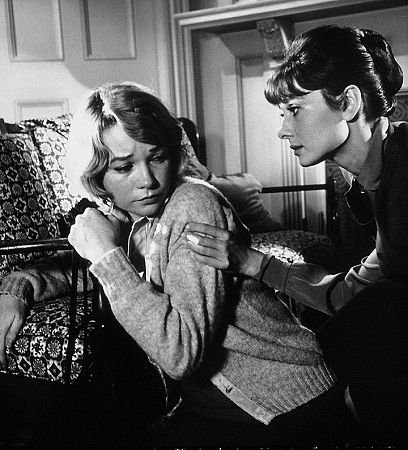

Laurence Harvey (Two Loves): “I did not like Larry Harvey. I turned down Breakfast at Tiffany’s to do Two Loves with him. Did you see that? No? Good.”
Dean Martin and Jerry Lewis (Some Came Running, What a Way to Go and Oceans Eleven with Martin; Artists and Models with both): “Dean was the funniest man I ever knew. Very much like Sinatra in always wanting to look like he’s not really working. Not Jerry. Jerry was like a drill sergeant. Dean used to try out material on me, because my favorite thing is to laugh. Of course, he couldn’t really judge because I would laugh at anything and he’d try it on his live audience and it would flop. I adored him—had a mini-crush on him. But I liked his wife more.”
James Garner (The Children’s Hour): “He’s the second funniest, next to Dean. In real life, hilarious. Such an educated sense of humor—such an observant sense of humor about anything that was going on on the set. Did he ever play a character like that? The ones that he’s famous for, they were straight. But he was a really extraordinarily comic man.”
Audrey Hepburn (The Children’s Hour): “Lovely, lovely person. Whenever I went to Europe, I would go to Switzerland and see her. I miss her. She taught me how to dress and I taught her how to curse.”
Clint Eastwood (Two Mules for Sister Sara): “I remember when his horse was acting up, this is when I knew he’s a true Republican: He got off the horse, looked at the horse, and socked him.”
Jack Nicholson (Terms of Endearment): “I never knew what he was going to do. When Aurora goes up to his door saying, ‘So you asked me go to lunch—a year ago,’ he was supposed to have his clothes on, but every time he came to the door, well, once he came in a robe, and the next time he came with his shorts, and the third time he came with a hooker, and the fourth time with nothing.” Prompting an audience member to blurt out the question on everyone’s mind: “What did it look like?” Never one to swing and miss at a fat pitch, MacLaine quipped, “It’s too long a story…”
Meryl Streep (Postcards from the Edge): “The best. Just the best. The scene on the stairs, when I’m talking about my dress ‘twirling up,’ she actually lost it during one take. That’s the highest compliment—that Meryl Streep went out of character!”
Maggie Smith (Downton Abbey): “Love her. I think we should make a movie together.” (Prompting Maltin to chime in, “Just not another one about a hotel in India.”)
Elvis Presley: “Incredibly sweet and polite. When I was starting out, my trailer was right next to his. And he always called me ‘Miss MacLaine’ or ‘Ma’am.’ I was 20.”
Whew! With memories like these, what could be next for Miss MacLaine? She’s already given it some thought: “I would love to remake Harold and Maude!”
RING-A-DING GIRL: The Deceptive Lightness of Maggie McNamara
One snowy New Year’s Day, as I slothed out on the sofa for my seventeenth-or-so Twilight Zone marathon, I noticed something funny: most of my favorite episodes were written by Earl Hamner Jr. of Waltons fame—including The Hunt (an old man refuses to enter heaven without his dog), A Piano in the House (a vicious husband is undone by a mystical player piano), Stopover in a Quiet Town (a fabulous couple is trapped in a sterile suburban hellhole after a drunken night out), The Bewitchin’ Pool (a lonely brother and sister swim free of their nightmarish parents)…
…And Ring-a-ding Girl.
When first we meet the bubbly Bunny Blake (Maggie McNamara), she’s running late as usual, feverishly prepping for a flight to Rome, where she’s starring in a new film. The last thing she slips on as she’s flying out the door is one of the rings she collects as a publicity gimmick. But this one’s close to her heart—it’s from the folks back home in Howardville, who, years earlier, had jumpstarted her dreams by taking up a collection to send her off to Hollywood. And, this being The Twilight Zone, it’s no ordinary ring: it’s more like a crystal ball. As Bunny gazes into it, her sister, Hildy (TV veteran Mary Munday, whom you may remember as the crusty City Hall clerk in The Rockford Files), comes floating into view—and she’s desperate. “We need you, Bunny,” she cries. “Please come home.”
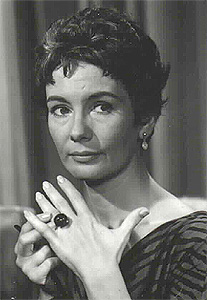
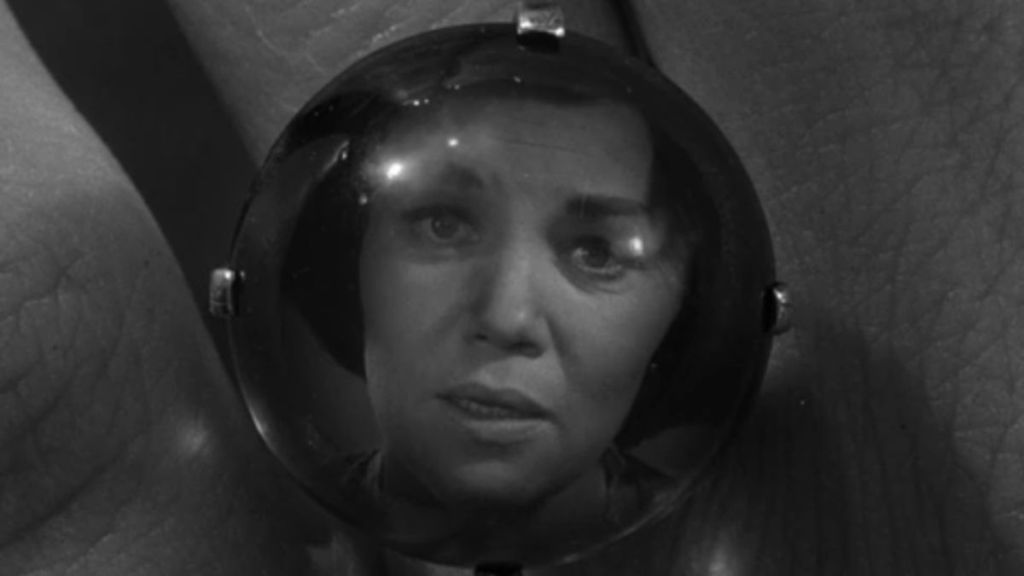
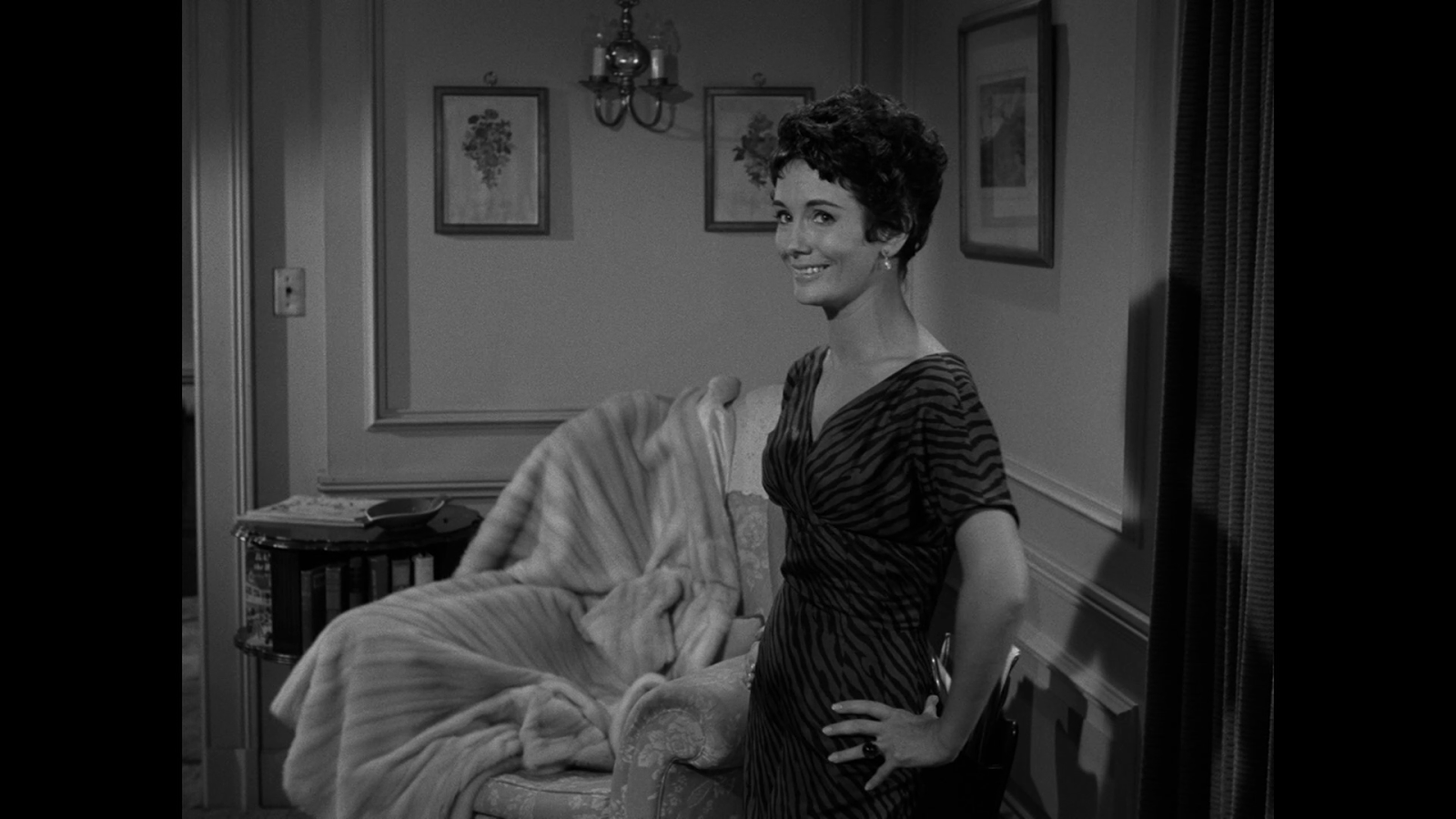
Bunny is deeply shaken by the apparition—and convinced it’s much more than that. So she arranges to make a pitstop in her hometown en route to Italy—but when she arrives, everything’s as tranquil as it was the day she left home. Far from the frantic figure who appeared in the ring, Hildy is delighted by her sister’s surprise visit, and happily prepping for the annual Founder’s Day picnic. Giddy with relief, Bunny grows playful, impishly acting the star, sending up both herself and Hollywood as she sashays around the living room. “Wiggling—my one natural talent!” she laughs as she trails her fur coat casually along the floor. “Wind me and I light up! Turn me on and I give off incandescent sparkles!”
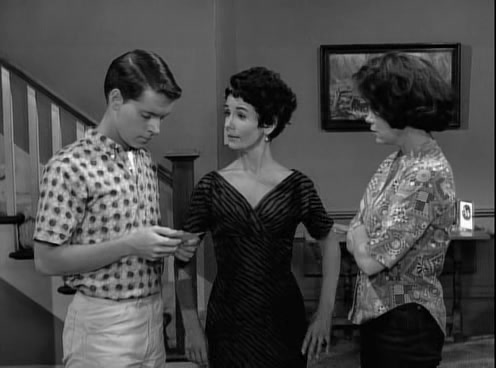
But when she idly glances at the ring again, her mood darkens. She sees even more urgent pleas from an unlikely source: the town elders, who’d always disapproved of her glamorous ambitions. It suddenly hits her that for some reason, she must keep everyone away from the fairgrounds—even at the risk of much harsher rebuke.
Determined to use her star power for some good, Bunny takes to the local airwaves to announce she’ll be performing her acclaimed one-woman show at the high school auditorium that very afternoon, as a way to say thank-you to her hometown. When a reporter reminds her she’ll be competing against the picnic, she summons all of her sparkle and appeals directly to the camera: “People have a choice—coming to see me at three o’clock or going to Riverside Park and getting bit by a bunch of ants!”
Meanwhile back at the house, her sister is mortified as the phone starts ring-a-ding-ing off the hook. But when Bunny returns, she sees how much it means to her to gather the town around her, and she softens. Bunny reluctantly glances at her ring again—as if seeking a sign of approval—and sees herself on the plane she took from Hollywood, which is in desperate trouble. Realizing her fate, she mournfully turns away from the unfolding disaster and pulls Hildy tightly toward her. “Thank you,” she says. “For what?” her startled sister asks. “Just for being my sister,” she smiles. And as fire engines and ambulances start to clamor outside, Bunny slips out the door and into the mist. “Goodbye, Hildy…”
Just then the phone rings, and Hildy learns that a plane bound for Rome has crashed right in the middle of the picnic grounds, killing all on board—including Bunny—but sparing the locals. On television, a newsman explains, or tries to: “Most of the citizens in town are safe because they were attending an announced performance by Bunny Blake… witnesses have sworn she was in town this afternoon visiting her sister…” Who then finds the mystical ring, which had winged its way to Bunny just days before, lying on the floor of the living room.
Watching Maggie McNamara literally fade away at the end of the episode is especially heartbreaking, as this was one of the last times she ever appeared on screen. After a splashy start in the early 1950s, she could never quite find her footing, and fame never sat as lightly on her as it did on Bunny Blake.

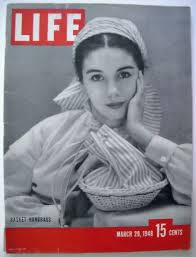
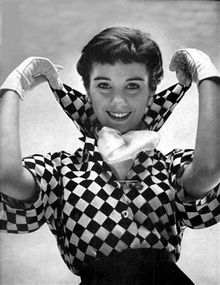
McNamara started out as a model—gracing the cover of Life before she was 20—all the while studying dance and drama in her hometown of New York. Success came quickly, perhaps too much so: at 23, she was starring on Broadway, replacing Barbara Bel Geddes as “professional virgin” Patty O’Neill in F. Hugh Herbert’s The Moon is Blue. When she reprised the part for Otto Preminger in the 1953 film, her wry, witty performance in a role that frankly could have been nauseating earned her a Best Actress Oscar nomination. (While the film is woefully dated now, it was banned in several states and failed to secure MPAA approval for its “adult content”—meaning everyone in it behaves like a horny 14-year-old—and for the use of such words as [gasp!] “virgin,” “pregnant” and “seduction.” Somehow it seems fitting that a film whose sensibilities about sex were every bit as infantile as those of the Hays Office actually helped to smash the Production Code.)
Preminger, who threw compliments around like manhole covers, was thrilled with her work—but years later, confided that he’d eventually felt guilty about hiring her at all. “Maggie suffered greatly after becoming a star,” he recalled in his memoirs. “She suffered a nervous breakdown.”
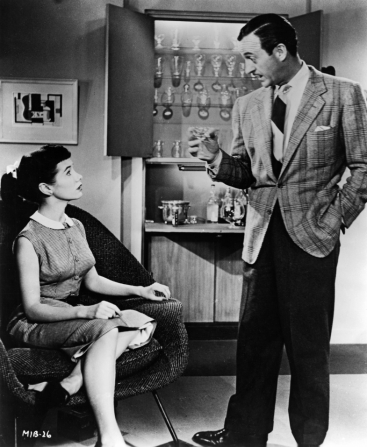
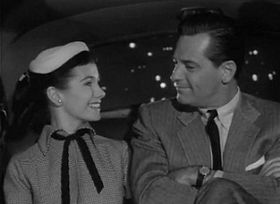
After her stellar debut, McNamara was quickly cast in Jean Negulesco’s romantic drama Three Coins in the Fountain. As the girl who sets out to snare Louis Jourdan but is just too decent to see her scheme through, she’s delightful, torn between her ever-insistent conscience and her sense of triumph at winning this elusive and arrogant man—whom she’s now grown to love. The movie heightened her popularity but did nothing for her nerves. “I was terribly shy and used to work on myself to keep from showing it,” she once told a reporter. “When I was facing a camera I pretended that neither it nor the photographer were there.”
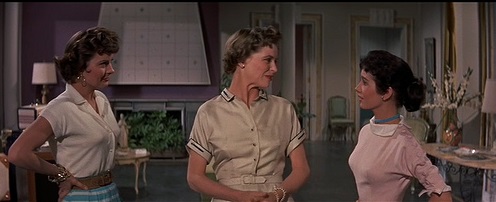
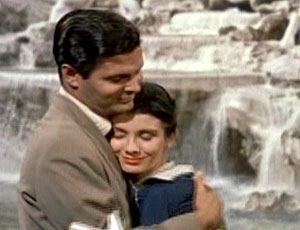
McNamara was also terrified of giving interviews and of moving to Hollywood, thousands of miles from her close-knit Irish family. To the studios, her fear came across as stand-offishness, and they moved on to more malleable starlets. After a few smaller roles, work sputtered to a near-halt by the mid-1950s.
Aside from a part in Preminger’s 1963 film The Cardinal, McNamara spent the rest of her scant career in television, finally retiring from acting in 1964 after a memorable turn with Lillian Gish in Body in the Barn, an episode of The Alfred Hitchcock Hour. For the last 14 years of her life, she supported herself by working as a typist in Manhattan. At the age of 48, deeply depressed and still plagued by her lifelong anxiety, she took her own life with an overdose of sleeping pills. On her piano, the last remnant of her Hollywood life, she left behind a suicide note and an unfinished screenplay she’d titled, perhaps in a moment of wishful thinking, The Mighty Dandelion. But of course, anyone who’s seen a dandelion when summer’s gone and the cold is closing in knows how fragile it is, and how the slightest breath can scatter its pale gray petals to the winds.
THE BURNING CRUCIBLE Fires The Imagination
If I wanted to introduce someone to silent film, The Burning Crucible is the last movie I’d show them.
And the first.
The last because it’s such a shock to the system it might scare them off. It’s totally subversive, completely unpredictable and impossible to define—bedroom farce, surreal nightmare, drawing-room comedy, romantic melodrama, goofy slapstick, detective story… it’s like the Whack-A-Mole of genres. Just when you think you’ve nailed it, something wildly different pops up in the next scene, or even the same scene. And that’s also why I’d show it first. At its height, this is what filmmaking used to be, when every possibility was explored and nothing was off the table, when labels were for film canisters, not for films.
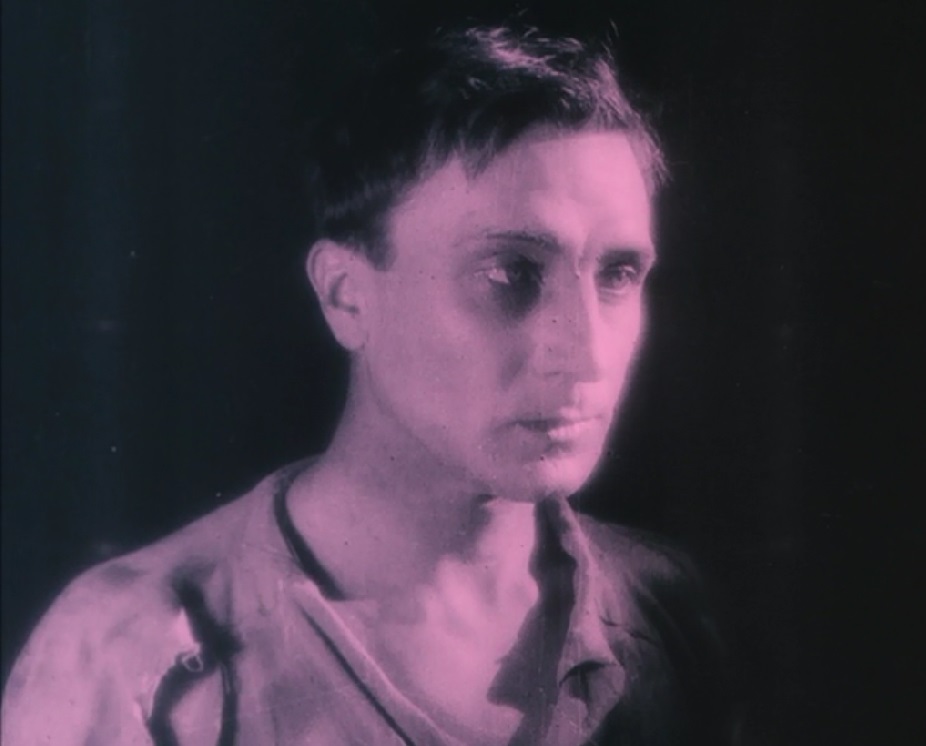

Starring Ivan Mosjoukine, who also wrote and directed, The Burning Crucible was potent enough to inspire Jean Renoir to abandon a life in ceramics for one in film: “I was delighted,” he recalled. “Finally, I had a good French film before my eyes…” Really more of a French-Russian one: threatened with arrest and execution by the Red Army, the hugely popular Mosjoukine had fled his homeland for Paris, where he became the linchpin for cutting-edge artists from both countries.
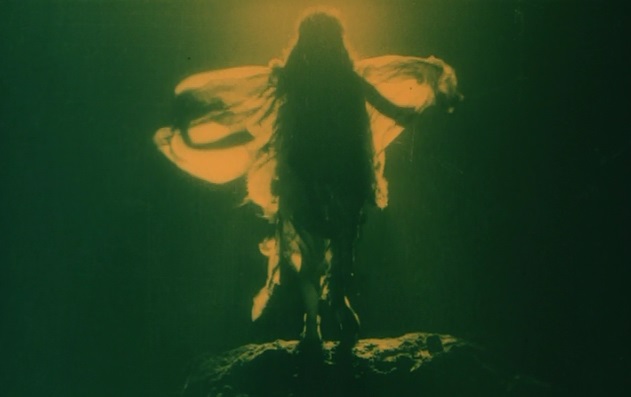
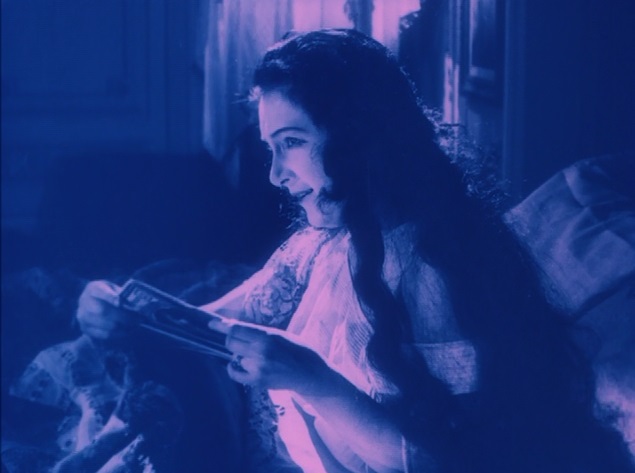
The film opens with a dream that shifts seamlessly, as dreams do, from one terrifying vision to another, including one where a prisoner chained to the stake is dragging a woman by her long braids into the fire… finally she breaks away and flutters like a moth from the flames. All of this chaos couldn’t be further removed from the dreamer’s waking life—and when Elle (Natalya Lisenko) finally emerges from her fitful sleep, she realizes the source of her nightmare: she’d fallen asleep reading the memoirs of “The Famous Detective Z” (Mosjoukine), a master of disguise and magnet for danger.
“What a stupid dream!” she laughs. “What connection can there be between these disturbing visions and the calm life and brilliant future in store for me?” Even as the title card fades, we know she’ll be shaken out of her complacency. But so will we.
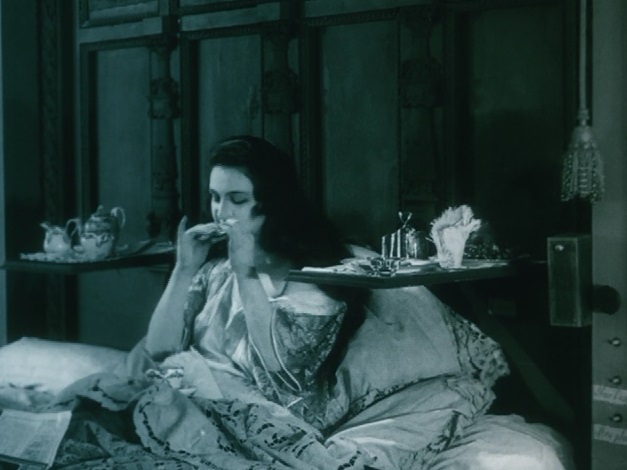
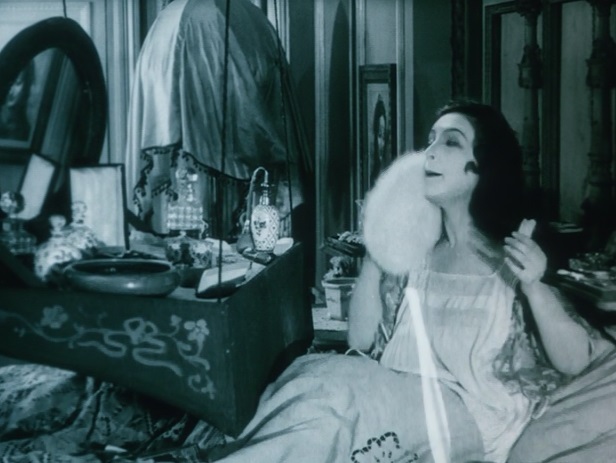
Elle is farcically pampered: her breakfast and tea trays pop out of her headboard (decades before similar goings-on in Jean Cocteau’s Beauty and the Beast), her vanity table slowly descends from the ornate ceiling, and as she primps and preens with her giant powder puff, a fawning servant scurries in with… wait for it… a tray of puppies!
Even her most useful accessory, her doting husband (Nicolas Koline), pops out from a panel behind a picture. But the “good news” he’s come to deliver knocks Elle for her first jolt: He’s selling their lavish estate and resettling them in their South American homeland. Frantically, she flees to her beloved Paris streets, sending her husband on a hunt for her in a world where nothing is as it seems…


Enter The Famous Detective Z, who’s tasked not only with finding Elle but taming her—a course that does not run smooth. Until then, the most ardent love of his life had been his grandmother…
To walk you through the plot would be as useless as bringing a coffee cup to Alice’s Tea Party. You really need to see it, and feel it, for yourself. It’s so inventive, visually astonishing and quirky it leaves you a little dizzy and drunk, and none too eager to reclaim your balance. You don’t want to leave this world, or Mosjoukine, behind; you’ve been spoiled for more linear films and less lyrical actors.


Mosjoukine was often called the Russian Valentino, which is a bit like saying Ingrid Bergman is the Swedish Ruby Keeler. Yes, he’s extravagantly romantic, and his eyes are truly hypnotic—but he’s also hilarious and brilliant and wry and touching and as physically fluid as Chaplin. In a single film, and without a trace of ego, he shows you there’s nothing he can’t do. If you’ve seen him, you know what I mean. If you haven’t, be warned: The Burning Crucible may be the start of a magnificent obsession.
The Burning Crucible is available from Flicker Alley as part of its five-film DVD collection, French Masterworks: Russian Emigrés in Paris 1923-1929. The other four fabulous films in the set are The Late Mathias Pascal (also starring Mosjoukine), Kean, Gribiche and The New Gentlemen. The prints are absolutely gorgeous, and contain both the original French as well as English subtitles.
This article is part of the Russia in Classic Film Blogathon, hosted by the fabulous Fritzi at Movies Silently and sponsored by The House of Mystery, an astonishingly stylish serial epic that has miraculously survived from the early 1920s and is now available in a beautiful DVD print from Flicker Alley. To read all the other entries, click here!

The George Sanders Touch: Even More Fabulous When He Sings
Need a little warmth to soothe you through those chilly nights? Wrap yourself in The George Sanders Touch….. Songs for the Lovely Lady.
He had me at the over-long ellipses…
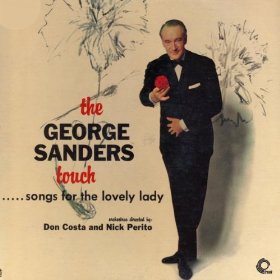
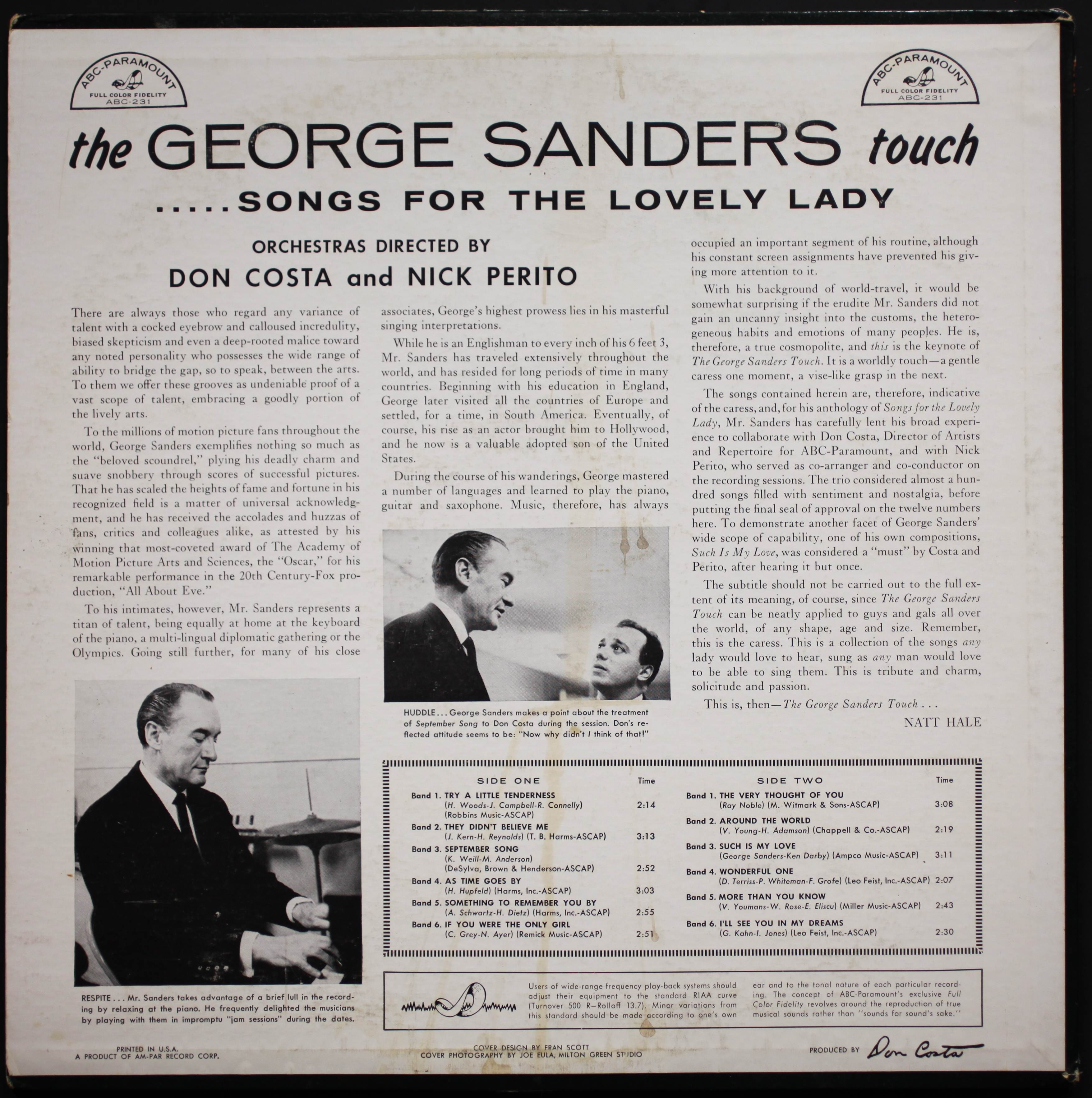
And you needn’t be content just to gaze at the cover of this hard-to-find album, where a slightly sleepy George, who always wakes up in a dinner jacket, slyly hands you a… carnation. (Can’t you just hear him at the photo shoot? “A single red carnation? Really? For God’s sake I give roses to the lovely lady who delivers my laundry!”)
Every song is right here…
One number simply flows into the next—you don’t even have to get up to turn the album over! (You can also buy this in MP3 format from a number of sources, including Amazon UK, but then you don’t get the fabulous visual of George.)
“To the millions of motion picture fans around the world, George Sanders exemplifies nothing so much as the ‘beloved scoundrel’… to his intimates, however, Mr. Sanders represents a titan of talent, being equally at home at the keyboard of a piano, a multi-lingual diplomatic gathering or the Olympics,” gushes Natt Hale in the liner notes. Suddenly I picture George in his tennis whites, tickling out a bit of Gershwin on the ivories while ironing out Cold War tensions with Khrushchev. Which actually doesn’t seem all that implausible.
“During the course of his wanderings, George mastered a number of languages and learned to play the piano, guitar and saxophone,” Hale goes on. “With his background in world travel, it would be somewhat surprising if the erudite Mr. Sanders did not gain an uncanny insight into the customs, the heterogeneous habits and the emotions of many people. He is, therefore, a true cosmopolite, and this is the keynote of The George Sanders Touch. It is a worldly touch—a gentle caress one moment, a vise-like grasp in the next…”
Heavens to Murgatroyd.
Mercifully, George seems to have left his vise at home for this one and gone straight for the gentle clinches of comfy standards: Try a Little Tenderness, They Didn’t Believe Me, September Song, As Time Goes By, Something to Remember You Buy, If You Were the Only Girl in the World, The Very Thought of You, Around the World, Wonderful One, More Than You Know and I’ll See You in My Dreams. There’s even a sweet song he wrote himself, Such Is My Love, captured here with some gorgeous George photos:
The whole thing is a bit dated, but in a good way. The second time through the album, I closed my eyes, let it wash over me—okay, caress me—and felt like I was right back there in 1958, listening on one of those big ol’ radios that seem more like furniture. Then I fell asleep. But I mean that as a compliment. I’ve listened dozens of times since, and even when I stay awake, I feel like I’ve had a good nap afterward. A nap with George. A girl could do worse.
On a couple of numbers, The Very Thought of You and Something to Remember You By, his velvety voice slinks in with kind of a deep-throated hum that’s a cross between Bing Crosby and really bad gas. It’s like having George Sanders sneak up over your shoulder and kiss your neck. After a really heavy meal. Sometimes when he goes very low, it sounds like he’s got a little indigestion going on, like maybe he’s trying to bring something up. But in a really elegant, charming way.
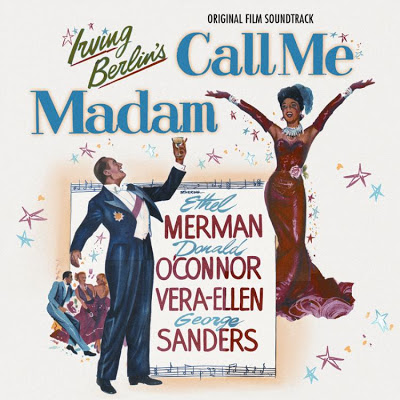
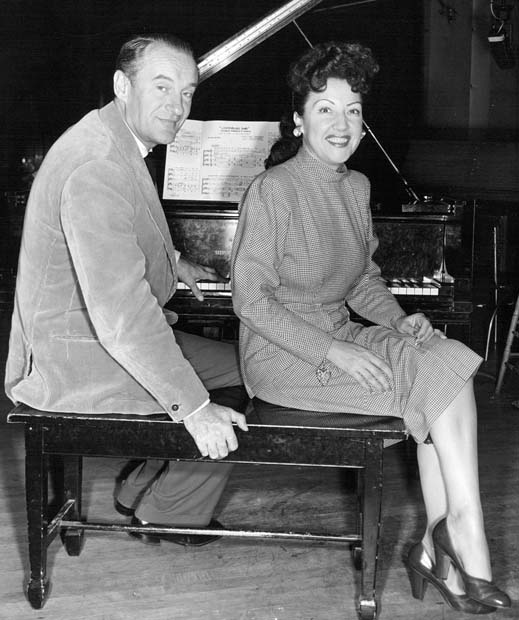
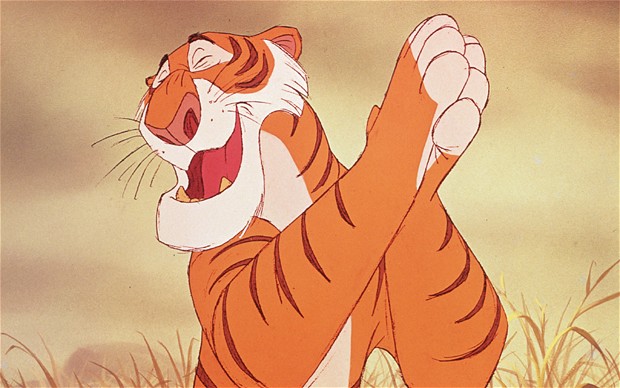
George’s fabulous bass-baritone can also be savored in several films, including Jupiter’s Darling, Call Me Madam (where he knocks the cover off Marrying for Love, giving us a taste of the ballads to come) and The Jungle Book, where he voiced the villainous tiger, Shere Khan.

And in 1949, he fought hard for—and won—the chance to play Emile de Becque in the Broadway production of South Pacific when Ezio Pinza left the show. But our George was always a complicated fellow, a mass of contradictions—and almost as soon as he signed the contract, he was seized with a hideous attack of nerves and had to wriggle out of it.
If you’re as achingly curious as I am about what nearly was ours, here he is singing This Nearly Was Mine…
…and Some Enchanted Evening (both of which can be found on So Rare, Vol. 4: A Selection by Barry Humphries of his Favorite Gramophone Records).
It’s no surprise, given his stage jitters, that he reportedly turned down an even more audacious assignment a few years later. According to his close friend Brian Aherne, in the early 1950s, after hearing Sanders perform several arias on Tallulah Bankhead’s radio show and elsewhere, the manager of the San Francisco Opera Company offered him the role of Scarpia in an upcoming production of Tosca. George told him thanks anyway, but he didn’t want to be an opera star…
In 1967, he seemed ready to give the stage another go, signing on to play Sheridan Whiteside in Sherry!, a musical adaptation of The Man Who Came to Dinner. But he bowed out when his wife, Benita Hume, was diagnosed with bone cancer, which claimed her life later that year.
But while stage success eluded him, he left us with this album. And the whole thing is right here on this page. So go ahead. Hit the Play button, close your eyes, and curl up with George. You can thank me later.
 Sister Celluloid
Recent Comments