The Oscar In Memoriam Reel: Who Got Snubbed This Year?
Another year, another botched attempt by the Academy to honor its own.
For a lot of movie lovers—classic-film fans especially—Oscar’s memorial-reel slights have become a cringe-inducing annual tradition. I don’t know if Bette Davis really did name the statuette Oscar because his backside resembled her husband’s. But when it comes to honoring those who’ve given so much to the movies, Oscar certainly makes an ass of itself.


The usual excuse for the snubs is that it’s a time issue: they simply can’t fit everyone we lost in the past year into a brief little montage. But here’s the thing: They’re the ones who decide to set aside so little time to honor people who’ve devoted their whole lives to their craft.


The producers could easily have cut out a production number (another lame bit where “real people” mingle with actors?), shorten the canned banter at the podium, or even—dare I say it?—eliminate a few commercials (“Walmart-inspired” movies? Really?). But they chose not to. So please, this year, spare us the “if only we had the time” lamentations, which are about as genuine as Eve Harrington’s humble acceptance speech at the Sarah Siddons Awards.


Still, somehow, no matter how pressed for time they are, they always manage to squeeze in a few agents or publicists. Cuz that’s what we tune in for, right? (“Honey, I’d be happy to get up and make you a drink, but I think they’re gonna show that guy from Rogers & Cowan!”)
The Academy has a much longer memorial slide show on its website, which includes all those who didn’t make the cut for the broadcast. But when the Hollywood A list/B list crap carries over to dead people, it’s frankly kinda creepy.


That said, here’s the list of oversights I noticed, including some glaring ones from classic film. Not all of these folks were primarily in film, but they all made a mark there. And even excluding the part-timers, the list of omissions is long:
Oscar winner Dorothy Malone, Dina Merrill, Bradford Dillman, Connie Sawyer (who had pretty much the longest career in film history), Nanette Fabray, John Gavin, Michèle Morgan, Heather Menzies-Urich, Stephen Furst, Juanita Quigley, Ty Hardin, Suzanna Leigh, Della Reese, Robert Guillaume, Jay Thomas, Glen Campbell, Michael Nyqvist, Adam West, Powers Boothe, Darlene Cates, Lola Albright, Jim Nabors, Leonard Landy, Anne Wiazemsky, Gastone Moschin, Elena Verdugo, Roy Dotrice, Michael Parks, Wendell Burton, Curt Lowens, Lorna Gray, Frank Vincent, Aleksey Batalov, Louis Zorich, Jean Rochefort, Daliah Lavi, Richard Anderson, Don Gordon, Anne Jeffreys, Robert Hardy, Clifton James, Federico Luppi, John Hillerman, Mireille Darc, Red West, Ann Wedgworth, Elsa Martinelli, Peter Sallis, David Ogden Stiers, Emma Chambers, John Mahoney, Reg Cathey, Jerry Van Dyke, Jean Porter, Marty Allen, Lassie Lou Ahern, Donnelly Rhodes, Rose Marie, directors Bruce Brown and Tobe Hooper, composer Dominic Frontiere, and choreographer Danny Daniels.


One bright spot: Eddie Vedder did a beautiful job with Room at the Top, fittingly a song by Tom Petty, who also deserved a place in the memorial reel. He wrote the soundtrack to She’s the One (featuring the much-covered Walls), and his music set the mood for so many films, including Fast Times at Ridgemont High, Jerry Maguire and Silence of the Lambs. (Jonathan Demme had sweet, unsuspecting Brooke Smith bop along in the car to American Girl as a kind of emotional shortcut; he wanted the audience to instantly like her.)


Please add in Comments anyone else who was overlooked (and remember, in this case, the “year” runs between the last Oscar broadcast on February 26, 2017 and today); let’s make sure they’re all honored somewhere, even if just in our little film family.
I’ve Fallen into Classic TV and I Can’t Get Up
Greater love hath no husband than to tell his wife about a Murder She Wrote marathon. “It’s running all day Saturday and Sunday,” Tim tells me wearily, thereby consigning himself to another room for pretty much two solid days.
But my trip to Cabot Cove comes at a price—and I don’t just mean the alarmingly high murder rate. I mean the depressing ads.


A leathery Pat Boone warns me to be terrified of my own bathtub—clearly a hideous deathtrap beckoning me with its gleaming porcelain—which should be replaced immediately with a walk-in model. But until I can get cracking on that, I should strap on a Life Alert button, just in case I fall, alone and terrified, bleeding out from a gaping head wound. And probably regretting I didn’t snap up one of those cheap life insurance or “final expense” policies they keep badgering me about.
Honest to God, I feel like I should be writing my will during the commercial breaks.
And the ads that don’t imply I’ll be lunching with St. Peter any day now assume I’m itching to sue someone or have already weaseled a structured settlement but need more cash fast. Perhaps to call a psychic, or hook up with strangers on a cheesy dating line! I know the demographics for classic TV stations skew older (read: fear-mongering), but do they also skew creepy?


An informal poll among like-minded friends and elderly relatives—including my 88-year-old Mom, who pretty much lives with Jessica Fletcher and Jim Rockford—reveals that none of us have ever bought anything being advertised on these channels. In fact when that California Psychic ad comes on (“When Mary called, I could tell she was hurting…”), I practically fall over furniture to grab the remote. Maybe I should have one of those Life Alert buttons after all…
STREAMING SATURDAY! THE HOLLY AND THE IVY Make for a Prickly Christmas
Hello, my classic movie family! I’ve spent most of the past year dealing with family and health issues and have been away. But I didn’t want to let the holidays pass without wishing you all joy and all good things. I also wanted to share this post on The Holly and the Ivy, one of my most beloved Christmas movies, which contains a link to the whole film. It can be a bit hard to track down, and I wanted to make sure you could see it!! Wishing you all the best for the holidays and the new year!
Love,
Janet

Welcome to another edition of Streaming Saturdays, where we bring you a free, fabulous movie to watch right here every week!
How can you help but love a Christmas movie where a brother and sister duck out on the family festivities to get roaring drunk?
They have their reasons. But then just about everyone has cause to knock back a few in The Holly and the Ivy, one of the least jolly Christmas movies ever. Which, for some of us, looks a lot like Christmas.


Adapted by Anatole de Grunwald from a play by Wynyard Browne (who wrote the screenplay for Hobson’s Choice), the 1952 film used to be a holiday staple on PBS back when they showed old British movies all the time. (I blame them for my insatiable crushes on Alistair Sim, Alec Guinness, James Mason, Robert Donat and Trevor Howard. They’re lucky I still give them money.) But it hasn’t turned up…
View original post 1,173 more words
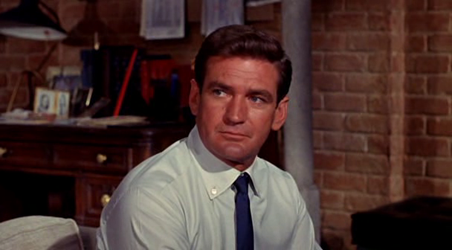
Reel Infatuation: Rod Taylor in SUNDAY IN NEW YORK
Ladies! Traveling around New York, you’re likely to run into all kinds of guys. Take, for instance, the manspreader: Not even Dame Helen Mirren was safe from him. And The Nicest Man in America™ actually was him.


Then there’s Oscar Shapeley, who’s certain your emphatic rejections are just a playful way of heightening the romantic tension before your unconditional surrender. (I was recently stuck next to this guy on a trip to Rochester. As he was finally getting off the train in Rome, NY, he leaned in and grinned, “Would you like me to take you to Rome?!?” And then he laughed so hard a bit of gack flew out of his mouth. Because it was literally the funniest thing anyone has ever said.)


There’s also the out-and-out perv, who makes you long for the subtle, sophisticated stylings of Mr. Shapeley. And the guy who seems to have last enjoyed the thrill of bathing sometime during the Carter administration. And the one who’s wolfed down so much garlic he’s travel-banned in Transylvania.
But sadly—tragically, even—you know who you’re never gonna run into?
This guy.


Remember when you’d sit around with your friends, imagining the perfect guy? Kind and decent, but not dull. Strong, but not overbearing. Smart, but not show-offy. Funny, but not a loudmouth. Protective, but not condescending. Exciting, but not dangerous. Gorgeous, but not vain. Is that so much to ask?!?
Not for Rod Taylor it isn’t.
In Sunday in New York, he slips easily into the role of Mike Mitchell, a music writer on a day trip to the city. Who hooks up, literally, with Eileen Tyler (Jane Fonda) on a crosstown bus, when her boutonniere gets snagged on his jacket. She should have that thing bronzed.
After an awkward parting and a fateful reunion—there’s that bus again!—they’re caught in a downpour and run for shelter.


Eileen is in town visiting her big brother Adam (Cliff Robertson), seeking sanctuary after her frustrated fiancé (Robert Culp) cools on her for not sleeping with him. Adam dutifully encourages her to remain chaste—and swears on his “sacred honor” he’s doing the same. But when she discovers a black negligee hanging in his closet, all bets, sacred or otherwise, are off.
And there sits this man. Good God. Could anyone blame her for deciding it’s time to jump in? Still, she’s a bit clumsy and naive, and Mike soon realizes she’s doing what she thinks she should be doing, not what she is comfortable doing—or has ever done before.
All her quirks and fears and vulnerabilities are flung out there like that ratty blue robe she pretends is her mother’s, to ward off predatory males. But he doesn’t pounce on them, or mock them. He loves them. He loves her. He honors her. And protects her, even from himself.
And when they argue over shifting sexual morés, he clearly relishes batting it back and forth with her. Yes—gasp—he even loves her mind!


Mike Mitchell is pretty much the perfect man: strong, smart, funny, gorgeous and insanely honorable. For me, the movie’s only false note was that he had a sometime girlfriend back in Philly who would let him stray beyond a three-foot radius.
I had been hounding TCM to show Sunday in New York since they started their festival. So when they finally did, in 2014, I was there before the doors opened, like the people who camp out overnight for the latest iPhone except this was for something important.


My friends Kay and Kathy arrived soon after—and the daylight pajama party was on! We’d just spent three days staring at screens, scarfing down all manner of sugary sin, and sleeping only at the odd moment there wasn’t a movie playing somewhere. As we waited for the house lights to dim, we gave in to our giddiness—hugging, swaying, and belting out the film’s signature tunes: “New York on Sundaaaay… big city takin’ a nap… Hellooo… what sweet magic brought you my wayyy…” Somewhere back east, Peter Nero’s ears were ringing. Or bleeding.
The woman sitting behind me huffed so hard she blew my hair off my neck: “I hope you’re not going to be doing that during the movie!” This to someone who’d rather streak through Holy Communion than talk in a darkened theater. But in the last scene, when Rod is gazing up at Jane, hugging the world’s luckiest pillow, I couldn’t hold it in any longer. I sighed. Out loud. And yup, she shushed me, complete with spittle.

Later that spring, Kay and I had Sunday brunch at the restaurant where Eileen and Mike go to haggle over the cost of mending his jacket. Now the Rock Center Café, it looks much as it did more than a half-century ago. “Oh my God, this is the door where they went in!” I sputtered as I wobbled up the steps.


From everything I’ve seen and read of him, I’ve always had the feeling that playing the perfect man was not much of a stretch for Rod Taylor. There’s a reason he could do it without a molecule of effort.
In 1963, when Sunday in New York was made, Fonda was still finding her way out from under her father’s shadow, deeply insecure, and battling bulimia. She has said that working with Taylor was the first time she enjoyed making a movie or dared to believe she could really act.
“Jane and I got on so beautifully, and we never stopped laughing, on screen, off screen, just laughing all the time,” Taylor also recalled. “And shooting in New York… that was fantastic, cops stopping traffic, and everybody going ‘Ooh, ahh!’ when I kissed Jane… just a wonderful experience!”
He even managed to make Tippi Hedren’s nightmarish stint on The Birds bearable. “Rod was a great pal to me and a real strength. We were very, very good friends,” she said. ‘He was one of the most fun people I have ever met, thoughtful and classy. There was everything good in that man.”
Here’s a more modest take, from the man himself: “Rock Hudson and Tab Hunter were very pretty fellows, and that was the trend. I was one of the first of the uglies to get lucky… I wasn’t good-looking enough to really pull off some of the roles that I was put into!”


Rod Taylor died just a few months after the Sunday in New York screening at TCM, and I haven’t been able to watch it since. You know that wonderful feeling of seeing someone you love on the screen and knowing they’re still out there somewhere? And then suddenly they’re gone, and that feeling is even more horrible than the other feeling was good? With Rod Taylor, I’m still working through that.
But ladies, if you haven’t seen this movie, you must. And guys, watch it and make mental notes—kind of the way I do when I see Edith Cortwright in Dodsworth. Because that’s the thing about old movies: They give us something to shoot for.

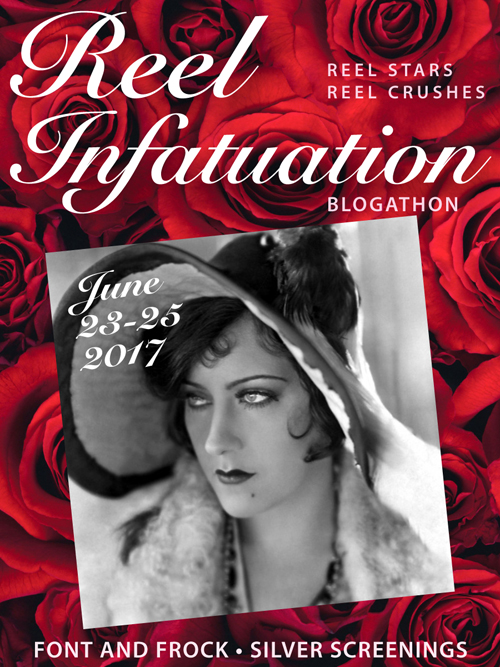
This article is included in the Reel Infatuation blogathon, hosted by Silver Screenings and Font and Frock. For more, click here!
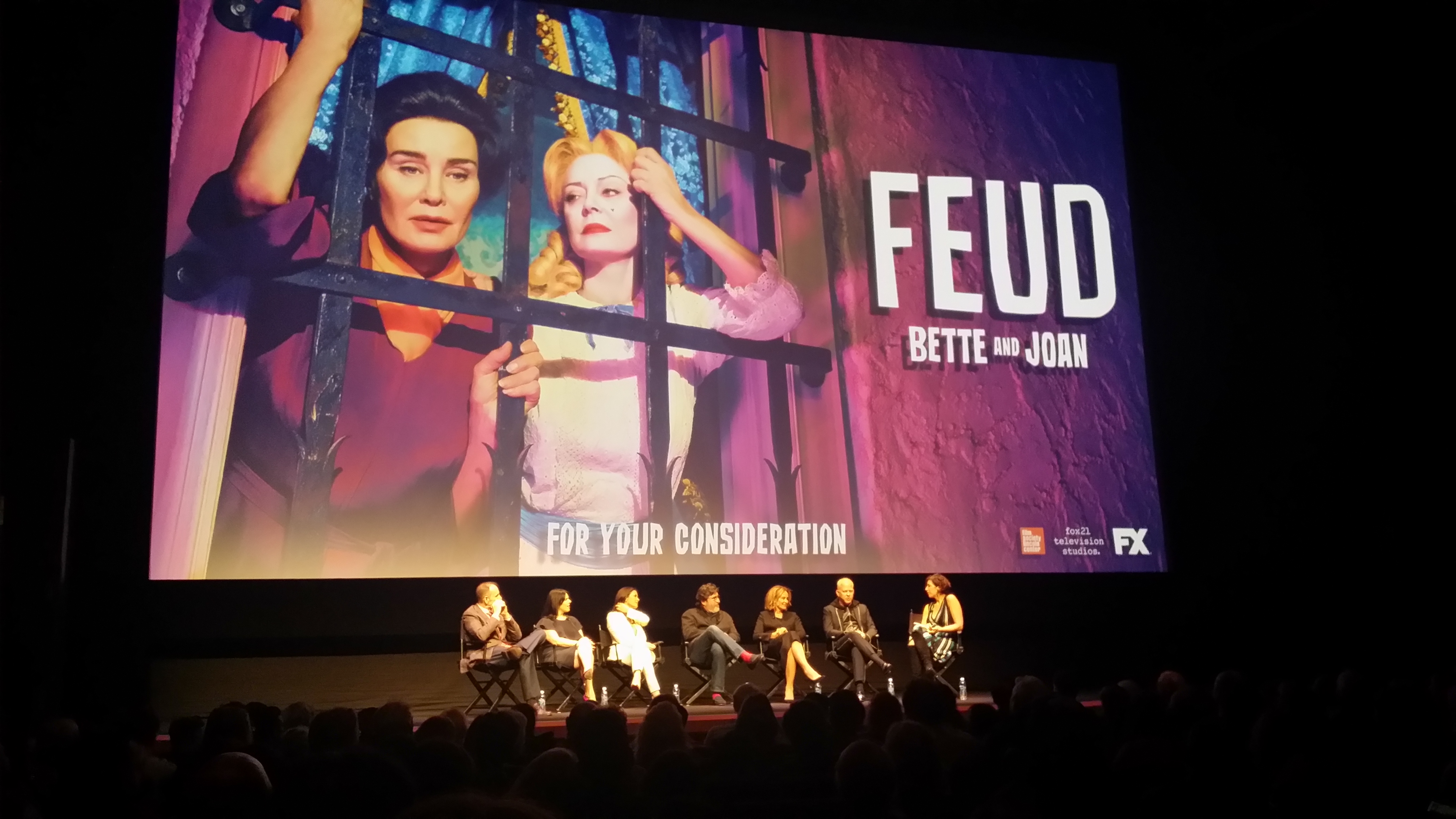
FEUD: BETTE AND JOAN! The Cast and Creator Open Up at a Sneak Preview of the Finale
While we were falling in love with Jessica Lange, she was falling in love with Joan Crawford.


“She was such a treasure,” said Lange at a Q&A hosted by the Film Society of Lincoln Center, following a sneak preview of the Feud: Bette and Joan finale. “She was never given the credit she was due. And when I went back and watched her films, she was a lovely actress, very subtle… obviously she had a style, that MGM style, but underneath it all, she was very real.
“People think of the glamour and the Hurrell photographs,” she added, “but there was so much more to her than that and it was thrilling to discover.”


Lange said she felt pressure to do right by Joan, who has been camped up and torn down for decades now. “I don’t think she got a fair shake from her daughter or from the film that was made,” she said, not daring to utter the name of the movie or the daughter, lest Faye or Cristina spring full-blown from the floorboards. “I do think she was maligned and she never got an opportunity to defend herself, of course. We dealt very fairly with Joan and created a character with all her strengths, vulnerabilities, peevishness, humanness. I hope in some way that brings another dimension to the way she’s seen. I hope we created a different idea about this woman, who was quite extraordinary.”
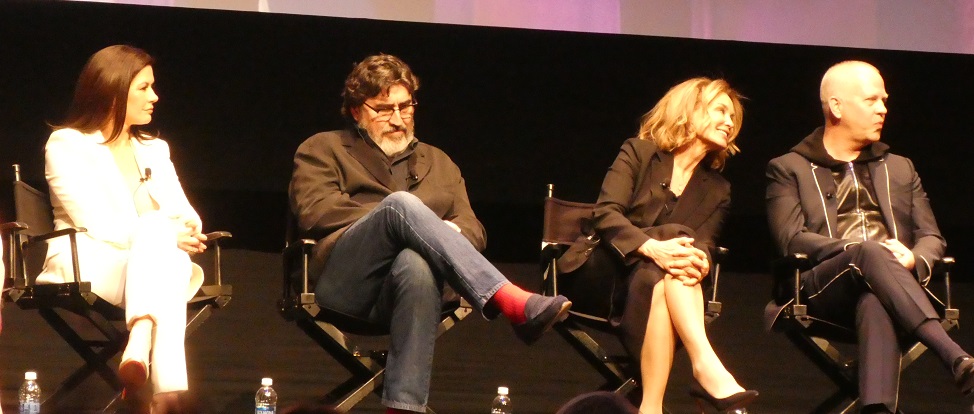 Focused mainly on the filming of What Ever Happened to Baby Jane, the miniseries captures an especially unhappy, even desperate, time in the careers of Joan, Bette Davis (Susan Sarandon, who skipped the Q&A), and director Robert Aldrich (Alfred Molina). As far as the studios were concerned, Aldrich’s sin was that his films, though often critically praised, were commercial flops. Joan and Bette’s sin was that they continued to breathe past 40.
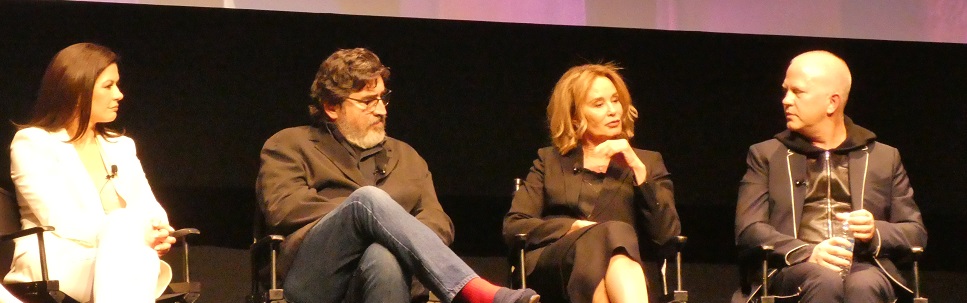
“I’m 52 and I feel like I’m just getting started, but for Bette and Joan, they were done,” said Feud creator Ryan Murphy, who also directed and co-wrote a few episodes. “And I just think about how unfair that is. I think the saddest thing in life is lost potential.”


“They all came together at a time of great need, trying to resuscitate their careers, keep themselves relevant and valid,” said Molina.
Lange agreed: “I think that’s typical of especially what happens to a women’s career at that point. You’re still in there scrapping and fighting and thinking, ‘This next role is going to bring it all back. This next role is going to make a difference.’ You think it’s out there but it isn’t, and yet you address the situation as if you still have some kind of control. This thing of struggling to resurrect something that is long gone is where the real human sadness of it exists, the poignancy… there’s still that thing of trying to hold on.”


The early days on the Baby Jane set held the promise that its long-feuding stars might forge a truce, or even—dare we dream?—some sort of brittle friendship, based on, if nothing else, the acres of common ground they shared: four marriages, difficult daughters, and decades of grappling with shortsighted, abusive studio bosses who built fortunes on their talents, wrung every ounce of work out of them, and threw them away like squeezed lemons at the first signs of age. (When Baby Jane was first pitched to him, Jack Warner—who had 15 years on Bette and 12 on Joan—sneered, “No one will pay to see those two old broads act.”)
But circumstances conspired against them—in the form of powerful gossip mavens like Hedda Hopper (Judy Davis) and even their own director, who feared a Bette-Joan alliance could blunt his power on the set. A feud, on the other hand, could spark their performances and generate buzz for a film he had little confidence in.
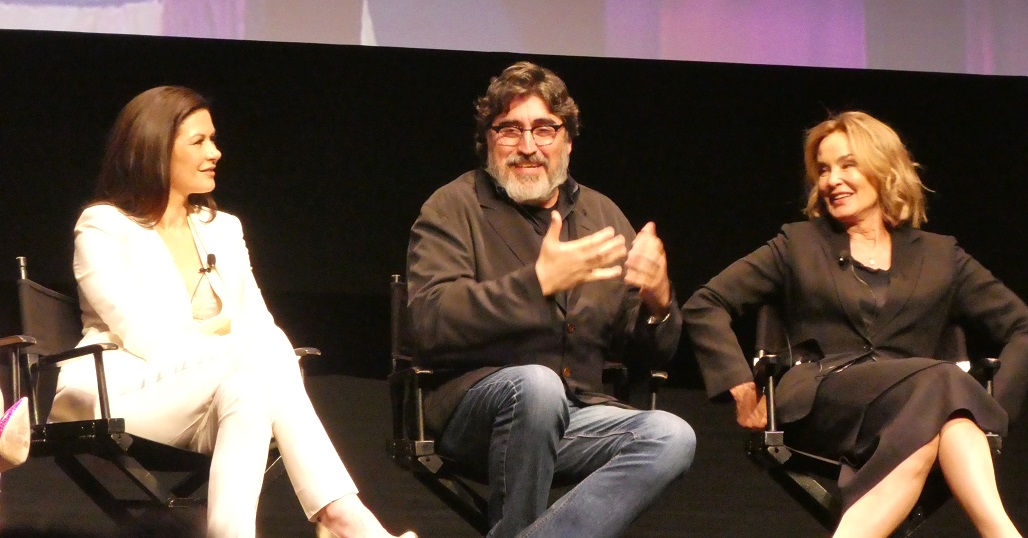 “Aldrich was definitely complicit, but he was also a victim of forces as well,” said Molina. “He was reluctantly drawn into stoking the fires of that feud. He was morally a complex man, I think that’s a polite way to put it… but he was also an unloved child in Hollywood. That scene where he asks Jack Warner, ‘Do you think I’m capable of being great?’ and he’s told, very blandly, ‘No’… it’s the question we all want to ask and we all fear the answer. So he was a victim but he was also complicit.”
“They were all pawns in one big confusing rat race,” added Catherine Zeta Jones (Olivia de Havilland). “You have all that fragility put onto the set, like a whole bunch of thoroughbreds, and Jack Warner is the jockey deciding which one to favor.”


Happily, the Feud set was much less fraught than Baby Jane‘s. “The atmosphere was the antithesis of what the story was about,” Molina laughed. “It was very relaxed. There’s an old saying among athletes—I’m not saying I’m an athlete in any way, but I’ve heard them say it!—that you get better when you work with the best, with people who have something to teach you. When we first started, I was petrified—with me it always starts out 50 percent excitement and 50 percent dread—but there was an effortlessness about this.”
Murphy credits much of the happy set to the fact that half the directors and many of the writers and other offscreen talent were women—a much higher quotient than the usual (criminally small) ratio. “Much less ego and drama!” he laughed.
“When I did The People Vs. O.J. Simpson, the woman who was supposed to direct the Marcia Clark episode got sick, and I stepped in for her,” he recalled. “And I wasn’t really happy with the results. And I thought, ‘Why didn’t I have nineteen women in my Rolodex I could have called to direct that?’ Now I make a point of hiring as many women as possible.”
When work on Feud began, the long slog of election season was nearing an end—and so, many hoped, was the daily bruising of one sleazy Trump outrage after the next. “It looked like Hillary was going to be our next President, and then about halfway through filming, we got what we got,” Murphy said. “And it was such a wake-up call for me. At first, this series felt a little bit like a time capsule to me… like, aren’t we past all this now—the misogyny, the sexism? And then it was like, no, it’s not over. And I could feel the women on the set getting madder and madder at the outcome and at what was already unfolding.”
But if Murphy and company couldn’t give the country a happy ending, they could give Bette and Joan one—sort of. (Warning: The next paragraph is a mild spoiler.)
In the finale, a gravely ill Joan dreams she hears laughter in the living room. She gets out of bed and moves slowly, warily toward the source… and sees Warner and Hopper knocking back a few at the card table. Soon Bette arrives, and after a little while, it’s just the two of them. And they say what we’ve always wanted them to say. That they wish they’d been kinder. Less self-protective. They wish they’d gotten it right. “But, it’s not too late!” Joan says, reaching across the table. “We can start now!” And Bette, a bit startled, smiles and nods. With that, Mamacita (yes, Jackie Hoffman’s back!) gently wakes her frail charge, wraps her arms around her and shepherds her back to bed.


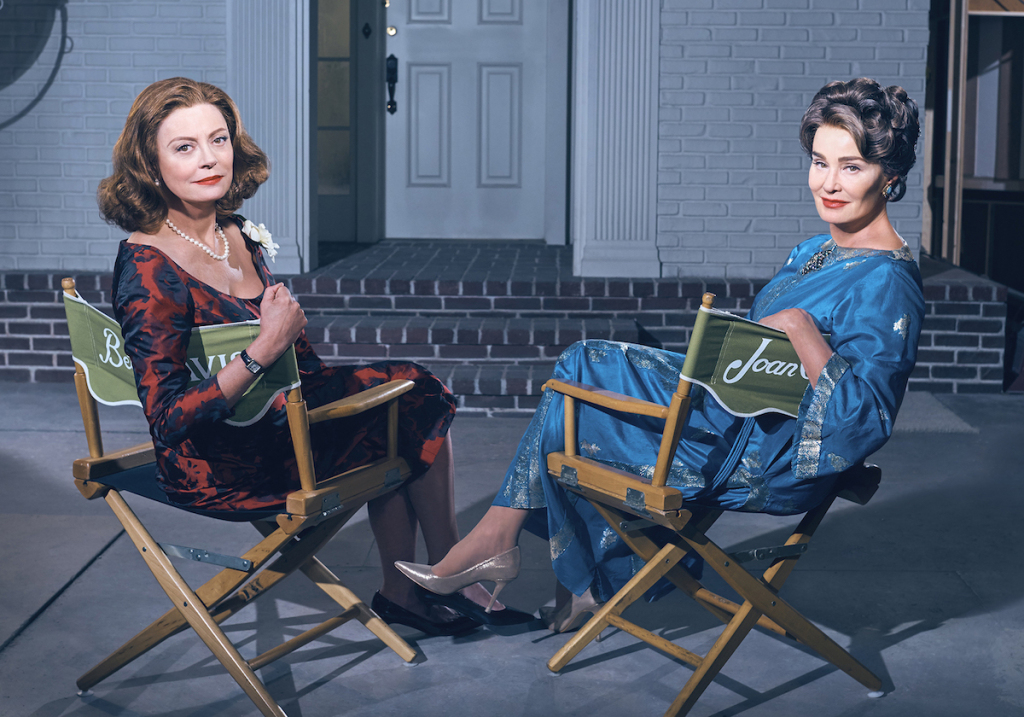
“I felt like I wanted to give them, and the fans, that closure,” said Murphy. “That photograph, when they started filming Baby Jane, where they’re sitting and chatting—what if it had stayed like that?”
“When I first came out to Hollywood, I interviewed Bette and she told me, off the record, how she really regretted that she and Joan didn’t somehow work things out,” he added. “People conspired against their becoming friends, and there were also romantic entanglements and rivalries…


“All of the older actors I’ve interviewed, at the end, they were all talking about that kind of regret,” he said. “If you love someone, tell them. If you’ve hurt someone, make it up to them. People you love, people you’ve fought with, if only you could sit with them and say I’m sorry, I screwed up… okay now I’m getting choked up.”
Even more so when he revealed he dedicated this series to his grandmother. “She raised me, and she reminded me so much of Bette Davis, and I would watch her movies and feel her around me,” he remembered. “So in a way I’m reconnecting with her. That’s why I put that line in the last episode, when Pauline is talking about how older people become forgotten, and she tells the young guy who’s interviewing her, ‘Call your grandmother.'”
You do the same, if you’re lucky enough to have one. Or call someone you’ve fallen out with, and make it right. Bette and Joan would be proud of you.
Can’t get enough of Bette and Joan? Read about why they should have been friends (written years before Feud!). And about Bette’s other feud—with dogs; her fabulous fundraiser for homeless pets, which drew half of Hollywood; and her surprisingly honest pitch for war bonds! And read about how Joan stepped in for her fallen friend, Carole Lombard; her hilarious turn in Torch Song; and the advice she doles out lavishly in her book, some of which is oddly practical, and some of which is just odd…
Photo credit for shots from the stage: Alejandro Kiesel.
BRIEF ENCOUNTER: The Rain, the Sane, And Mainly Lots of Pain
When I was invited to join a celebration of rainy movie scenes, the first one that came to mind wasn’t something like this…
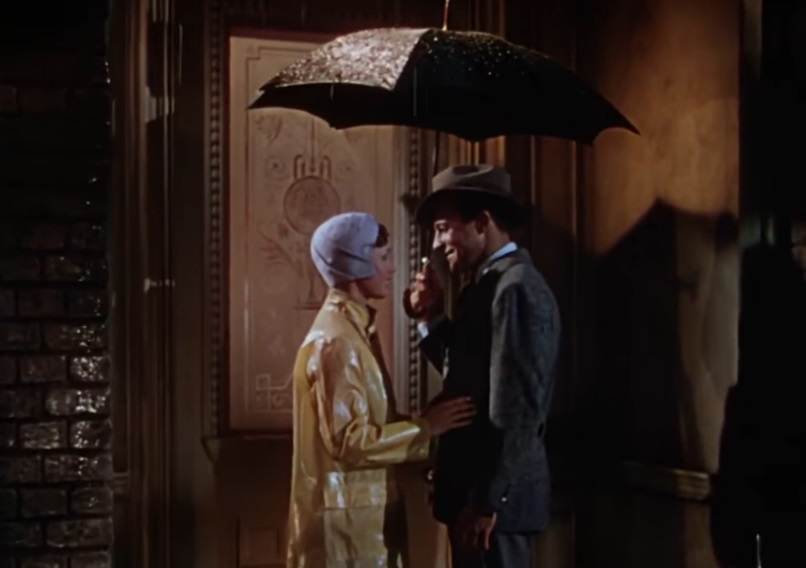
or this…

or this.
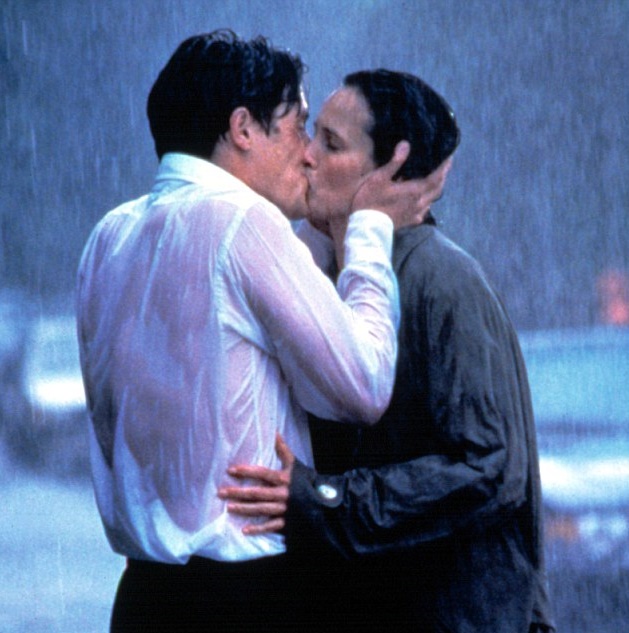
You see, I’m Irish. So of course I thought of this doomed, guilt-ridden duo.

The scene in Brief Encounter where Laura (Celia Johnson) tears through the wet streets after getting caught with Alec (Trevor Howard) is the flip side of every rain-drenched romantic scene ever filmed. Because this isn’t romance—it’s love. Sacred, fierce and terrifying, an untold blessing and an unholy mess.
“I’m an ordinary woman,” Laura says early on. “I didn’t think such violent things could happen to ordinary people.”
And yet here she is, fleeing a stranger’s flat, where she’d gone to meet a man who was a stranger only weeks before.


After bolting from the safety of her homeward-bound train at the last second, Laura rushes to meet Alec at his friend Stephen’s apartment, where he stays every Thursday while working at the hospital. But when they hear Stephen’s key in the latch—he’s home early, with a nasty cold—Laura hurries out the back way, down the tradesman’s staircase.
Stephen (Valentine Dyall) hears the scuffling—and, smugly sizing up the scene, picks up the scarf Laura left behind, letting it dangle from his fingers. “This is a service flat… it caters to all tastes,” he smirks, all but oozing a trail of slime across the carpet. “You know Alec, you have hidden depths I hadn’t suspected…”
Laura, meanwhile, is flying through the strange streets in the middle of a downpour, heading anywhere at all as long as it’s away. (“I felt humiliated and defeated and so dreadfully ashamed…”)


Finally, too tired to keep running but in no shape to go home, she huddles into a callbox at a tobacco shop and concocts a story for her husband, with a quick-witted nimbleness that appalls her. (“It’s awfully easy to lie when you know that you’re trusted implicitly. So very easy, and so very degrading.”)


Wandering back out into the night, she takes refuge on a park bench, where she lights a post-non-coital cigarette and—thinking of her husband—feels ashamed even for doing that. (“There was nobody about… I know how you disapprove of women smoking in the street… I do too really but I wanted to calm my nerves, and I thought it might help.”)


But her guilt is just getting started: “I sat there for ages, I don’t know how long. Then I noticed a policeman walking up and down a little way off. He was looking at me rather suspiciously…”
When he approaches, it’s clear he’s just concerned: “Feeling all right, Miss? Waiting for someone? Don’t go and catch cold now… it’s a damp night for sitting about on seats!”


She assures him she’s fine, and was just about to get up to catch a train.
“I walked away, trying to look casual, knowing that he was watching me.”
“I felt like a criminal.”


And in this grim, rainy scene, Robert Krasker shot her like one. The cinematographer (who also teamed with David Lean on Odd Man Out and won an Oscar for The Third Man) shadows Laura up and down the dark streets like her own accusing heart. And in the callbox, as she lies to her trusting husband, she’s set in stark, near-black relief against the bright lights of the cheery shop on the other side of the glass. Any shlub with a camera could conjure noir out of guiltless sex, but only a genius could find it in sexless guilt.
(P.S.: If you crave a bit of Noel Coward where the illicit lovers really let their id flags fly, here’s a streaming link to The Astonished Heart, also starring Celia Johnson, but this time as the betrayed wife. It’s enough to convince you that, however frustrated they might have ended up, Laura and Alec got it right.)
The Legendary BEHIND THE DOOR Is Out On Blu-ray, and You Can Win a Copy!
Kevin Brownlow called it “the most outspoken of all the vengeance films.” It’s also one of the most daring and disturbing. And now—finally—it’s available on DVD.
Irvin Willat’s 1919 masterwork, Behind the Door, has been gorgeously restored through a collaboration of the San Francisco Silent Film Festival (SFSFF), the Library of Congress, and Gosfilmofond of Russia. And Flicker Alley releases the Blu-ray disc on April 4th.

The restoration—the most complete version of the film since it was released almost a century ago—was a years-long labor of love. The print was meticulously pieced together using a copy of Willat’s original continuity script and every known film source element—including some critical action sequences tracked down from actor Hobart Bosworth’s personal collection.
Because the movie was made in the US right after World War I, you can imagine how the battle of the protagonists—patriotic American Oscar Krug (Bosworth) and monstrous beast Lieutenant Brandt of the Imperial German Army (Wallace Beery at his Wallace Beeriest)—shapes up. What you can’t imagine is the shockingly brutal turn of events that ensue when Krug’s ship is captured by the Germans and his wife (Jane Novak), who has sneaked aboard, is kidnapped and dragged onto their U-boat, leading her heartbroken husband to seek bloody revenge. If you think you’ve seen it all but you’ve never seen this film, trust me, you haven’t seen it all. (Warning: You may never be able to watch The Champ the same way again.)


Photoplay said of Behind the Door, “it took courage to make such a picture as this, for it is a ‘he-picture’—no pap for puking infants.” Though a few adults in the audience might have felt their lunch making a return appearance as well. But the film is as gorgeous as it is graphic: Willat used color tinting in unusual ways to underscore emotion and move the narrative along. And its 70 minutes seem to fly by in less time than it takes to boil an egg.


Here’s a peek at the trailer:
As part of the roll-out, you can purchase Behind the Door at $10 off the regular price. Meanwhile, the fabulous folks at Flicker Alley have teamed with some classic film websites, including ours, to give away copies of this gorgeous print, which also includes scads of bonus materials:
- The Russian version of Behind the Door: The re-edited and re-titled version of the film that was distributed in Russia, with musical accompaniment by composer Stephen Horne, who also scored the English-language version on the DVD;
- Outtakes from Behind the Door: Featuring music composed and performed by Horne;
- “Restoring Irvin Willat’s Behind the Door”: A behind-the-scenes look at the restoration;
- “Kevin Brownlow, Remembering Irvin Willat”: An in-depth interview with the legendary film historian and honorary Academy Award® winner on Willat’s career;
- Slideshow gallery of stills and promotional material from Behind the Door; and
- Souvenir Booklet: Featuring rare photographs and essays by film historian Jay Weissburg, Rob Byrne, president of the SFSFF board of directors, who did the yeoman’s work of the restoration, and Horne.
One lucky winner will receive a copy of Behind the Door on dual-format Blu-ray/DVD from Flicker Alley. The contest is open to all US and Canadian residents and ends April 12, 2017, so hurry!
When you enter the contest by clicking below, you’ll be given the option to follow Sister Celluloid on Twitter—and I do mean option. But I hope you’ll give us a follow and join more than 2,000 movie-crazy people already at the party, sharing pix, comments, links and live-tweet events.
The Annual Oscar Memorial Reel Fiasco: Who Got Snubbed This Year
Okay boys and girls, it’s time for our annual Sister Celluloid tradition: filling in the massive gaps in the Oscar memorial reel!


Granted, this was a horrible year. That old cliché that celebrity deaths come in threes? Yeah no. Sometimes it felt more like tens. The most common posts on social media consisted of a single word: No. As in, Not him. Not her. Not another one.


So the producers had an overwhelming job this time. But instead of acknowledging what a hideous year it was—and giving the memorial segment the time it deserved—they blew it again.


Couldn’t they have cut down on the lame-ass patter, contrived stunts or commercials to honor the long, long list of people we loved and lost? Good God, you could drive that stupid tour bus they spent 10 minutes on through the gaping holes in that “tribute.”


But hey, not to worry: the Academy assures us there’s “an extended photo gallery of filmmakers, artists and executives”on its website! Can you think of a more depressing Hollywood fate than being an also-ran in the freaking memorial reel? “Hey, Mom, I’ll bet Dad’s glad he devoted his whole life to his craft—he’s number 121 in the slideshow! Really, just keep clicking, you’ll get there!”


A friend once kidded that I only watched the Oscars “when some old guy was getting an award.” Which wasn’t true. I also watched for the old ladies. But a few years back, in a further kick in the teeth to classic film, the Academy ghettoized the Governors Awards for lifetime achievement—and doesn’t even bother to televise them. So now I watch the Oscars mostly for the memorial reel—and then clack away at my spittle-flecked laptop to honor all the fabulous people they didn’t bother to acknowledge.


You didn’t have to be from the classic era to be snubbed—but as usual, it helped. Among the missing actors were Gloria DeHaven, Alan Young, Ruth Terry, Robert Vaughn, Madeleine Lebeau, Michele Morgan, John McMartin, Gordon Kaye, Anne Jackson, Steven Hill, Brian Bedford,Tammy Grimes, Bernard Fox, Rita Gam, Richard Bradford, Joan Carroll, Billy Chapin, Dick Davalos, Patricia Barry, Marvin Kaplan, Al Molinaro, Francine York, Van Williams, Douglas Wilmer, Peter Vaughn, Fritz Weaver, Madeleine Sherwood, William Schallert, James Stacy, Doris Roberts, Alec McCowen, Burt Kwouk, Barbara Hale, Fyvush Finkel, Robert Horton, Jon Polito, Garry Shandling, Charmian Carr, Maggie Blye, Larry Drake, Miguel Ferrer, Alexis Arquette, Florence Henderson, Richard Hatch, Bill Henderson, Teresa Saldana, Kevin Meaney, Noel Neill, Jinpachi Nezu, Joseph Mascolo, Frank Pellegrini, Joe Santos, Gil Hill, Ron Glass, Jack Riley, Peter Brown, Nicole Courcel and David Huddleston.


Overlooked filmmakers included Guy Hamilton (as in “Bond. James Bond.”), Pierre Etaix, Giorgio Albertazzi, Don Ireland and Herschell Gordon Lewis.


I’m counting on you, dear readers—as you did in 2015 and 2016—to take note of the ones I missed, in comments. Let’s honor them all—and never, ever hold our breath for the Academy to do so.


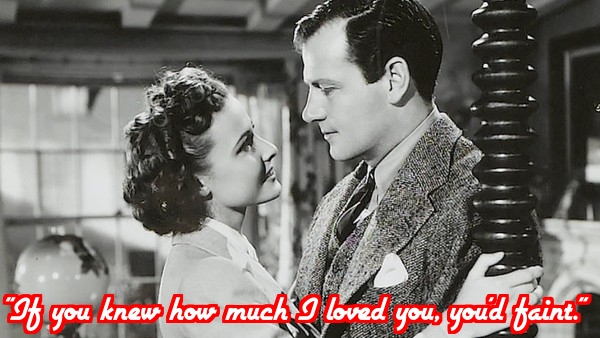
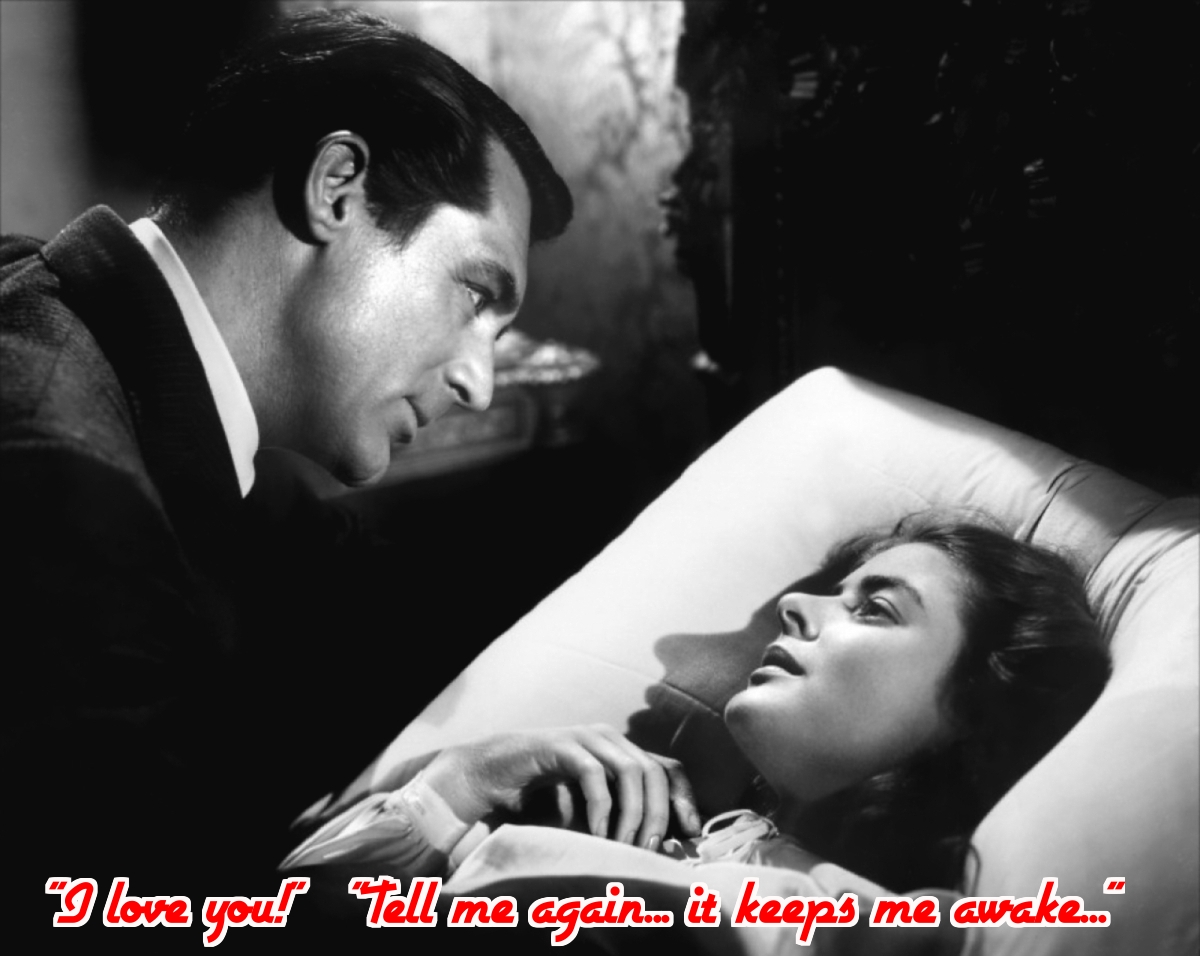
Happy Valentine’s Day! Grab Your Sweetie—And One of These Cards!
Happy Valentine’s Day and lots of love to my classic film family of friends!
Still looking for that perfect card, or maybe you—gasp—you forgot the big day is today? Feel free to grab one of these, created just for you.
And whether you’re still searching for love or are lucky enough to have found it, I hope your day is a lovely one!!



Godspeed, John Hurt
What if 2016 wasn’t just a horrible year, but the beginning of horrible, period? 2017 is off to an awful start, with the passing of John Hurt the latest piece of unbearable news to come thudding on the doorstep.

He was so much more than just an insanely versatile actor. He gave everything he had to this world, in every way he could. Aside from his brilliant career of more than half a century, Sir John also devoted massive amounts of his time and talent to great causes, including Greenpeace, the WAVE Trauma Center for victims of violence in the north of Ireland, and Project Harar, an Ethiopian medical charity he became involved with after playing the disfigured John Merrick in The Elephant Man.


My own introduction to this amazing man came in Catholic school, of all places, when we got to spend one blessed afternoon watching a great movie instead of listening to Sister Mary Arthur boom at us from behind her massive desk and even bigger glasses. (Thank you, God!) The film, as you may have guessed, was A Man for All Seasons, and Hurt played the sniveling, villainous Richard Rich, who perjures himself for a cushy post, helping doom Thomas More (Paul Scofield) to the chopping block. (“Why, Richard,” More tells him. “It profits a man nothing to give his soul for the whole world. But for Wales?”) Good Lord, he was a creepy little bastard! So why did I develop such a huge crush on him? Like I didn’t have enough Catholic guilt?
Not long after, our local PBS station showed The Naked Civil Servant, where Hurt disappeared into the role of flamboyant British writer Quentin Crisp. But there was something about those eyes… Wait. Hold it. That guy was this guy? Another head-exploding moment soon followed, when PBS aired I Claudius, with Hurt pulling out every crayon in the crazy box as Emperor Caligula (but he was so fabulous you missed him when he was murdered). So, just to recap:
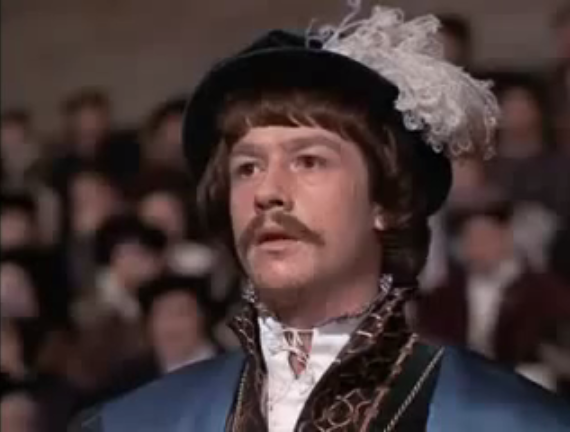
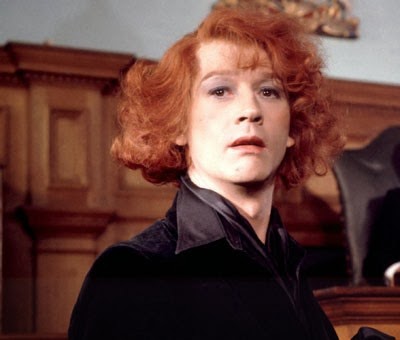
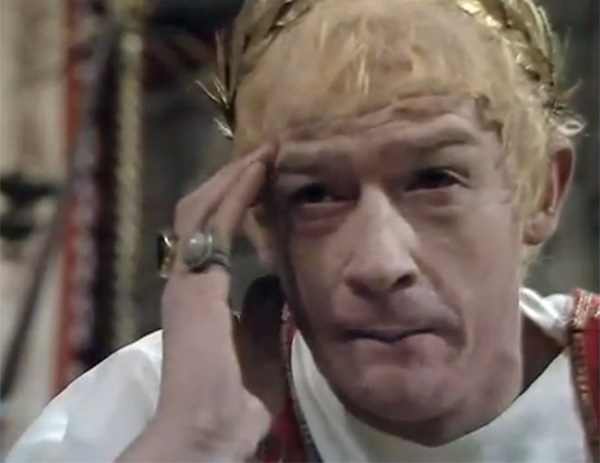
And he was just getting started!!
The man who betrayed a saint and and knocked off half of Rome became the leader of the rabbits in Watership Down. A desperate heroin addict in Midnight Express. A doomed space traveler (who got “indigestion” way too early in the movie—and later parodied his role in a Spaceballs cameo) in Alien. A brilliant wastrel in Heaven’s Gate. A prisoner of his own body in The Elephant Man. The head propagandist in Nineteen Eighty Four. A dogged detective in Crime and Punishment. An obsessed writer in Love and Death on Long Island. A hero’s weather-beaten sidekick in Indiana Jones and the Kingdom of the Crystal Skull. (He was the only one who insisted on reading the script before signing on. No one else did “because Steven [Spielberg]—you know, ‘God’—was doing it. And I said, ‘Well, I need to have a little bit of previous knowledge even if God is doing it.'”) An ex-con struggling for a new start in Night Train to Munich. A mystic wand-maker in Harry Potter and the Deathly Hallows. A proud, betrayed MI-5 boss in Tinker, Tailor, Soldier, Spy. An Elizabethan scribe in Only Lovers Left Alive.


The only thing these characters have in common is the actor who played them all. No one but John Hurt could have. Still, I have only scratched the surface of his work. And you get the feeling he had, too.
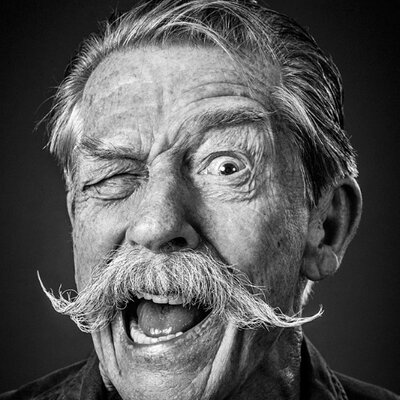
We will never see his like again, in a million different guises, with only a singular soul in common. Godspeed, Sir John. And thank you for every crazy, beautiful thing.
 Sister Celluloid
Recent Comments