For Rod Taylor, with Love
Beyond heartbroken.
You should never find out that someone you love is gone by scrolling through your Twitter feed. That’s how I found out that Rod Taylor had died today.
I’ve been in love with him since I was a girl. He was the approachable terrific, gorgeous guy. The one you’d have a dizzyingly wonderful time with and be safe with. The one who’d protect you from monsters (The Birds) or your own worst impulses (Sunday in New York) or even himself, if necessary (36 Hours).
And he didn’t even know how fabulous he was. “I was one of the first of the uglies,” he said, recalling his early years in Hollywood. “Rock Hudson and Tab Hunter were very pretty fellows, and that was the trend. I was one of the first of the uglies to get lucky.”
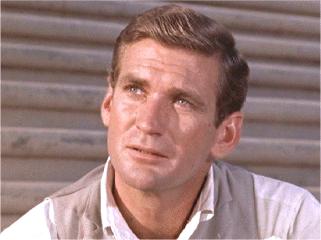
Last spring, after I shamelessly lobbied them for four years running, TCM showed Sunday in New York at its annual Classic Film Festival. (Pity my poor husband, when he discovered, to his horror, not that I was in love with Rod Taylor—which he already knew—but that I had now realized that relentless nagging can work.)
I was first on line the Sunday morning they screened the film, with my friends Kay and Kathy helping to hold me up. (The woman from TCM even gave me the title card they made for the lobby—the way you might give a cold compress to a swooning Victorian relation.) I had hoped Rod would be there to introduce it, but he was in Australia. The small consolation, I guess, was that his absence meant I’d actually be conscious for the movie rather than crumpled in a faint on the floor. I’m usually quiet as a churchmouse during films, but I actually got shushed for sighing during this one. (You can read all about that screening, and other highlights of the Festival, here.)


Rod Taylor’s roles ran the spectrum from romantic to action to sci-fi to adventure to animation (Pongo in 101 Dalmations!) but for me, Mike in Sunday in New York seemed the most like who I imagined he really was. Because basically, Mike was the perfect man. He was kind, funny, strong, patient, and—here’s a throwback word—honorable. He genuinely honored Eileen (Jane Fonda), and you knew—just as sure as you knew they’d end up together—that she’d always be safe with him, but it would never be dull. He was the one who’d always come through, who’d never let you down. It was all right there in his face, in his eyes.


Even the best actor in the world can’t fake that.
After last year’s Festival, Kay sent me this screencap, to commemorate the moment I sighed the loudest.
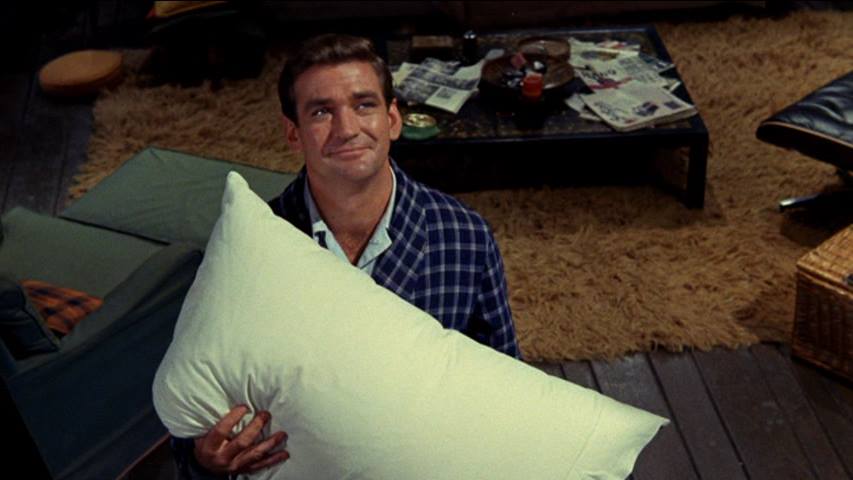
And just today, she and I were emailing back and forth about that movie, and about him. I don’t have to tell any classic movie fan that after an actor you love is gone, you can still enjoy their movies, but it’s never the same as when you knew they were still out there somewhere.

“I am a poor student sitting at the feet of giants,” Rod Taylor once said, “yearning for their wisdom and begging for lessons that might one day make me a complete artist, so that if all goes well, I may one day sit beside them.” He earned his place among the giants, and he is sitting beside them now. But oh, how I wish with all my heart he were still here.
HISTORY IS MADE AT NIGHT: Hard to Define, Harder to Forget
History Is Made At Night: Charles Boyer, Jean Arthur and Colin Clive, under the gloriously romantic direction of Frank Borzage. What’s not to love?
But loving it is easier than explaining it. Clive plays Bruce Vail, a deeply crazed shipping magnate whose creepy scheme to hang onto his wife Irene (Arthur) drives her straight into the arms of another man (Boyer). Not that she’d need to be driven there; most of us would gladly walk—or run.

Irene is desperate for a divorce, so Bruce bribes his chauffeur to break into her room and force her into a compromising position, which, by law, would halt the proceedings. Fortunately for her, Paul Dumond, a local restaurateur, overhears the scuffle in the next room and rushes to her rescue by decking the driver. When Bruce bursts in, expecting to catch his wife in flagrante, Paul—who must now explain his own presence to the suspicious husband—claims to be a cat burglar and absconds with Irene and her jewels.


Once he’s made it clear he’s not a thief, Paul whisks his breathless captive off to his cafe, where they pop open pink champagne and dine on the chef’s lavish creations in the half-lit dining room just before dawn. Fortified by the bubbles, Paul broaches the awkward issue of why Irene would ever marry a man a man like Bruce. But rather than ask her directly and risk scaring her off, he playfully questions her by painting a little face on his hand, calling the little puppet Coco, and cooing at her in a high-pitched voice.
Okay I’ll pause a moment while you read that last bit again. Suffice to say Charles Boyer is one of about five men on the planet who could pull that off without the woman smiling awkwardly while slowly reaching for her purse and backing up toward the door. Or maybe just saying to hell with the purse and running. (Oh and in the close-ups of the hand-puppet, that’s none other than Señor Wences.)

And from here, things get really complicated. But I won’t spoil it for you.
I don’t even know what to call this film: crime story, mystery, melodrama, romantic comedy, buddy movie, disaster epic, it’s got it all—even a lovely musical interlude where Irene kicks off her evening slippers and and dances with Paul as the violinist plays I Get Ideas. And as it slips seamlessly out of one mood and into another, each scene builds upon the last, making the whole film even more intense than the sum of its many moving parts.
Lovingly filmed by Gregg Toland (four years before his legendary work in Citizen Kane), the movie’s darkness and light play off each other perfectly. And under Borzage’s tender direction, Arthur, a woefully unsung leading lady, and Boyer, who never really got his due as an actor (more on that here), have never been better—whipsawing from romantic to frantic and back again. You just ache for these two to make it.
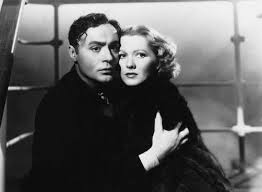

Meanwhile, Clive takes what could have been a cardboard-cutout villain and makes him dark, complicated, intriguing and even pitiable. One scene, where Bruce asks Irene to please smile at him when they’re in public, is just heartbreaking. Another, when he’s all but begging for details of her affair, is downright subversive. By then, he’s already murdered a man, framed Paul for it, stalked Irene and tried to pin a false adultery rap on her. But when she mocks him, I’m sitting there thinking, You don’t have to be so mean to him. (Such is my love for Colin Clive.) Already painfully fragile, he lived only five more months after completing this film, succumbing to tuberculosis and alcoholism at age 37.
Why this film isn’t considered a classic is an absolute mystery to me. Watch it and see if you agree.
You can catch History Is Made at Night any time on Hulu, but really, wait until nightfall:
http://www.hulu.com/watch/254171
Win Classic Film Cards in the Sister Celluloid Contest!
Season’s Greetings, my classic film family of friends! To thank you all for helping make the first few months of this website such happy ones, I thought I’d shimmy in one more contest before the end of the year.
This time, the prize is 10 classic film cards from the company that made them best: Garbaty of Germany. All of these cards are from the 1934 “Modern Beauty” series; the stars are Annabella, Virginia Bruce, Madeleine Carroll, Lil Dagover, Kay Francis, Miriam Hopkins, Emil Jannings, Gloria Swanson, Lupe Velez and Alice White.
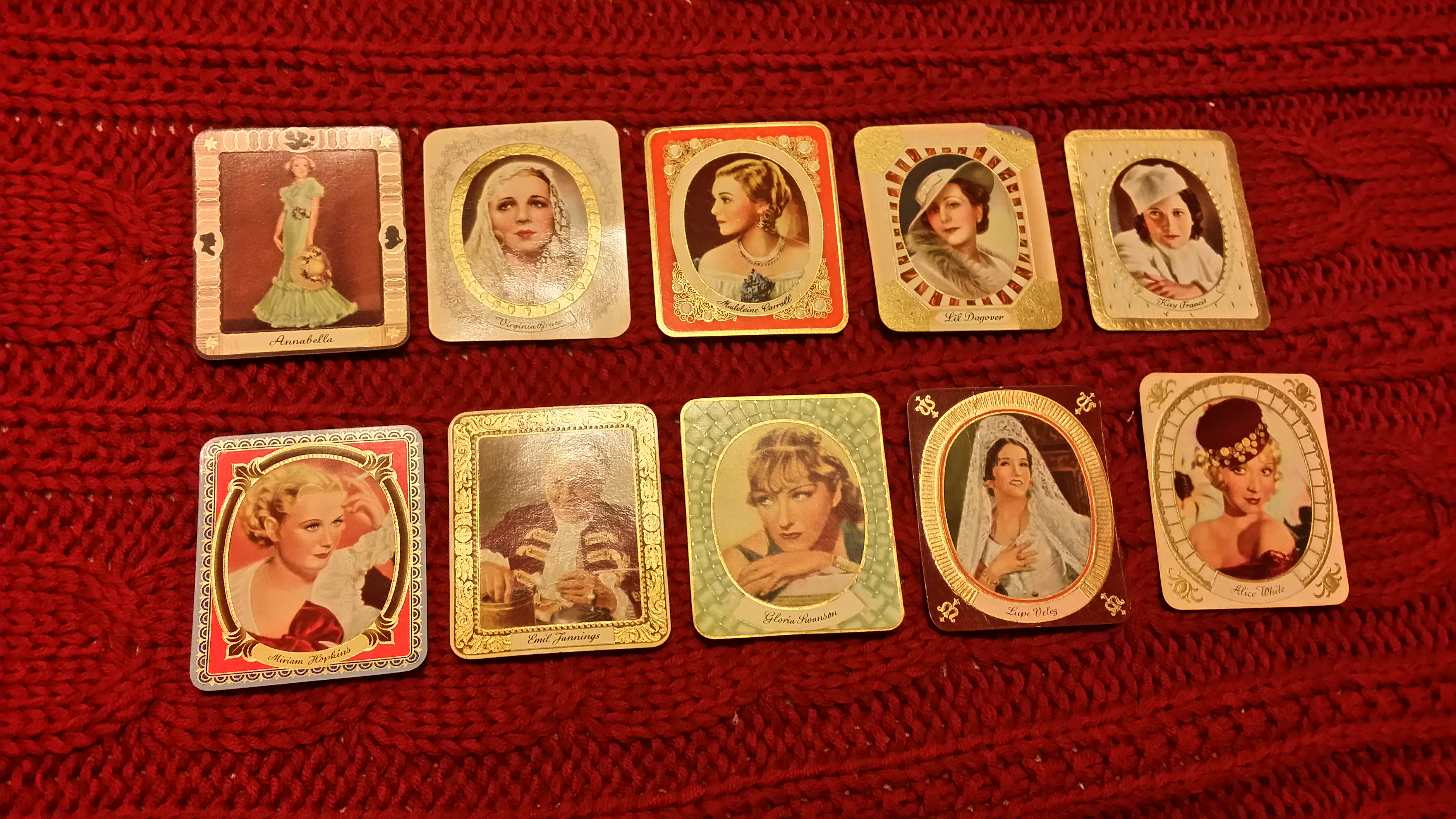
To enter, just do two simple things: After scrolling through the website, 1) comment on any post, and 2) share any post on Twitter and/or Facebook. That’s it. On January 17, I’ll jot down the names of everyone who did, put the slips of paper in a vintage hat, and pick one.
I’ll then announce and contact the winner, who can send their name and address to me at sistercelluloidwebsite@gmail.com. (And anyone else who wants to drop a line, please do!)
Good luck, and thank you so much for sharing your time and your passion for classic film with me here!
A Soldier Lovingly Remembers Marlene Dietrich
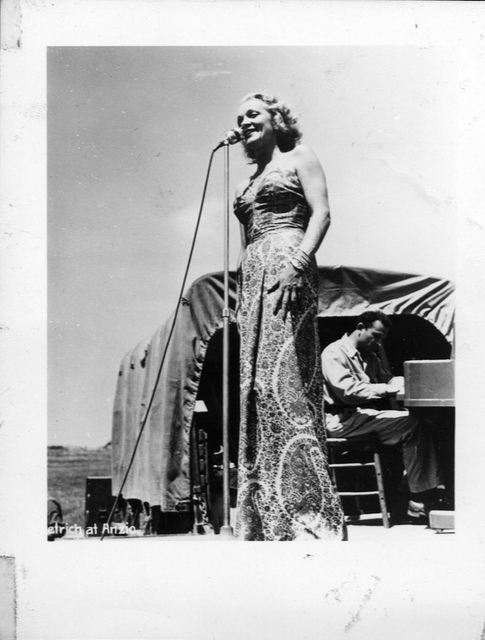
She sizzled onscreen with the hottest leading men in Hollywood—Gary Cooper, Cary Grant, Charles Boyer, Robert Donat, James Stewart, Ronald Colman—but Marlene Dietrich’s most memorable co-star may have been a balding, jowly, irascible middle-aged man. While entertaining the troops during World War II, she ventured within a mile of the German front lines on the arm of Gen. George Patton. When asked why she’d take such a huge risk—especially when the Nazi government had placed a seven-figure bounty on her head—she replied, “Aus anstand.” Out of decency.
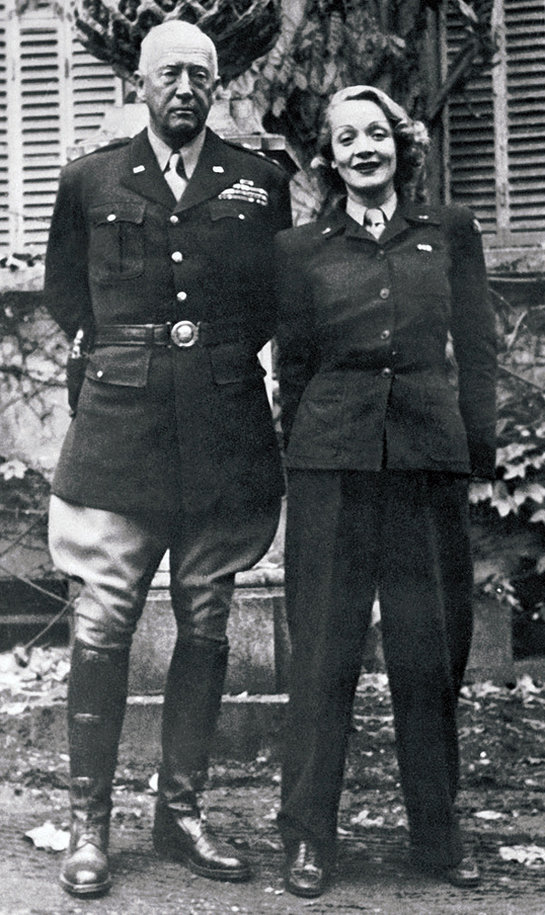
A staunch anti-Nazi, the Berlin-born actress had become a U.S. citizen in 1939, refusing a personal request from Adolf Hitler to return to Germany as the centerpiece of his propaganda campaign. Following the attack on Pearl Harbor, she was one of the first in line to sell war bonds.
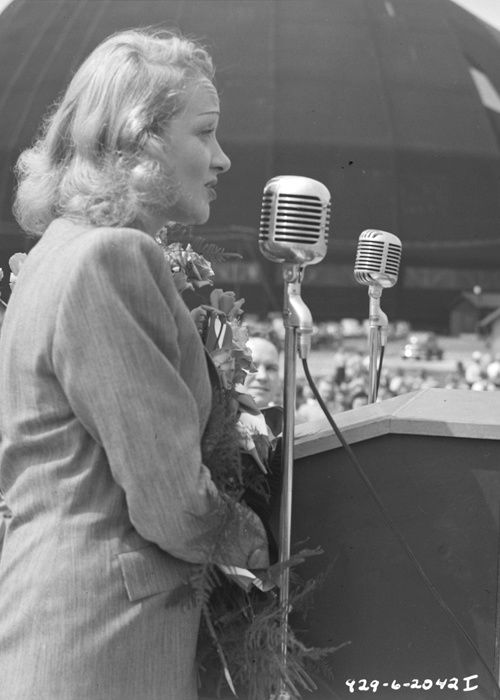
After barnstorming the country for a year and a half, selling more bonds than any other star, Dietrich headed for the front lines in 1944, spending the rest of the war performing for Allied troops in Algeria, Italy, Britain, France and Belgium. She’d roll up her sequined gown in a knapsack as a makeshift pillow, and wash her silk skivvies by sloshing them around in a helmet filled with melted snow. She fought off frostbite, influenza and near-pneumonia, and scoffed at the more immediate threats on her life that arrived by way of bombs, grenades and rifle fire.
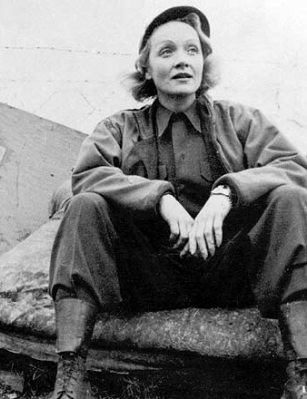
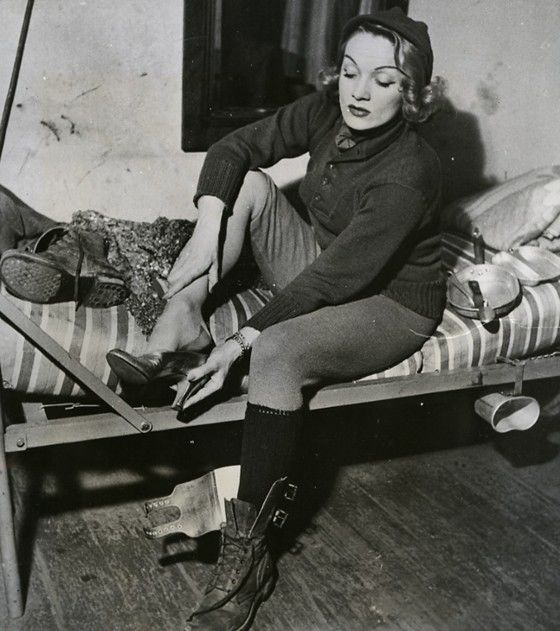
In June 1944, Dietrich touched down in Naples to entertain 3,000 wounded soldiers crammed into a 1,000-bed Red Cross hospital. Lt. Russ Weiskircher of the 45th Infantry Divison, who was shot in the shoulder on an Anzio beachhead a month earlier, had recovered enough to help escort their glamorous visitor. In a career that included the Legion of Merit, the Silver Star, the Bronze Star and three Purple Hearts, his memories of Marlene were among his most vivid:
She arrived in a rush, she returned daily for an entire week, she remained and left in a rush. It was her style.
First order of business was a show, presented to the patients who were able to gather in the huge cafeteria/dining hall. Marlene sang, did magic tricks and told raunchy jokes. She was clad in a translucent, shimmering blue gown, slit to reveal those million dollar legs… Before she turned the show over to her supporting musicians and entertainers, she hiked up her dress and paraded across the stage. Then she started tossing autographed blue garters to the audience. There was pandemonium, bedlam. Wheel chairs collided; crutches and canes became weapons as the men fought to capture a prize. The authorities had to stop the show to keep from adding to the casualty list.
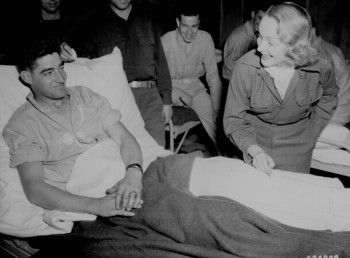
Marlene then began a relentless, seven-day, dawn-to-dusk tour of the entire hospital. She visited every room except the quarantine ward. She sang, she joked, she gave autographs, she flirted; she ran from bed to bed and room to room. I struggled to keep up with her. She never stopped. She lived on cigarettes, coffee and martinis, worked 16-hour days every day, and was a hell of a trouper.
At one time she met up with Rita Hayworth’s kid brother. He was wounded and distraught because he couldn’t get a message home to tell his family that he was recovering. La Dietrich marched into the hospital commander’s office, commandeered a phone and put through a call from Naples to Hollywood. She was able to link mother and son, transoceanic.
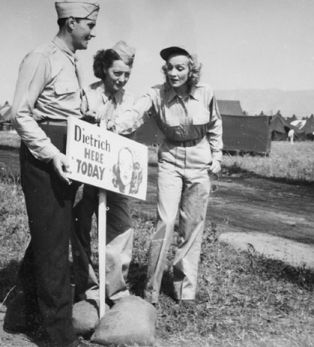
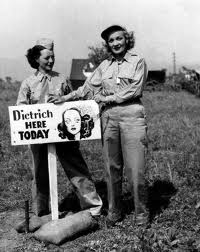
She was middle-aged, she was a mother, in fact she was a grandmother, but unlike any grandmother that I had ever met. She was kind, caring and fun to be with. She autographed a picture for me and even signed a cartoon-like drawing that my girlfriend then, later my wife of many years, had sent me. Unfortunately the cartoon disappeared from the letter I sent to Jane. I always suspected some dishonest censor. I even tried to trace it but to no avail.
Finally the week was up and Marlene and company moved on. It was a tearful goodbye. Few entertainers matched the Blue Angel with her husky voice, her glamour, and her genuine dedication to the troops. When she finally left I had to go back to bed for two days to recover from the pace of trying to keep up with her.
You can be certain that I became and remain an avid fan, loyal to the memory of Marlene Dietrich—the lady who laughed at Hitler, refused his command appearance order and poured body and soul into the WWII effort.
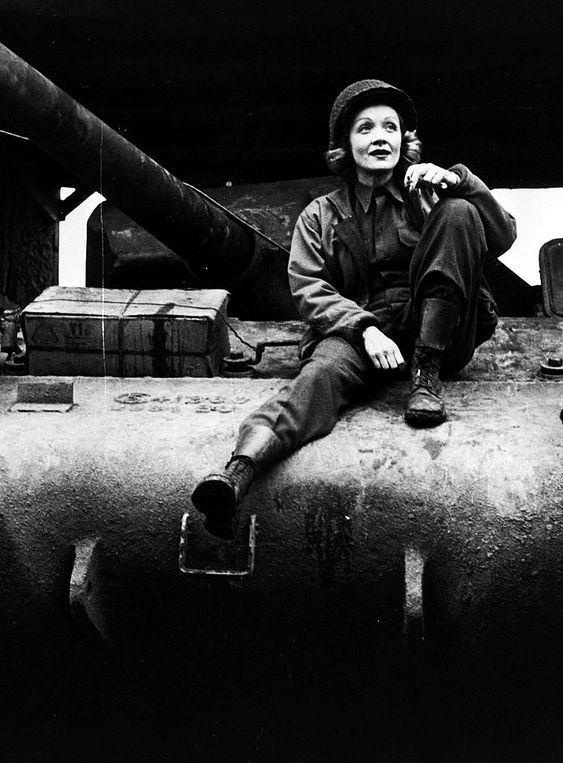
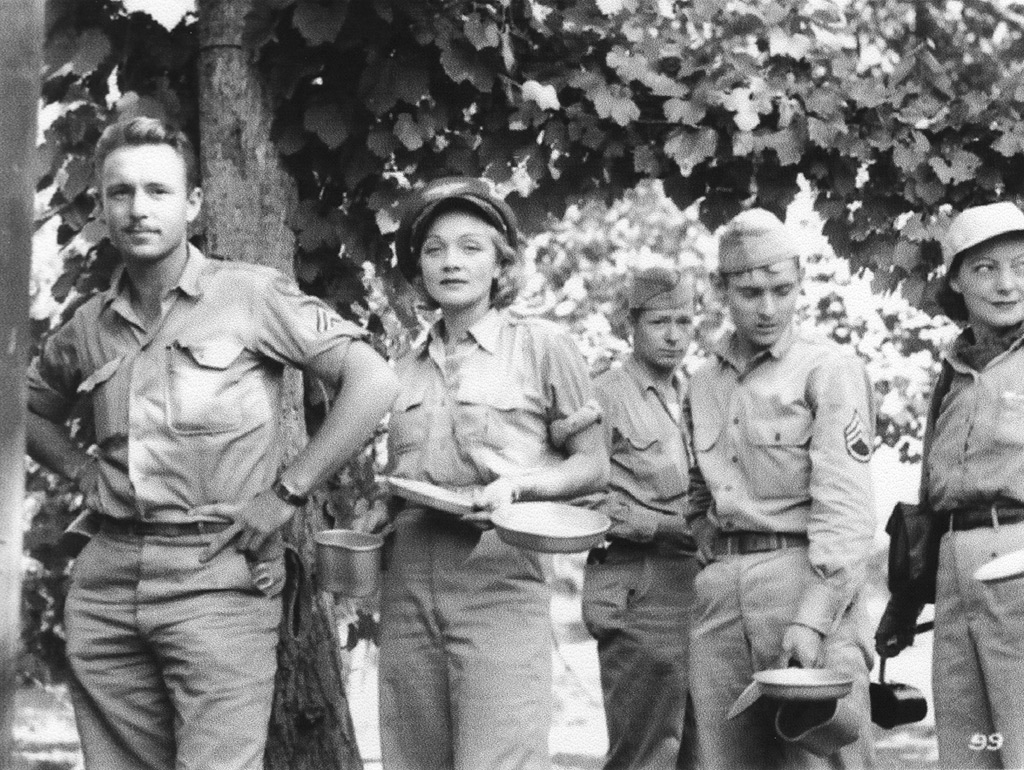
For her valiant, extraordinary wartime service, the U.S. government awarded Dietrich the Medal of Freedom in 1945, which she called her proudest achievement. “There’s something about an American soldier you can’t explain,” she later recalled. “They’re so grateful for anything, even a film actress coming to see them.”
Buy Your Christmas War Bonds from Bette Davis!
I’m borderline-obsessed with the way Hollywood threw itself body and soul into the cause during World War II. I can’t get enough of stories of the Hollywood Canteen, the bond drives, the USO shows… not to mention those who actually fought on the front lines. Here’s a little war-bond short that Bette Davis (who would go on to co-found the Canteen with John Garfield) filmed at Christmastime 1943.
I love how, when we cut to Bette in her dressing room, her hair looks all fabulous and wild and Bette-ish, after being bound and gagged within an inch of its life when she was playing the mother. And how the kids come around… but not completely. You get the feeling they still think Mom could have finagled the war bonds and the dolls and bicycles. It was thoughtful of the screenwriter not to get moviegoers’ hopes up about how this little chat, however essential it was, would go over with their own kids…
I once watched this short on TCM with my extremely dramatic Aunt Ruth, whom you may remember from her heart-stopping encounter with Van Johnson. There’s Bette on the TV screen, talking about how the bonds would help the soldiers who were wounded on the battlefield, and Ruth gets all ashen and says, “That happened to your mother and me.” Really? She and my Mom fought in WWII? Because that seemed like something I really would have heard about. And I could have sworn they were both wearing Catholic school uniforms, not khakis, back then. “No,” she recalled, reliving the trauma like it was an hour ago. “We got war bonds… instead of gifts.” Knowing how my grandmother doted on them, this seemed even harder to believe than that they were grizzled combat veterans. “Yes but it was for a good cause, so you really didn’t mind not getting anything, right?” I asked her. “Oh we got things,” she conceded. “But some things, we didn’t get. Because of the war bonds.” This was roughly fifty years later, and she could barely fight off the tears. Somewhere back there, in a store in the 1940s, there’s a thing that Ruth should have gotten for Christmas except for those damned Axis dirtbags! Oh, the horror, the horror…
Baking with Marlene Dietrich! Here’s Her Easy Chocolate Cake
Looking for a chocolate cake that’s so easy it will have you falling in love again with baking? Here’s a recipe from one of my favorite books, Marlene Dietrich’s ABCs. Which isn’t exactly a cookbook. It’s more like a quiet conversation off in the corner of the room with your impossibly glamorous favorite aunt who you can’t even believe is your mother’s sister—the one the whole family talks about all the time, and not always so nicely.
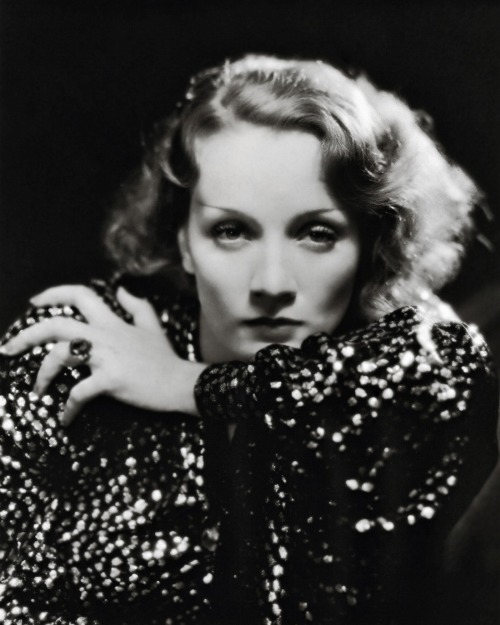

But Marlene was a homebody at heart; her lover, Jean Gabin, once complained, “She’s always scrubbing and cleaning!” One night at the Hollywood Canteen, Van Johnson watched the legendary diva work herself up to something close to ecstasy while washing dishes. When he told her how surprised he was, she growled, “I’m a hausfrau, a cook—not that sequined clown you see on the stage!”
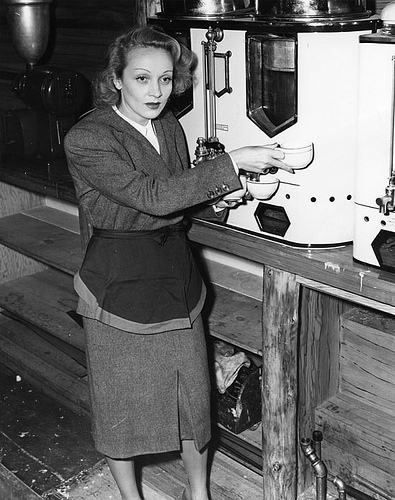
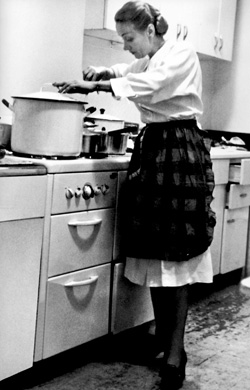
Well alrighty then! And just to prove it, here’s her fabulously simple recipe for chocolate cake:
2 squares unsweetened chocolate
1 cup sugar
2 eggs
1/4 cup sweetened butter
2/3 cups twice-sifted flour
1 tablespoon rum (plus some for the cook)
1 teaspoon baking powder
Melt chocolate and butter in a double boiler; remove from heat and add rum, beat in sugar, gently fold in eggs. Then gently fold in flour and baking powder. Pour into a buttered aluminum pie pan; let it rest (so dramatic!) for half an hour. Then bake at 375 for 35 minutes or so. That’s what the recipe says, but I usually take it out as soon as a toothpick comes out clean, which is generally about 30 minutes. The rum for the cook is my own little twist…
Marlene’s book has a few other recipes in it as well. My favorite is the one for moss, which starts out with… moss. Basically you take moss, and add water, and get lots more moss. Hey, Garbo’s not gonna tell you that! Just get the book, though. It’s fabulous. You will find yourself turning to Aunt Marlene over and over again, with burning questions such as what to do with extra egg whites. (Two words: hand treatment.)
Enjoy! Now I must get in touch with my inner Dietrich and scrub the floors…
Make Merry with Myrna Loy’s Cheese Puffs!
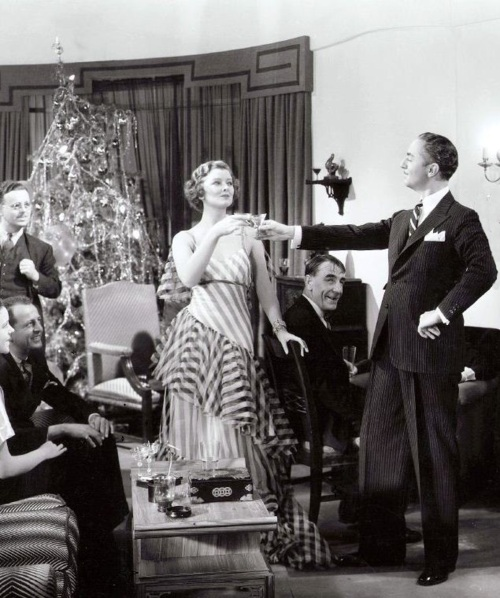
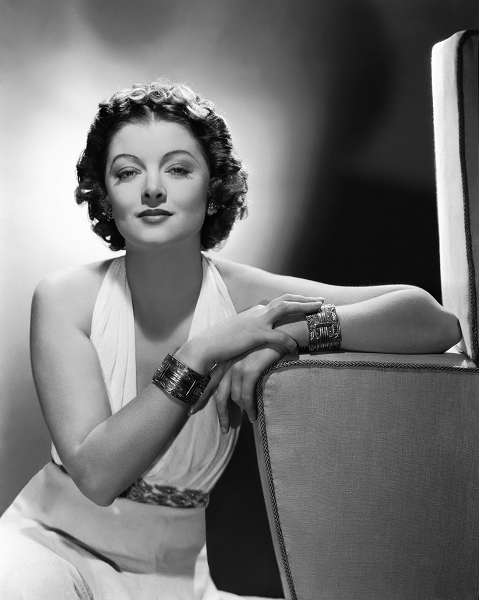
“Some perfect wife I am. I’ve been married four times, divorced four times, have no children, and can’t boil an egg.” — Myrna Loy, who was perfect.



Okay so if boiling eggs is your thing, maybe Myrna’s not your girl. But oh my God, check out her cheese puffs (you’ll pardon the expression)! If you’re looking for fabulous hors d’oevres, look no further. And if your guests don’t gobble these up, they should be shot five times in the tabloids.
Myrna Loy’s Cheese Puffs:
Ingredients:
1/2 cup mayonnaise
2/3 cup Swiss or aged cheddar cheese
1/4 cup chopped fresh green onion, chives or leeks
1 tsp. worcestershire sauce, or tabasco or chile sauce if you like it hotter
2 stiffly beaten egg whites
Freshly ground black pepper, to taste
Optional: 1/4 cup finely chopped bell pepper, for a fabulous bit of crunch
8 slices hearty brown bread, such as pumpernickel or rye, cut into squares of about two inches or so
Directions:
Set oven to broil.
In a medium-sized mixing bowl, combine all ingredients but the egg whites and bread. Mix well, and then gently fold in the egg whites.
Spoon an equal amount of the mixture onto each of the squares of bread. Place on a nonstick baking sheet (not a greased one or you’ll end up with a gooey, if tasty, mess), and put them under the broiler until the topping has puffed up and turned light brown. This will generally take about three to four minutes, but check frequently, as cheese puffs are fragile things and easily burned.
Serve immediately, as they will “puff down” as quickly as they puffed up.
Enjoy!! And Cheers from Myrna, Bill and me!
Please Join Us for the “Contrary to Popular Opinion” Blogathon!


This isn’t about plugging obscure movies or people, though heaven knows we’ve all got a few of those up our sleeves. And it’s not about quibbling over who or what deserved an Oscar, or complaining that a good film is nevertheless overexposed. Yes, we know, none of us ever needs to see another Casablanca coffee mug—but if you genuinely loathe the movie itself, then go to town!


So go ahead! Say Guy Madison never got the acting props he deserved. Or that Louise Brooks sets your teeth on edge. Praise Cimarron to the skies. Heckle Bambi. Give Kitten with a Whip the critical raves it’s been denied.

A few ground rules
What you need to do: Just tell us your movie, performer or director of choice.
Once your choice is accepted, grab a banner, create a link to this post out of it, and display it proudly on your site!
When you write your post, please include one of the banners at the top or the bottom, with a link to the blogathon post I’ll be putting up here at Sister Celluloid on January 16, which will be updated as entries pour in on January 17 and 18. And add this brief description: “This post is part of the Contrary to Popular Opinion Blogathon, where we set the consensus on its head by defending a maligned film, performer or director or toppling a beloved one!”
We will not be assigning days, so post your review on either day. Then, after you’ve posted, copy the URL into the comments section of the post I’ll be publishing on January 16, and I’ll put your link into the post. Easy!


Here’s the roster so far:
Sister Celluloid The Women (anti)
Movies Silently The Godless Girl (pro)
Critica Retro Marilyn Monroe (anti)
Girls Do Film Federico Fellini (anti)
Moon in Gemini Jezebel (anti)
Hitchcock’s World Desk Set (anti)
Silent-ology Pandora’s Box (anti)
The Movie Rat Song of the South (pro)
Now Voyaging Dr. Zhivago (anti)
Cary Grant Won’t Eat You Some Like It Hot (anti)
Movie Movie Blog Blog Monsieur Verdoux (anti)
Vienna’s Classic Hollywood The Train Robbers (pro)
The All Things Kevyn Entertainment Network Lawrence of Arabia (anti)
Silver Screenings The Postman Always Rings Twice (anti)
Writer’s Rest Arsenic and Old Lace (pro)
Classic Reel Girl The Band Wagon (anti)
Speakeasy Kiss Me Deadly (anti)
Caftan Woman Christmas in Connecticut (anti)
Mildred’s Fatburgers Best Foot Forward (pro)
MovieFanFare Dr. Jekyll and Mr. Hyde, 1941 (pro)
CJC Leach Gone With the Wind (anti)
Margaret Perry Doris Day (anti)
Second Sight Cinema Stella Dallas (anti)
Pettibloggery The Night They Raided Minsky’s (pro)

December 1931: Frankenstein Takes Manhattan!
Eighty-three years ago this week, on a stormy December night in 1931, James Whale’s Frankenstein came ali-i-i-ve at the Mayfair Theatre in New York City—pulling in a record-breaking 76,360 fans in the first week alone. According to the NY Times‘ rave review, “the stirring grand giugnol type of picture aroused so much excitement that many in the audience laughed to cover their true feelings.” The film opened to wider release a few days later, with equally eye-popping numbers at the box office.
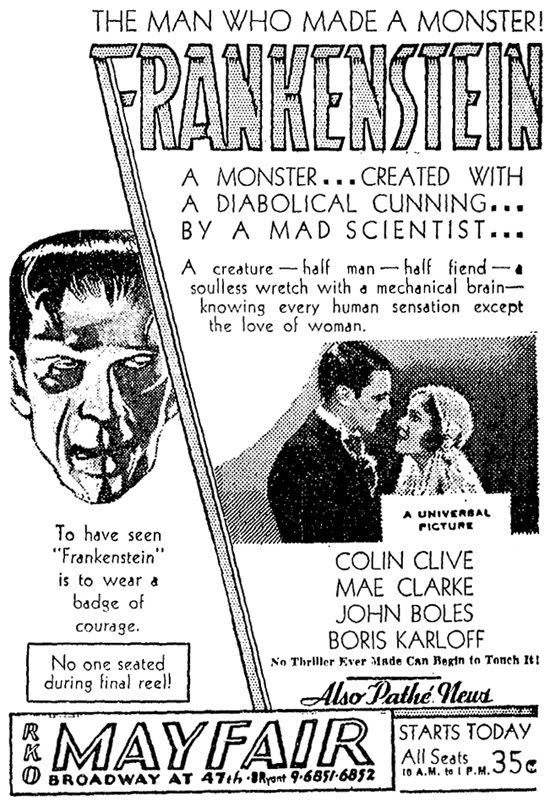
The good doctor himself, Colin Clive, had already sailed back to England by then, but not before giving the Times an interview in which he praised the movie for remaining faithful to the book by killing off his character at the end. He found it refreshing that the producers didn’t opt to have the leading man and his ladylove “clasped in each other’s arms” at the fade-out…
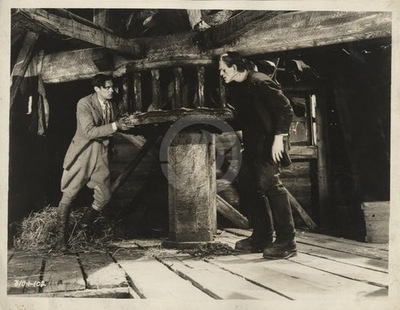
Little did he know that, after preview audiences hated the ending in which Dr. Frankenstein was killed by his creation, the studio re-shot it—over Whale’s violent objections—with stand-ins for both Clive and Mae Clarke clasping each other quite nicely, thank you. (Robert Livingston, who went on to be a semi-successful Western actor, reportedly subbed for Clive.)
Much to Whale’s frustration, the same thing happened with The Bride of Frankenstein: Clive was supposed to be blown up by the monster at the end, but preview audiences rebelled, and Universal gave him yet another reprieve. By then, however, the disgusted director had moved on to his next project, and the studio never bothered to re-shoot the final few frames. So in my screencaps below, you can clearly see Clive still pinned to the left wall of the tower even after he is seen escaping into the arms of Elizabeth (Valerie Hobson):


Such was the fate of Dr. Frankenstein when played by the fabulous Colin Clive. Sure, he created a monster that terrorized a town and killed a few folks, but lordy, those eyes, those cheekbones! And he and Elizabeth—they’re so darn cute together! What are a few bodies in the face of true romance?
What’s Your “Green Eggs and Ham” Movie?
Has there ever been a movie you’ve avoided every time it was on, sure it wasn’t your cup of tea, and then bam! You finally watched it and fell in love?
It happened to me recently with Lassie Come Home. For some silly reason I always thought it would be a bit on the clichéd and maudlin side, so although it was on pretty much constantly, I managed to sidestep it every time. For decades. And the weirdest part is I love dogs to pieces. I’ve had them all my life. And I’m on the board of directors of my local animal sanctuary.
Well the last time it was on, I sat down and watched it. Afterward, as I mopped the tears from my face, one thought ran through my mind:
What the hell was wrong with me all these years?

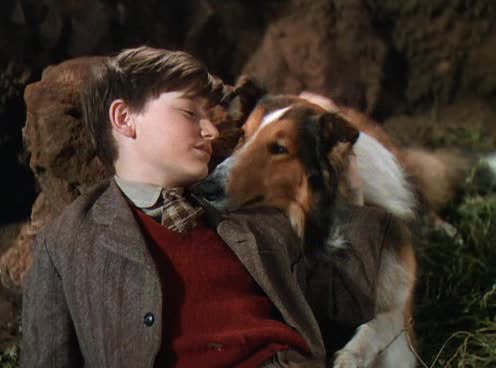
I mean you’ve got the beautiful, soulful Lassie, played by an amazing collie named Pal, and to say he seems almost human is frankly an insult to dogs. He’s absolutely transcendent. Add a supporting cast of Donald Crisp, Elsa Lanchester, Nigel Bruce, Dame May Whitty and Edmund Gwenn, any of whom I would hang out with any time, anywhere, in any movie. And of course Roddy McDowall and Elizabeth Taylor, two of the oldest souls ever seen on film. Okay I really need to say it again:
What the hell was wrong with me?
My only real gripe is that at in one scene, a small, beloved dog is killed, which pretty much made the next few minutes a total sobfest for me, so don’t ask me to recount that part of the plot. Also I couldn’t understand how Joe’s parents could sell his dog in the first place, since my parents would have moved us all into a storage locker before they would have sent my dog away. Of course if Joe’s folks hadn’t sold Lassie, there would have been no storyline, so there’s that.
Anyway, here’s my question: What’s your “Green Eggs and Ham” movie? What movie did you finally watch after avoiding for years, and fall in love (or at least in like) with? Please let us know in Comments!
 Sister Celluloid
Recent Comments