How Alice Adams Rescued Katharine Hepburn
On the surface, Katharine Hepburn seems to have little in common with the working-class heroine of Alice Adams, a fumbling, insecure Midwestern girl longing to rise above her roots and rejected at almost every turn. But at the time she took the role, Hepburn could empathize with Alice much more deeply than she may have wished.
After winning an Oscar for 1933’s Morning Glory, Hepburn was trapped in a series of dismal flops that threatened to derail her career. In Spitfire, she was comically miscast as Trigger Hicks, a faith-healing hillbilly. (If you’ve ever wondered how a Bryn Mawr girl says, “I’d better go rustle up some vittles,” this is your chance.) In Break of Hearts, she and Charles Boyer generated about as much electricity as a fuzzy slipper on a shag carpet. And in The Little Minister, she played a noblewoman disguised as a gypsy in mid-19th-century Scotland. (No really.) Hepburn initially rejected that last one—and who can blame her—but was talked into it by her agent and then-lover, Leland Hayward. They broke up soon after.
When Hepburn briefly fled Hollywood for the theater—where she had once felt so at home—the results were even worse. Her stint on Broadway, starring in The Lake, inspired Dorothy Parker’s famous quip, “She runs the gamut of emotions from A to B.” And that was one of the kinder comments. She returned to California with little of the self-assurance she had when she first stepped off the train just a few years earlier.
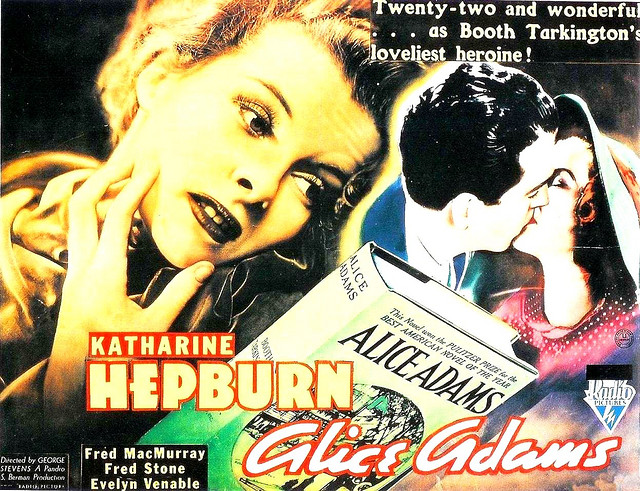
By the time Alice Adams came calling in the spring of 1935, Hepburn was reeling from the first bout of failure and rejection she’d ever known, and craving acceptance as much as the film’s heroine was. She also longed for the safety and security of her friend George Cukor at the helm, but he was directing David Copperfield and suggested either William Wyler or George Stevens.
Wyler was already a name, but Stevens, while a respected cinematographer, had directed only a handful of feature films. So he set about charming the actress, who openly preferred his competitor. “Now what George said to me I don’t know, but I’m sure it was something like, ‘I think you’re the most fascinating, thrilling person in the world and I want to work with you,’” Hepburn laughed in an interview years later. She was growing fond of Stevens, but still had her eye on the prestigious Wyler.
Exasperated and anxious to get started, RKO producer Pandro S. Berman finally suggested they flip a coin to see which man would do the directing honors. “It came up Wyler,” he recalled. “And I looked at her and she looked a little bit disappointed. And I said, ‘How about again?’ and she said ‘Okay!’” The second flip sealed it for Stevens, whom Hepburn often credited with warming up her somewhat chilly persona by encouraging her to reveal a more vulnerable side she’d always been reluctant to expose. (They’d team up twice more, for Quality Street and Woman of the Year.)
(Watch Hepburn and Berman discuss Alice Adams here.)

Based on Booth Tarkington’s 1922 novel, Alice Adams centers on a factory worker’s daughter and her desperate attempts to rise through the ranks of small-town society. Hepburn’s nervous mannerisms suit Alice like a second skin, as she flutters frantically through the local country-club ball in her shopworn gown, clutching a poesy of purloined violets picked from a nearby garden. There she meets the well-heeled Arthur Russell (Fred MacMurray), who is charmed by her gaiety even as he glimpses the tender, fearful girl beneath the facade. MacMurray is not given an awful lot to do, and he does it beautifully. Like all of Hepburn’s best leading men, he stays solidly rooted to the ground as she flies and frets around him. (He’s also a seriously underappreciated hottie.)
When Alice finally agrees to let Arthur meet her family, the results are beyond disastrous. On a beastly-hot night, Alice and her parents (Ann Shoemaker and Fred Stone) are totted up in formal evening wear, while Arthur arrives in a simple jacket and tie. When they try to tuck into a crushingly heavy meal more suitable for Thanksgiving than mid-summer, Alice attempts to deflect the blame for the unfolding nightmare onto Malena (Hattie McDaniel), the maid they’ve hired for the evening. “Perhaps we should change le domestique, n’est-ce pas?” she coos nervously. “Excruciating” is an overused word, but here it may be an understatement. It’s actually physically difficult to watch this scene without balling up into knots inside; only Stevens’ carefully orchestrated touches of comic relief—including McDaniel’s aggressively droopy lace cap, Stone’s popping shirt buttons and a runaway Brussels sprout—make it at all bearable.
As they all settle awkwardly into their after-dinner cordials, Alice’s brother Walter (Frank Albertson) returns home with news of his latest and worst embarrassment: he’s been caught embezzling money from the plant where both he and his father work, and he may be arrested. And suddenly what had merely been a dreadful dinner party morphs into a loud and messy family meltdown.

Aware of just how awful the evening has been, Alice ushers Arthur to the front porch to bid him goodnight, all but certain it’s goodbye. Still clinging to her composure but clearly devastated, she tells him she knows he won’t come calling again. But Arthur assures her, somewhat weakly, that he’ll be back. As he disappears down the street, she reluctantly retreats to the tawdry, tumultuous domestic drama still playing out upstairs. Finally, heartbroken and overwhelmed, she breaks away and turns her face to the window, where her tears meld with the rain outside. (And those are real tears: In a rare moment of disharmony with one of her favorite directors, Hepburn wanted to throw herself onto the bed instead. She and Stevens argued bitterly about it until Hepburn gave in and began to cry—at which point he yelled, “Action!”)
The original script ended with Arthur returning to the porch to comfort Alice, declaring his love and reassuring her that nothing has changed. That was a sharp detour from the novel, which sent him scurrying politely for the door, never to return. (Poor Tarkington: RKO could never leave his bleak finales alone. A few years later, much to Orson Welles’ fury, they tacked a chirpy postscript onto The Magnificent Ambersons.) Hepburn and Stevens sought to leave it ambivalent, letting viewers decide for themselves whether the fragile romance would survive after the screen faded to black. But Berman believed that anything less than a happy ending would alienate the audience, and enlisted Cukor to plead his case with the director and star. Ultimately he won.

Aside from the ending, Alice Adams remained fairly faithful to the book and generally won praise from the critics. “What was in 1922 a shrewd and observant novel emerges in 1935 as a portrait of an era, uproariously funny and perceptive,” gushed James Agee, who was hardly a pushover. Audiences liked it too, boosting the box office for RKO. Hepburn’s losing streak—perilously long by Hollywood standards—was finally over.
Both the film and Hepburn got Oscar nods, but Mutiny on the Bounty captured Best Picture honors while Bette Davis won for Best Actress in Dangerous. Still, more than once, Davis said Hepburn should have taken home the trophy. She felt her victory was compensation for being snubbed, without so much as a nomination, for her riveting turn as the vicious, savage Mildred in Of Human Bondage a year earlier.
Not to worry, though: Hepburn would go on to win three more Academy Awards. And from 1935 on, she would carry the yearning, vulnerable spirit of Alice Adams with her through every part she played.
For Sighing Out Loud, and Other Tales from the TCM Festival
Ah, popcorn for breakfast, Milk Duds for lunch and french fries and Coke for dinner. I must be at a film festival! But these essential food groups balance each other out nicely: I’d bounce off the walls from the sugar if I weren’t so bloated from the salt.
This was my third trip to the TCM Classic Film Festival, and I’ve made friends I can resume conversations with in mid-sentence after eleven and a half months apart. It’s kind of like Same Time, Next Year without the sex.
Here are some highlights from the four-day event:
MARGARET O’BRIEN: She came for Meet Me in St. Louis—and stayed to meet pretty much everybody.
Introducing the film at Grauman’s, O’Brien began by dispelling one of the persistent myths surrounding the famous scene where she sobs into the arms of Judy Garland, who comforts her by singing Have Yourself a Merry Little Christmas.
“That rumor, it’s out there everywhere—that to get me to cry, my mother told me my dog was hit by a car or something like that,” she said, rolling her eyes to the rafters. “Well she would never do anything like that. And anyway, what she did do was much more effective.”

It seems that June Allyson and O’Brien were known around the MGM lot as “the sob sisters” for their ability to cry on cue. But O’Brien was having such fun making the movie that in take after take, the tears just refused to fall: “My mother took me aside and said, ‘Now honey, don’t worry, they can just use glycerin drops if you can’t cry. But you know, June would be able to make real tears.’ And that made me burst out crying!”
She also recalled how Garland, whom she still calls her big sister, refused to sing some of Hugh Martin’s initial lyrics, which included such peppy sentiments as “Have yourself a merry little Christmas/It may be your last/Next year we may all be living in the past…”
“Judy said—and she was right of course—that they were too depressing!” O’Brien laughed. “She told Hugh, ‘I would never say things like that to her when she’s already so upset!’” And with a few minor tweaks, the Yuletide was gay and all their troubles would be miles away…
O’Brien spent much of the weekend popping in and out of Festival venues, chatting cozily with fans in the leather banquettes of the Hollywood Roosevelt lobby and generally flitting about like the sprite she still is. It was thrilling and exhausting just watching her.
Not so fun, though, was seeing people rudely shove all manner of memorabilia into her face for her to sign. She clearly loved connecting with the crowds, but was probably getting dizzy from the Sharpie fumes. In the Roosevelt lobby bar, I saw one woman—who is notoriously pushy—stick the sheet music from Meet Me in St. Louis right under her nose, the way you might force smelling salts on a swooning matron. Yeesh. I mean really?!?
SUNDAY IN NEW YORK: You know all those ‘60s sex farces that make you cringe when you see them now? This isn’t one of them. Sunday in New York is somehow completely of its time and thoroughly modern. It’s got “‘60s” written all over it, from Jane Fonda’s fabulous Orry-Kelly fashions to the streamlined sets to the bouncy, jazzy score by Peter Nero. But Fonda and Rod Taylor are so at ease, so natural, that there’s nothing dated about it at all. In 1963, Fonda was just finding her footing as an actress, so the role of Eileen—a bit baffled and naive, a touch rebellious and a little neurotic around the edges—was a great fit. (And if her decades of drama—on and off the screen—have made you forget how funny she is, this movie is a delightful reminder.) And Taylor, without an ounce of effort, is pretty much the perfect guy: smart, strong, witty, gorgeous and absolutely honorable. (The film’s one false note, for me, was that his sometime girlfriend back home would ever have let him out of her sight.)

I’d been lobbying TCM to show this film since 2011, so I had my nose pressed up against the multiplex early that morning. Then, before the houselights dimmed, my friends Kay, Kathy and I gave in to the giddiness of our semi-sleepless weekend and had kind of a mini-pajama party—swaying in our seats and beltin’ out the movie’s songs like lounge lizards: “New York on Sundaaaay… big city takin’ a nap…” and “Hellooo… what sweet magic brought you my way…” Somewhere, Mr. Nero’s ears were bleeding.
A woman sitting behind us, who’ll be played by Margaret Dumont in the movie version, clucked, “I hope you’re not going to be doing this during the movie.” I pointed to the still-blank screen and assured her that we were religiously quiet during films. But then in the last scene, when Rod Taylor is gazing up at Jane Fonda and clutching a (very lucky) pillow, I couldn’t help myself. I broke down and sighed. And yes, she shushed me for it.
By the way, if you’re ever looking for the restaurant where Taylor and Fonda discuss the damages after her boutonniere snags on his jacket, it’s now the Rock Center Café—and it looks much as it did 50 years ago. On the other hand, you can ride the Fifth Avenue bus until you’re begging for Dramamine and you won’t end up pinned to someone like Rod Taylor. (Not that there is anyone like him.)
MARY POPPINS: Before the film began, “the Mightiest of the Mighty Wurlitzers” rose from the stage of El Capitan, the wildly ornate movie palace that opened in 1926 as “Hollywood’s First Home of Spoken Drama” and hosted the premiere of Citizen Kane fifteen years later. Organist Rob Richards gently pumped and pedaled through every lovely song in the score, and then the red velvet curtains opened to reveal a vision of long-ago London through a soft blue-green mist…

I have to admit I quietly sniffled through much of the movie, and from what I heard around me, so did a lot of other alleged grown-ups. Mary Poppins was the first film I ever saw in a theater, and the soundtrack was the first album I ever owned. I played it over and over, morning till night, start to finish. I’m guessing that at some point after its hundredth spin around the ol’ turntable, Mom and Dad discovered that a spoonful of sugar also helps the vodka go down. But it’s still a great score, and a wonderful movie. Especially in El Capitan.
WILLIAM FRIEDKIN’S BOOK SIGNING: As he signed his autobiography, The Friedkin Connection, the director chatted happily with everybody, posed for photos, and set up a few shots himself. (“No, you sit down, here, like you’re signing, and I’ll stand behind you!”) He even slogged through retakes if people were unhappy with the initial results staring back at them from their smartphones. When I got up to the table, I told him I come from a Brooklyn-Irish family of cops and firemen who said “The French Connection” was the most realistic movie they’d ever seen. “That really means a lot to me,” he beamed, and signed my book, “For Janet, from a family of The Finest, with my very best wishes, William Friedkin.” What a lovely man. If you get down to the Hollywood Roosevelt fast enough, you may still be able to catch him, patiently posing for that perfect shot…
But wait, there’s more! Click on the Festivals/Events tab for stories on Eddie Muller’s fabulous interview with Friedkin and the screening of the director’s long-lost classic, Sorcerer; Kim Novak’s epic takedown of the online bullies who attacked her after the Oscars; Maureen O’Hara’s emotional appearance at How Green Was My Valley; and Shirley Jones recounting her Hollywood fairy tale career and dishing about Sinatra at the world premiere of the restoration of Oklahoma!
The TCM Classic Film Festival: Friedkin Reminisces and Reclaims the Spotlight
The official theme of this year’s TCM Classic Film Festival was Family—which, for some, meant coming home: actors and films that had been dissed and dismissed finally felt the warmth of the spotlight and the embrace of appreciative crowds.
Director William Friedkin was on hand to introduce his 1977 film Sorcerer, which, in its original release, was swamped by the Star Wars juggernaut and saddled with a title that implied it might be a supernatural follow-up to The Exorcist, which it resembled not in the least. “It opened right here at Grauman’s,” Friedkin told the packed house, “and closed a week later.” But all of that was forgotten as he invited some of the people who worked on the film, including screenwriter Walon Green (The Wild Bunch), up onto the stage to share the moment with him. The evening suddenly took on the feel of an awards ceremony, with the coveted prize being long-overdue recognition for a brilliant film—and nary a Wookie in sight.
Having seen The Wages of Fear, on which Sorcerer was based, I knew it would be heavy going, but I was so excited to see a “new” Friedkin film, especially one starring Roy Scheider. Still, watching it play out on the four-story-high screen was truly harrowing. I’m pretty sure I left my fingernail marks in the armrests—and maybe in the arm of the poor guy sitting next to me. In typical Friedkin fashion, he had us worried sick about deeply flawed and even criminal characters, including a terrorist, an embezzler and an armed robber. Warner Home Video has just released a restored print; I wouldn’t recommend it to the faint of heart, but for everyone else, arm yourself with a fistful of Valium and hang on for an unforgettable ride.

Earlier in the Festival, Friedkin had spent a fabulous hour at Club TCM with Eddie Muller, President and Founder of the Film Noir Foundation (and now a TCM contributor—hooray!). And when you pair an interviewer like Muller with a storyteller like Friedkin, an hour blows by in about fifteen seconds.
(Check out a brief clip here: http://filmfestival.tcm.com/about/video-gallery/video/william-friedkin-club-tcm/?display=friday-videos)
Admitting he still feels a bit guilty, Friedkin recalled how the legendary chase scenes in The French Connection put some of the cast and crew and even a few bystanders in mortal jeopardy. “Back then there were no computer special effects,” he said. “We actually had to do all that stuff. People could easily have been hurt or killed.”
“The same with The Exorcist,” he added, as if to lighten the mood. “That scene with Regan’s head spinning around? We went through, like, fifteen girls for that! We had another ten standing by but fortunately we didn’t have to use them.”
The one girl they really did use was extraordinary. “We looked at maybe hundreds of girls,” recalled Friedkin. “But we couldn’t find anyone who was as young as Regan is supposed to be who could handle the material, which was very intense.” Then in walked 12-year-old Linda Blair, with her mother. “I asked her if she knew what Regan does in the story,” he said, “and she told me she yells at her mother, curses at a priest and masturbates with a crucifix. I asked her if she knew what that meant and she said, ‘It’s like jerking off, isn’t it?’ And her mother is standing there nodding and smiling…”
Muller pointed out that Blair was one of several actors, including Roy Scheider, Gene Hackman, Ellen Burstyn and Jason Miller, that Friedkin directed in breakthrough performances. “To me, maybe seventy percent of the success of the film is due to the casting—at least that,” he responded. “The cast is the most important detail after the script. And the director is somewhere down the line there as an interpreter.”
Friedkin worked especially closely with Blair. “I would find out from her what it was that made her happy or unhappy or scared… and I would draw on those things to get a performance out of her,” he explained. “The thing that made her the saddest at that point in her life was losing her grandfather… and I would just suggest that to her before she did a scene, and she would go out and produce the proper emotion. Or something that made her happy, like a chocolate milkshake. I do that with all the actors I work with… it’s called sense memory. With Gene Hackman it sure as hell wasn’t a chocolate milkshake.”
Jason Miller, the Pulitzer Prize-winning playwright of That Championship Season, sought out Friedkin and pressed him for a chance to play Father Damien Karras in The Exorcist. Miller, barely a journeyman actor at that point, was raised in a family steeped in Catholicism and had once considered the priesthood, but was now plagued by doubts. He insisted to Friedkin, “I am that man.” The director told him they’d already signed another actor for the role, but eventually gave in and tested the relentless Miller, who was right: He was Father Karras. “We felt bad about it, but we had to let the other actor go and pay off his contract,” Friedkin recalled.
So naturally the film-crazed audience demanded to know, who was that other actor? “Oh come on, the guy is a still alive and still acting!” Friedkin protested. “And at the time he was already a successful stage actor.” But the crowd was relentless. “Okay I’ll give you three guesses,” he said, “And if you get it right I’ll tell you.” Just then someone called out, “Stacy Keach?” And the director nodded sheepishly, probably wishing he hadn’t promised to fess up if someone nailed it. (Evidently Keach didn’t hold a grudge; he went on to co-star in the film version of That Championship Season, directed by Miller, and acted alongside him in Exorcist author William Peter Blatty’s The Ninth Configuration.)
To close out the hour, Muller asked Friedkin how he feels about his legacy. “When I hear that word, I think about films like Citizen Kane and Breathless, the ones that influenced me,” said the director. “I really can’t think of any film that, say, The French Connection has influenced.”
Apparently the poor man hasn’t seen a cop movie since 1971.
TCM Classic Film Festival: Kim Novak Battles the Bullies
Kim Novak came to the TCM Classic Film Festival to introduce Bell Book and Candle—but when she arrived at The Egyptian Theatre on Saturday night, she had much more pressing matters on her mind. “I know you’re all here to enjoy the movie—and I love it, it’s one of my favorites,” she began haltingly, one hand clinging to the mike and the other fluttering slightly around her face. “But I want to talk about the elephant in the room.”
We leaned forward, knowing what was coming—and wishing she’d never been trampled by that marauding elephant. Novak was referring to the hate heaped upon her after her Oscar appearance, when virtual torch-wielding mobs attacked her from one end of the internet to the other, both for her looks and her slightly shaky delivery. She said she wanted to stand up to those who had bullied her—and she urged the rest of us to do the same in our own lives.
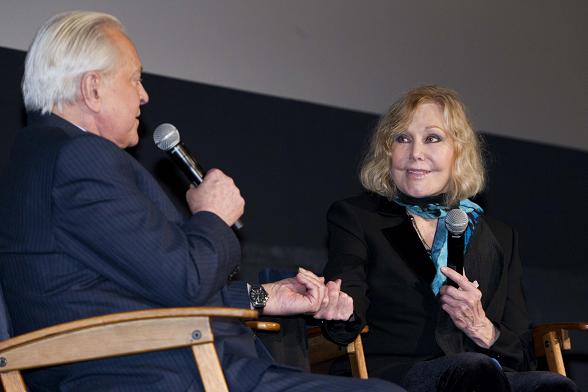
It’s impossible to see Kim Novak and not be aware of how vulnerable she is. And when she was hit by such vicious blowback, it sent her reeling—at first. “I just wanted to hide under the bedcovers,” she recalled. “But I knew I had a commitment to come here… I realized that it was important for me to address it and I told my husband, I said, ‘I’m gonna talk about it because… I’m gonna make a point that we’ve gotta stand up to these bullies.
“We have to be stronger than they are and say, ‘We’re not gonna take it any more!’” Without ever raising her voice, she was so powerful it gave me chills. Suddenly this truly fragile woman whom a breath might wither was Howard Beale in a flowing turquoise scarf and silk pants suit.
“It’s important to work out, to speak out, and to act out. Because if we keep it inside, it’s going to fester and that’s when you have problems,” she added, stretching her arms out to the audience gathered around her. “It’s healthy if you let it out. Don’t keep it inside. You can’t do that.”
Then she smiled and laughed a little, maybe a bit taken aback by the force of her own words. She turned to TCM host Robert Osborne—who clearly adores her and was hovering so protectively he almost knocked over the small table between them—and said, “We can talk about the fun things in the movie, and it was so rewarding, so great… but thanks. Thanks.”
“Well thank you! And it’s what makes you, you!” he reassured her.
“The thing that I did wrong, and you have to admit when you do something wrong… and I can admit it, it’s like confession, which is good for the soul,” Novak smiled, “and I’m gonna confess it to you guys because I feel like I’m at home with you… but when I went to the Academy Awards, I was dieting, trying to lose a few pounds before I went on, and it’s a hard audience.” (And a thoroughly unappreciative one, which stayed firmly seated when the screen icon took the stage. And let’s not even try to contemplate what kind of crowd would drive a perfectly lovely 81-year-old woman to feel the need to diet.)
“I want to do right by them, in front of them and all, that’s my toughest audience… so what I did, doggone it, is I took a pill before I went there to relax, you know?” she explained as we all nodded. “But I did it on an empty stomach, so when I got there I was kinda like, ah, in a haze, you know? And I shouldn’t have done that. I didn’t take anything bad, but it made me sort of groggy… you know, you do the wrong thing sometimes when you try too hard.
“But you’ve gotta be strong and say that you’re nervous… there’s nothing wrong with being nervous,” Novak continued. “I would have been better off coming out and saying, ‘Gee I feel nervous in front of all you guys and I wanna impress you…’”
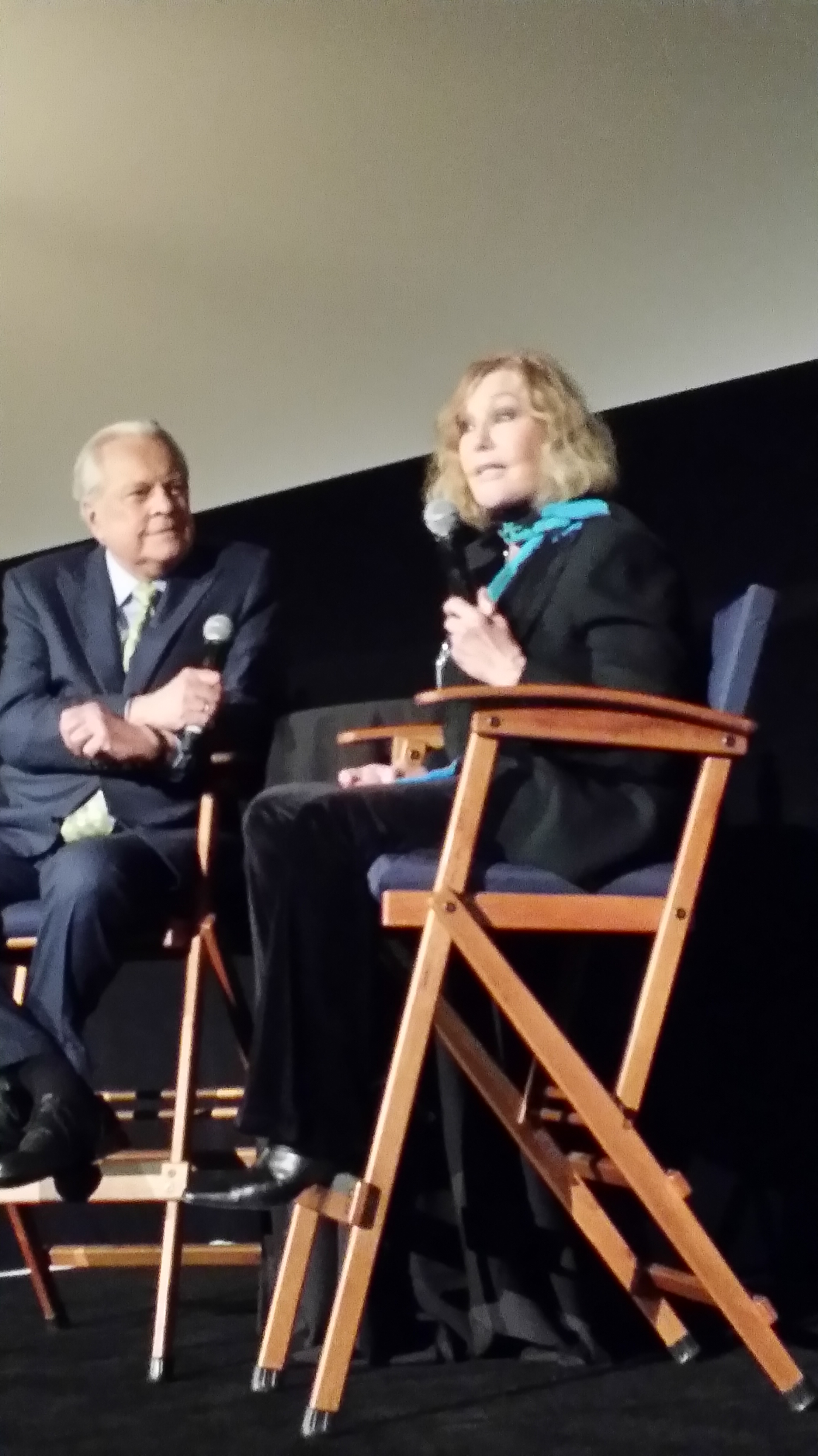
At some point I lost track of the standing ovations, whoops and cheers that washed over Kim Novak that night. What I do know is that after the Oscars, I had made up my mind that no matter what was going on opposite her at the Festival—even if they’d resurrected the cast of The Wizard of Oz—I was going to see her and cheer her on. And clearly everyone else in the full house at The Egyptian felt the same way.
On the opening night of the Festival, I had run into her in the Grauman’s Chinese Theater ladies’ lounge. (Where every woman winds up eventually. Because after a giant concession-stand soda, a lady’s nose suddenly gets awfully shiny.) I introduced myself and told her how fabulous she looked (still hoping she had not heard any of the post-Oscar nastiness) and how excited we all were that she was there. She clutched my hand in both of hers and said, “Are you coming on Saturday?” There was genuine fear in her voice, as if she were worried that no one would show up. I pulled out my program with the event circled and said, “Oh yes, at 6:15!!” She seemed so relieved, she was near tears.
Now, after that night at The Egyptian, I keep thinking of something she said as Judy in Vertigo:
“Couldn’t you like me, just me, the way I am?”
Is it okay if we love you instead?
Oh What A Beautiful Restoration! TCM and Shirley Jones Relaunch “Oklahoma!”
The Fifth Annual TCM Classic Film Festival opened with a glorious restoration of Rodgers & Hammerstein’s Oklahoma!—guaranteed to make you forget every muddy, washed out version you’ve ever seen on Sunday afternoon television. It truly looked and sounded like a whole new movie.
The print was lovingly struck from the original 65mm Todd-AO elements and screened at 30 frames per second instead of the usual 24, just as it was when the film premiered in 1955. The original 6-track soundtrack was also restored and remastered. I know little about the technical aspects of all this, but when the curtains opened at Grauman’s, and Gordon MacRae’s steed galloped through those golden fields against that azure-blue sky… Oh, what a beautiful morning!
And oh, what a Hollywood story Shirley Jones, who introduced the film with TCM host Robert Osborne, shared with the audience. Jones was named after Shirley Temple—and her road to stardom sounds like the storyline from one of the moppet’s movies. She started singing when she was a toddler, eventually training formally. “It was a gift,” she said matter-of-factly. “I thought everybody could sing like that!” Her voice teacher, who knew otherwise, convinced her to pack up her life in Pennsylvania and audition in New York City.
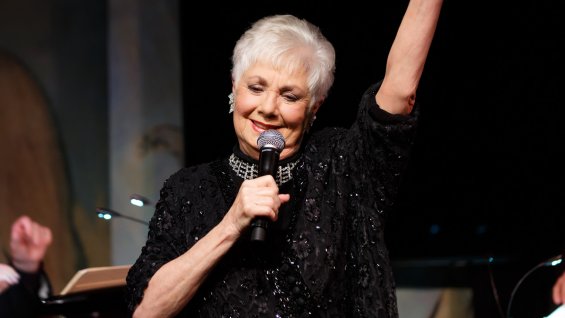
“I was eighteen, and on my way to college to become a veterinarian!” she recalled, shaking her head. But she agreed to the audition, which turned out to be with John Fearnley, a casting agent for Richard Rodgers and Oscar Hammerstein—whom Jones had never heard of. “He in turn called Mr. Rodgers in to hear me personally and he called Oscar Hammerstein to hear me personally, and that’s how it all started,” she said, letting out a startled laugh, almost as if she still can’t believe it more than 60 years later.
Eventually, after smaller roles in the pair’s Broadway productions of South Pacific and Me and Juliet, Jones beat out every Hollywood veteran who had her eye on the role of Laurey in the movie version of Oklahoma! And still, her dream was just beginning. “I used to wake up listening Gordon MacRae’s radio show every morning,” she sighed. “For me to have the opportunity to sing with him… that was very, very exciting for me.”

The following year, she starred with MacRae in Carousel—though he wasn’t the producers’ first choice. Frank Sinatra was originally signed to play Billy Bigelow, and Jones remembered how excited he was about it. “We made all of the pre-recordings, the photographs, everything,” she said. “He had told me, ‘Shirley, this is a dream come true for me—this is the best musical part for a man ever.’” And Sinatra seemed a great fit for the role of the dangerous, romantic rogue.
But then…
As Jones remembered, the cast, crew and director Henry King were gathered on the pier in Boothbay Harbor, Maine, ready to film the first scene. Because it was being shot in both 35mm and 55mm CinemaScope, two camera rigs were set up as well. All that was missing was Sinatra. Finally, the latecomer pulled up in his limo—and immediately confronted King about the dual cameras. The director told him about the two separate film processes, and Sinatra balked. “Does that mean I’ll have to shoot a scene twice?” he asked. “Perhaps sometimes,” King replied. His reaction stunned everyone. “I signed up to do one movie—not two,” and with that, Sinatra jumped back into his limo and headed for the airport, never to return.
“Henry Ephron, the producer, was frantic, almost in tears,” remembered Jones. He turned to her and asked, “Where’s Gordon MacRae?” She said he was performing a nightclub act in Lake Tahoe with his wife, Sheila.
“He asked me if I could get him on the phone,” she recalled. “Now here we are on a dock, and I have to use a pay phone, right? So he comes back with this big roll of quarters and hands them to me. I didn’t think I would get him on the phone but I did.
“I said, ‘Gordon, how would you like to play Billy Bigelow in Carousel?’” And he said, ‘Give me three days. I need to lose 10 pounds,’” she laughed.
Jones said she always wondered if Sinatra was really so offended by the prospect of potential retakes, or if there was a more pressing reason he stormed off so suddenly. But he always refused to discuss it with her. Then years later, at a press conference, a few veteran reporters cornered her and told her what they called “the real story.” They said Ava Gardner, who was then married to Sinatra, was shooting Mogambo in Africa at the time. “And she called him and said, ‘Unless you get your fanny down here, I’m going to have an affair with [Clark] Gable,’” said Jones. “And apparently that’s why he left the movie.”

Oh my God, that’s incredible! The gloriously potty-mouthed Gardner used terms like “fanny” and “have an affair”? Well, no. And as it turns out, the rest of the story those reporters told Jones couldn’t have been true either. Carousel began shooting in 1955 and Mogambo wrapped in 1953. As the cast and crew—kept awake by epic bouts of fighting and making up—could drowsily attest, Sinatra was with Gardner in Africa right from the start of filming, leaving only briefly to audition to From Here to Eternity.
So the rumor about why Sinatra left Carousel could be disproved with a five-second Google search, but that didn’t stop a lot of “journalists”—including those at Variety, Vanity Fair and the New York Post—from treating the story as the gospel truth when they wrote about Jones’ appearance at the Festival. Personally I wish she had spent less time on that and more time explaining how MacRae lost 10 pounds in three days.
Ironically, shortly after Sinatra bolted, the producers discovered a way to film scenes in 55mm and transfer them to 35mm, dramatically cutting down the need for reshooting. Oh and if you’re wondering how Sinatra and Jones might have gotten on together if he had stuck around, I found this clip of the two singing “If I Loved You” on The Frank Sinatra Show in 1958 on an obscure website (it’s well worth sitting through the loud 10-second commercial, in Russian, at the beginning):
Welcome, Classic Film Lovers!
Welcome to Sister Celluloid: Where Old Movies Go To Live! I’m so happy we found each other! Here, it’s all about classic films—and you! It’s a dialogue, not a monologue. Please take a look around, and jump in on every story that interests you. Stop by often, as I’ll be adding lots of great history, news, interviews, photos etc. And I’ll be running contests for fabulous prizes like vintage jewelry, great books and terrific DVDs and CDs! Please scroll through, dig in and pipe up! I’d love to hear from you!
TCM Classic Film Festival Flashback: Mad for Maureen O’Hara
The five words that got the most thunderous ovation at the 2014 TCM Classic Film Festival:
“Ladies and gentlemen, Maureen O’Hara!”
On the surface, at least, the woman at the center of all the fuss was having none of it. As the applause in the El Capitan Theater melded with whistles, hoots and cheers, the 93-year-old O’Hara, now visibly frail and in a wheelchair, shook her head and threw her arms out in front of her in a gesture that said emphatically, “Aw, g’wan witcha!”
“I think they like you,” said TCM host Robert Osborne, who joined her onstage to introduce How Green Was My Valley.
“They like applauding!” she laughed, her voice thick with emotion.

Osborne’s first question seemed safe enough: “So Maureen, tell us about John Ford, what he meant to you…”
But sounding every inch like Mary Kate Danaher, O’Hara turned to the audience and playfully harrumphed, “I thought I was here to talk about me!”
The chastened Osborne chuckled, made a motion to zip his lips, and tried again: “What I mean is, What did John Ford mean to Maureen O’Hara?”
“Well,” she said, softly dabbing her eyes and nose with a tissue, “I knew him and his family very well, and he’d tell us how, when there was the next call for Hell, he’d see to it that we didn’t answer. And you know, I still think about it, and I hope he still means it! But anyway, I’m still here, and I’m quite an old age now…”
“But you’re kind of ageless to us,” Osborne interrupted, as the cheers rose again.
O’Hara smiled and leaned back, letting it all wash over her. “Well, I hope that it’s true that we do live wa-a-ay beyond the years that God gives us on earth, and that way, we can have Saturday night every weekend!”
This time, the rapturous response summoned up a bit of a sermon from her. “Don’t laugh and applaud and think it means nothing,” she warned. “Believe me, God is listening all the time, and he’s listening to see if He can catch you doing something you shouldn’t be doing. And please God, every one of you will do everything you’re supposed to do better than you’re supposed to do it, and that you have a wonderful old age. And for God’s sake, don’t make fun of it!”
It’s funny how when the nuns told me stuff like this, it drove me crazy. But coming from Maureen O’Hara…
“Do you know what a gift you’ve given us by being here?” said Osborne, trying to steer the conversation in a more earthly direction.
“Well don’t be fooled into thinking I do magical things!” she protested.
“But you kinda do,” Osborne insisted. “You’ve done magical things up there on the screen…” And again, a wave of applause crested over the actress. “Well,” she said, no longer even trying to catch the tears as they fell, “now you’ve taken all my strength away.”
Which really seemed to be true. After only a few rare and lovely moments, O’Hara was losing focus, and her energy appeared to be winding down, in a way that anyone with quite elderly loved ones would recognize right away. Osborne picked up on it immediately and cut the conversation a bit shorter than perhaps it was intended to be.
It left me wondering how much the trip had taken out of her. She was determined to come, and TCM had arranged a private jet for her, taking every care to minimize the stress and strain of the journey.
And it was such a joy for us to see her. But I wonder if it was worth it for her. She was deeply moved by all the love surrounding her in that room, but I hope it didn’t come at too high a price for her to pay.
 Sister Celluloid
Recent Comments