MOMA Launches a Spectacular Series: Universal Restorations & Rediscoveries, 1928-1937
Friday the 13th just got lucky.
That’s when the Museum of Modern Art (MOMA) kicks off its fabulous series, “Universal Pictures: Restorations and Rediscoveries, 1928-1937,” which runs from May 13 through June 15.
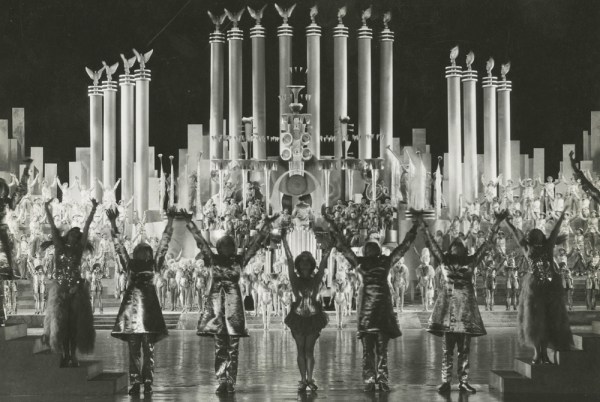
With several gorgeous prints newly struck by the studio, “this seemed a good opportunity to look at the Carl Laemmle Jr. years—which are greatly undervalued—and show how really audacious they were,” said MOMA’s adjunct film curator Dave Kehr, who pulled the program together. “He was very conscious of trying to create art, of doing something unique. He bought truly daring properties and was willing to take the kind of chances a lot of other studios weren’t.”
Derisively known as Junior—the running joke was “The son also rises”—Leammle was widely written off as merely the beneficiary of his father’s notorious nepotism. (Ogden Nash dryly observed, “Uncle Carl Laemmle/Has a very large faemmle.”)
But Junior had a vision—and a plan to see it through. “He cut the number of movies Universal produced by 40% and started focusing on pretty spectacular films he thought would enhance the image of the studio,” Kehr noted.

“In a way, he was reacting against Irving Thalberg, who’d once worked for his father and went on to create almost a production line at MGM, with a strict formula and brand,” he added. “So, for example, where Thalberg fired Erich von Stroheim and drastically cut Greed to ribbons, Junior hired avant garde directors who were considered even crazier, like Paul Fejos—who, before he made the classic Lonesome, had only made one obscure feature, in Budapest.”
Other European émigrés who found a home at Universal—as well as the freedom to spread their wings and hone their own styles—included William Wyler, a distant Laemmle cousin himself, whose A House Divided and The Good Fairy are featured in the series, and John Stahl, whose Only Yesterday—the first film adaptation of Letter from an Unknown Woman—will be shown, along with the popular Back Street and the sophisticated soaper Seed. James Whale has five films in the program, including the lush and mesmerizing The Kiss Before the Mirror and the restoration of a longer version of The Road Back—which Charles Rodgers, who replaced Junior, slashed in an effort to appease the Third Reich and retain the German film market. (Much more on the new print in a future article.)


American directors were also free to let their film flags fly—including John Ford, whose Air Mail will be screened in the series; the wildly energetic Tay Garnett, on tap with Okay, America; and the darkly brilliant Edward L. Cahn, who’ll weigh in with three films, among them his newly rediscovered masterwork, Laughter in Hell.
So much energy crackled through Junior’s brief reign—such a sense of wonder and adventure, of discovering everything movies could do and say and be—that his story deserved a fairy-tale Hollywood ending. But it got a depressingly real one: in 1936, when cost overruns on Whale’s Showboat forced Universal into the grubby hands of its creditors, the Laemmles were drummed out of the studio Carl Sr. had founded in 1912.
With this sensational series, MOMA has added an uplifting coda to the story. It’s hard to pick highlights from a program that reads like one long highlight reel, but here goes:
- The series opens with a dazzling new two-color Technicolor print of John Murray Anderson’s King of Jazz, the first time the full-length version will be seen in over 75 years. (And to give you some idea of Junior’s breadth of taste and style, he produced this film the same year he made All Quiet on the Western Front.) Ironically, the big production number is Rhapsody in Blue—and blue was the one hue Technicolor couldn’t capture. “They played around with it a lot and finally got a sort of gray-green—but if you squint, it looks blue,” laughed Kehr. “But more importantly, the production values are absolutely spectacular.”


- A major new restoration of Fejos’s Broadway, featuring the long-lost Technicolor finale. The film’s million-dollar budget shows up in every shot, as the world’s largest camera crane wends its way through the uber-Deco sets. This is another visual feast from start to finish—and don’t be surprised if your surroundings seem unbearably drab when you get home.
- I love James Whale with the fire of a thousand suns, so I’ll be there for all five of his films—The Road Back and Showboat, of course, as well as Remember Last Night?, The Kiss Before the Mirror and By Candlelight. Among them, they offer a good sampling of his strengths: long, languid tracking shots that loom in for a more intimate view, effortless sophistication, a deep humanity, and an unabashed but grown-up romanticism. The former set designer was also stylistically adventurous; when he decks out a drawing room, you want to move in. That’s especially true in the dark and sumptuous The Kiss Before the Mirror, which opens with a long, winding shot of Walter Pidgeon’s flat as he prepares for a tryst with Gloria Stuart. Walter’s never been my idea of a dream date, but I’d have an affair with him just for that apartment. The other two lesser-known titles—Remember Last Night? with a baby-faced Robert Young and By Candlelight, starring Paul Lukas as a somewhat oily leading man—are luscious confections deserving of more attention.


- Three dark, edgy dramas from Cahn: A brand-new print of Law and Order, a gangster film disguised as a western starring Walter Huston and co-written by his son John; Afraid to Talk, perhaps the most cynical crime drama of the era, where pretty much the whole town’s on the take including the district attorney; and Laughter in Hell, which opens with Pat O’Brien killing his wife and her lover and careens downhill from there. “It’s very much along the lines of La Bete Humaine,” said Kehr. “They cut the last reel because it was too much. It was so grim it pretty much ended Cahn’s career. He wound up directing the Little Rascals.”
- A House Divided. Wyler, who started at Universal as a messenger in 1923, was already a potent creative force just eight years later. Part Ibsen and part Freud with a heavy dose of Oedipus thrown in for good measure, the film stars Walter Huston as a brutal fisherman, Kent Douglass as his (what else?) sensitive son, and the fragile and luminous Helen Chandler as Huston’s mail-order bride (whom he sends for roughly 15 minutes after losing his wife). If you know Wyler mostly from his later, lusher work, this stark drama might surprise you. “Wyler was a better director before he met Sam Goldwyn,” mused Kehr. Well, certainly a grittier one: the film starts out bleak and literally descends from there, following Huston’s character to the floor when he’s laid low with a grievous injury.


- The Good Fairy. Wyler directed the studio’s biggest non-horror star, Margaret Sullavan, in Preston Sturges’s adaptation of Ferenc Molnár’s bonbon about a woman who invents a husband to protect herself from her predatory millionaire (Frank Morgan)—only to meet a struggling barrister with the same name (Herbert Marshall). This is Marshall at the height of his champagne sparkle, before he was relegated to stuffier roles. But in real life, Wyler got the girl, marrying Sullavan during the shoot.
- There’s Always Tomorrow. Later remade with Fred MacMurray and Barbara Stanwyck, this early version stars Frank Morgan as a middle-aged, neglected executive and Binnie Barnes as a former employee who’s always been in love with him. “By the early thirties, Morgan was already starting to age out of leading man roles, but he had that brief period…” said Kehr, his voice drifting off. “And he’s just incredible in this.”
- The Last Warning. German director Paul Leni helped set the style for Universal’s classic horror films, with works like The Cat and the Canary and The Man Who Laughs. His final effort, a lavish murder mystery set backstage at a Broadway play, has been digitally restored and will feature a live piano score.


- Seed was the first of what I call Stahl’s “reluctant adultery trilogy”—sure, these people are stepping out on their spouses, but they feel really, really bad about it. No Pre-Code casually-falling-into-bed romps for these folks. In Seed, the guilt-racked husband (John Boles) strays with the subtly spectacular Genevieve Tobin, and really, who can blame him? (Well, his daughter, a gaspingly young Bette Davis, for starters.) Stahl followed up with Back Street and Only Yesterday, which are also in this series. Both are terrific films, but require a high tolerance for women who drive you insane with their self-sacrifice. Honestly, you’ll want to reach through the screen and shake them, early and often.
- Little Man, What Now? Frank Borzage’s only film for Universal stars Margaret Sullavan and Douglass Montgomery (formerly Kent Douglass) as a secretly married couple struggling through the poverty of post-war Germany. The backdrop of rising militarism, though only hinted at, makes this one of the earliest American films to even allude to the Nazis. Borzage and Sullavan would later reteam at MGM for three much more highly polished affairs: Three Comrades, The Shining Hour and The Mortal Storm. But this earthier film, with the director’s classic love-over-adversity theme at its heart, shows them both at their best.


- Two early Lew Ayres films. Before he got all wholesome and earnest on us, Ayres had a bit of an edge, which is very much on display in Garnett’s breakneck-paced Okay, America, loosely based on the life and times of Walter Winchell, and Monta Bell’s Up for Murder, about a naïve young reporter who becomes entangled with his publisher’s jaded mistress (Genevieve Tobin). Both are steeped in the kind of gaudily corrupt urban stew that was something of an obsession for Junior.
Here’s the link to the entire series. If you make it there, look for me. I’ll be the woman with the wrinkled dress and mussy hair—from sleeping behind the bar at the pub across the street between films, just to make sure I don’t miss anything.
All photos courtesy of the Museum of Modern Art; all rights reserved.
Your Complete Guide to the 2016 TCM Classic Film Festival!
Ah, spring! When movie lovers’ thoughts turn to the TCM Classic Film Festival…
For the past two years, I’ve covered this fabulous fest for Sister Celluloid, and the lovely folks at TCM were kind enough to invite me again. But then, life had other plans. My Mom, who’s 86 and was already frail, recently had a bad fall, and I need to be close by in upstate New York.
Still, that won’t stop me from meddling in your life from a distance, trying to make sure you have the best trip possible. So hang onto your passes, kids, here we go…

What should I pack?
The festival is on the late side this time around—April 28 to May 1—so it’ll be pretty mild, at times even hot, out in L.A. But the nights can still get chilly, at least by California standards (mid to high 50s), so bring along a jacket, sportscoat, sweater or, as my Mom might say, “a nice wrap.” The theatres can be cold too—especially The Egyptian, where I’m pretty sure they run a side business hanging meat.
Bring comfortable shoes for hot-footing from one venue to the next and standing in line. If you’re gettin’ all dressy and sneakers simply won’t do, brands like Merrell, Ecco, Börn and Clarks have fabulous shoes you can actually walk in. But trust me, by Day Three or so, you’ll be craving comfort over couture. I’ve found it best to bring simple separates and set them off with fancy-shmancy (costume) jewelry and accessories, like great ties or scarves. It’s easier on you and your luggage, and you’ll still shine. (But then you’ll do that anyway.)
And toss in an umbrella. You know the rule: As long as you bring one, it won’t rain. But if you don’t, it will. And everyone will blame you. On the flip side, pack sunscreen and sunglasses for queuing up outside. Palm trees may sway beautifully but they don’t provide a lot of shade, so when it comes to sun protection, it’s BYOB—bring your own block. (This from a woman who once got sunburned in her own living room because the window was open and the screen wasn’t in.) And pack a tube of sports cream, in case your legs and feet get sore—but not the mentholated kind unless you want to be remembered as the festivalgoer who smelled like a giant breath mint.
And when you’re standing in line, don’t just stand. Walk a little, even from side to side, or just pick up your feet as if you’re marching. (You’re among friends; no one will think you’re weird.) Because standing still and then sitting down for hours at a time is a surefire recipe for pesky fluid build-up, which is not only unhealthy but let’s face it—cankles are not a good look for anyone. And when you get back to your room at night, sleep with your legs propped up on pillows.
This may sound obvious, but remember to pack anything you normally bring to the movies. A nearsighted friend, who only needs her glasses for films, plays and such, once left home without them and had to ask her sister to overnight them to her hotel. Which she’s never heard the end of. Lozenges or hard candies are also a must: the air in L.A. is so dry you half-expect Peter O’Toole to come riding up on a camel, and to paraphrase Miss Adelaide, a person could develop a cough. The first year I was out there, I rasped my way from opening night to the farewell party; I like to think I sounded like Dietrich, but I suspect the effect was more Andy Devine.
 Bring a light totebag to carry during the day, and fill it only with necessities. A bag that feels fine at nine in the morning could weigh you down like Jacob Marley’s chains by nightfall. (If you’re an Essential or Spotlight passholder, you’ll get a totebag as part of your swag.)
Leave a little room in your suitcase for whatever you may buy. And if you pick up, oh, say, so many movie books that you can’t fit them in your luggage—or you just don’t want to shlep home even more stuff than you left with—there’s a Fed Ex at 1440 Vine Street, off Hollywood Boulevard, and another in the Hollywood and Highland Center, at 1755 North Highland Avenue. There’s also a post office a bit farther away, at 1615 Wilcox Avenue, though when I went there one year, I literally had to wake up a guy to get packing tape.
And speaking of souvenirs, this year, the Festival gift shop will be in Sweet!, a candy store on the second level of Hollywood/Highland, rather than in the lobby of the Roosevelt.
Where and what can I eat?
My first year at the Festival, I relied on theatre concession stands for my meals and ended up so full of salt I could have passed for Lot’s Wife. Don’t do this! Just because you can eat popcorn at nine in the morning doesn’t mean you should. And, again not to nag, but steer clear of caffeine and sugar in the evening, or you’ll be too wired to sleep, which you’ll need to do after your movie marathon.
During the Festival, you’ll mostly be eating on the run or in theatres, which means you’ll need portable, quiet food. (In 2014, during Noir Czar Eddie Muller’s fabulous interview with director William Friedkin in Club TCM, the woman next to me crunched on a seemingly bottomless bag of tortilla chips, which sounded like a hydraulic drill in the otherwise pin-drop-quiet room.)
Sadly, the Fresh ‘N’ Easy supermarket, which was almost directly across from the Hollywood Roosevelt, has closed. But the same little mall, at 7021 Hollywood Boulevard, has a CVS drugstore where you can stock up on things like bottled water, string cheese, nuts, yogurt, bananas, napkins, plastic spoons and forks, etc. If you opt for sandwich wraps, get the ones without the drippy dressing, which will find its way to your shirt even in the dark. And remember to check your bag at night for any stray perishables you need to stash in the fridge. (Another lesson I learned the hard way. Thanks, yogurt-turned-science project!)

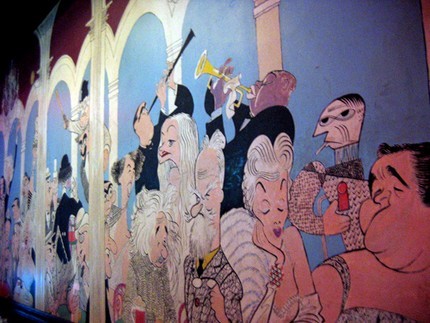
If you have a few minutes between events, the Coffee Bean and Leaf and Baja Fresh on Hollywood Boulevard offer pretty good salads and sandwiches. For a real sit-down, there are a few spots on the main drag: Miceli’s, which features a giant mural of Ol’ Blue Eyes in ironic black and white; The Pig ‘N Whistle, where classic stars dropped by for drinks after premieres at the Egyptian and Judy Garland had her 16th birthday party; the kinda dive-y Frolic Room, where you need to see Al Hirschfeld’s classic-movie mural sprawled across the wall; The Snow White Cafe, lined with scenes from Snow White and the Seven Dwarfs painted by early Disney animators; and, of course, the legendary Musso and Frank Grill, where the waiters—some of whom, like Walter and Louie, have been there since Frank and Ava dropped in—are happy to spin tales of Old Hollywood if the kitchen’s not too busy. The Hollywood and Highland Center also has a slew of restaurants (choose carefully to protect your wallet, and definitely avoid the pizza), and there’s a casual diner, 25 Degrees, tucked inside the Roosevelt.

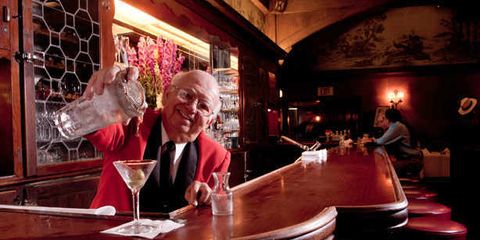
Miceli’s has a special place in my heart for this edict, enshrined in a plaque near the entrance:

So many choices on the schedule! How do I decide?
First of all, there are no bad choices. Honestly, you could let darts decide for you and you’d still have a great time. And the decisions you’re agonizing over now? Once the Festival’s over, you probably won’t even remember what you passed up, only what you chose.
But here are a few suggestions. First, circle your Must-Do’s—experiences you will never, ever get to have again. For me, especially as more and more films become available on streaming and other media, this means seeing the people who made them.
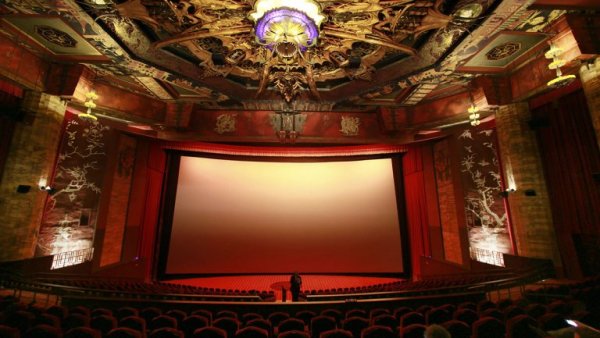
Once your Must-Do’s are set, go back and make the rest of your choices. If you’re torn between two events, close your eyes and picture yourself at each one. Which makes your heart race faster? Is one a unique opportunity? Is someone you love speaking at more than one event? That can really help winnow down your choices. And if two films are tugging at you and one’s at Grauman’s Chinese Theatre (or TCL, its official but fake name, which I’ll never use), go for that one. The screen is four stories high, and even the bathrooms are fabulous.
If this helps, in addition to the regular screenings, I always pick at least one event from each of these categories:


The Legendary Guests: I’ve sometimes opted for movies I could take or leave just because I had to see the people introducing them—as when, just months before winning her Honorary Oscar, the legendary Maureen O’Hara was at the Festival in 2014 for How Green Was My Valley, which—and I know this is heresy—I sometimes call How Long Is This Movie. (And yes, I’m now ducking the shoes being thrown at me.)
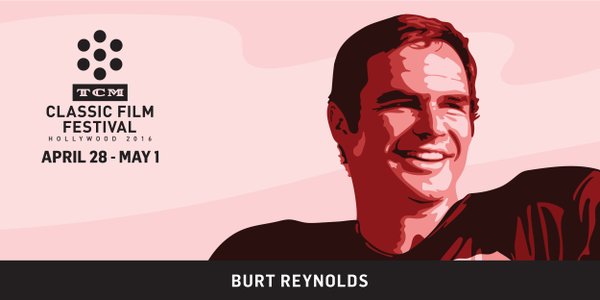
Unfortunately, Burt Reynolds—who was scheduled to chat with Muller about The Longest Yard and be the focus of the Live from the TCM Classic Film Festival segment at the Montalban Theatre—has cancelled, which isn’t an enormous surprise. Even back in 2013, when stole the show while appearing with the cast and director of Deliverance, he seemed incredibly frail. Sending lots of love and good thoughts his way, and hoping he gets stronger soon.
Another modern legend, Faye Dunaway, will be sitting down for a talk at the Montalban, to be televised next year. Still, it’s well worth going to that event in person: the set-ups and break times are fun to see up close. One year during a between-scenes touch-up, Eva Marie Saint solicited a compact from the crowd, and my friend Karen—who runs the Movie Star Makeover site and is never without one—was thrilled to oblige…


… which brings us to our next great storyteller: Saint was the subject of the Live from… interview in 2014, and I wish she were still talking. She was warm, funny, and altogether fabulous, revealing, among other things, that she once wanted to be a teacher… an ambition she kind of got to fulfill by sprinkling advice to the audience all afternoon (never give up on your dreams, use your fears, walk a lot…). This was after wowing us with her high school cheerleading moves on opening night. This year, she’ll be on hand for The Russians Are Coming. And who knows? If Carl Reiner has a minute or two free…
…he may stop by too. Illeana Douglas, no slouch as a storyteller herself, will interview Reiner for Dead Men Don’t Wear Plaid, and if you’ve read any of his books, including the latest, I Just Remembered, you know how well he spins a tale. Between the two of them, this could be the funniest segment of the Festival.
Angela Lansbury, who once brilliantly introduced The Manchurian Candidate at a TCM screening in New York, will be there for the film in Hollywood this year. When she was on hand for Gaslight in 2011, she recalled how one day she was toiling as a teenage shopgirl in Bullock’s department store, and the next day she was on a soundstage with George Cukor, Ingrid Bergman and Charles Boyer. Go see her. Not only is she a great storyteller—she’s everything you hope and dream Angela Lansbury will be, and more.


The Special Events: Every year at The Egyptian, TCM screens a silent film with a live orchestra. Fittingly, for Voices of Light: The Passion of Joan of Arc they’ve added a full choir. Line up extra-early for this one, kids. It promises to be spectacular.
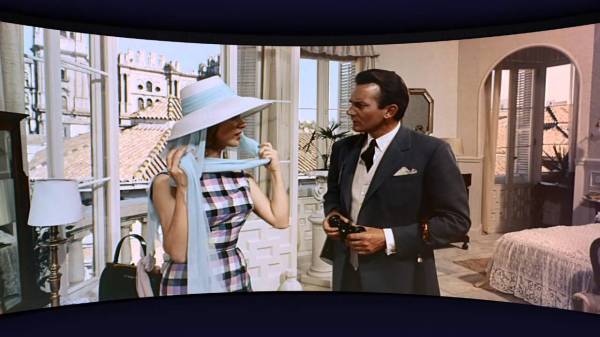
From the sublime to the unmissably ridiculous, Holiday in Spain will air at the Cinerama Dome in fabulous Smell-O-Vision! And if you’ve already spent an evening with Joan of Arc, you needn’t feel guilty about spending Sunday morning with Peter Lorre and Elizabeth Taylor in the one and only movie presented in this format—as aromas waft through the theatre to underscore certain key plot points. “First they moved, then they talked, now they smell!” trumpeted the ads when the film came out in 1960. Originally called Scent of Mystery, this is producer/showman Mike Todd (then Taylor’s husband) at his finest.
The book signings are also especially fabulous this year. Douglas, a one-woman special event, will be signing her touching, hilarious, can’t-put-down memoir I Blame Dennis Hopper, where you can hear her singular voice in every syllable. Photographer and author Mark Alan Vieira, the passionate keeper of George Hurrell’s flame, will be signing his latest luscious volume, Into The Dark: The Hidden World of Film Noir, 1941-1950. And film historian and perennial Festival favorite Cari Beauchamp will be autographing My First Time in Hollywood, where you tag along with forty movie legends as they take their first tentative steps in Tinseltown. She’ll also be talking on this topic at Club TCM, with lots of great visuals, as usual.


The Real Oldies: Ron Hutchinson, co-founder of The Vitaphone Project, will screen 11 vintage Vitaphone shorts featuring such stars as George Burns and Gracie Allen, Molly Picon, Baby Rose Marie (please let Carl Reiner show up for this!) and… get ready to hiss… Will Hays, though in this case he’s just explaining the Vitaphone process, not scolding everyone to keep their clothes on already.
And famed French film preservationist Serge Bromberg will showcase some of his greatest finds, including a collection of slapstick shorts—such as Buster Keaton’s The Blacksmith, Charles Chaplin’s The Bank and the uncut version of the legendary pie fight in Laurel and Hardy’s The Battle of the Century. Really, after that, it’s a wonder any comedian ever dared pick up a pie again.
In fact, if you ever see Ron or Serge presenting a program anywhere, run, don’t walk.


The Pre-Codes: Three of this year’s Pre-Codes are being introduced by the sons of their directors: Josef von Sternberg’s Shanghai Express by his son Nicholas, John Cromwell’s Double Harness by his actor son James, and William Wyler’s A House Divided by his son David. All are well worth seeing, though be warned that the Wyler film, which has been called Pre-Code noir, is a bit grim—and not in a fabulous noir way, but in a realistic Wyler way.
A fourth, Pleasure Cruise—starring one of my movie husbands, Roland Young, and the luminous and criminally undersung Genevieve Tobin—features a bedtime stateroom scene that may be one of the Pre-Code-iest things you’ll ever see.


How should I time everything?
When plotting your schedule, don’t plan on coming in on the middle of a film or Club TCM event, which is a no-no, as it should be. And don’t count on cutting things razor-close, scurrying from one venue to the next. In most cases, unless you have a Spotlight Pass, you’ll need to be in line at least a half-hour or so ahead of time.
The wait can be shorter at the cavernous Grauman’s, but longer at the Ricardo Montalban Theatre. Of the multiplexes, Chinese Theatre 1 is the largest at 477 seats, followed by Chinese Theatre 6 at 250 and Chinese Theatre 4 at 177. So keep that in mind when you’re figuring your odds of getting in.
 On the upside, those to-be-announced (TBA) spots on the Sunday schedule will generally be filled by films where the largest crowds were turned away. And there’s usually at least one Pre-Code in there, as they often shoehorn them into small theatres on the first go-round, leaving lots of people stranded in the lobby. (The TBAs are also why all your Sunday plans may be knocked into a cocked hat once the screenings are announced.)
If you have time before the Festival, walk along Hollywood Boulevard from the Roosevelt to Vine Street (as you’re facing the main hotel entrance, that’s to your left). You’ll pass Grauman’s, the Chinese Theatre multiplex and The Egyptian and end up on the same street as the Montalban, which will be to your right on Vine. This will give you a rough idea of how long it takes to get from one venue to another, though it will take a bit longer when the streets are even more crowded.
Will I be able to mingle with the stars?
In a word, no. TCM is fiercely but politely protective of its special guests, and rightly so. But some stars come out and play after they’ve wrapped up their official duties. One year, Margaret O’Brien, who’s roughly 95 pounds of pure energy, happily nestled into one cocoon of adoring fans after another, laughing off the occasional indignity; one night at the Roosevelt bar, I saw a notoriously pushy regular—who shows up every year, like some especially aggressive strain of malaria—shove a copy of Meet Me in St. Louis sheet music in her face for an autograph, the way a bounty hunter might serve a subpoena. Ugh. (Yes, Virginia, there are a number of fans like this, but don’t let them get you down…)
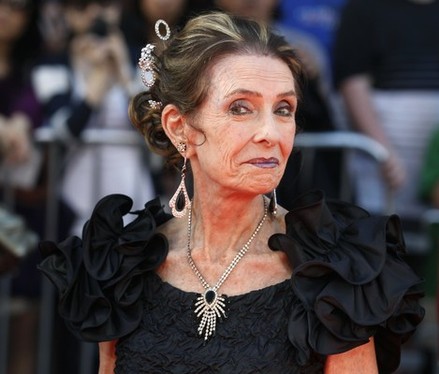
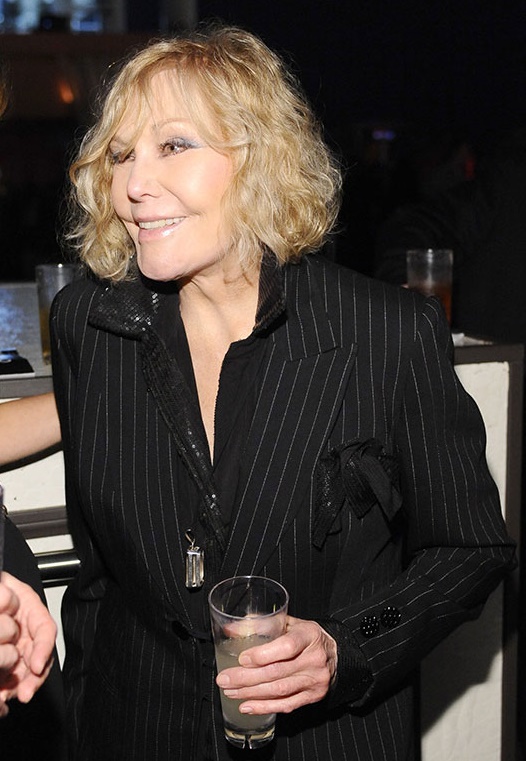
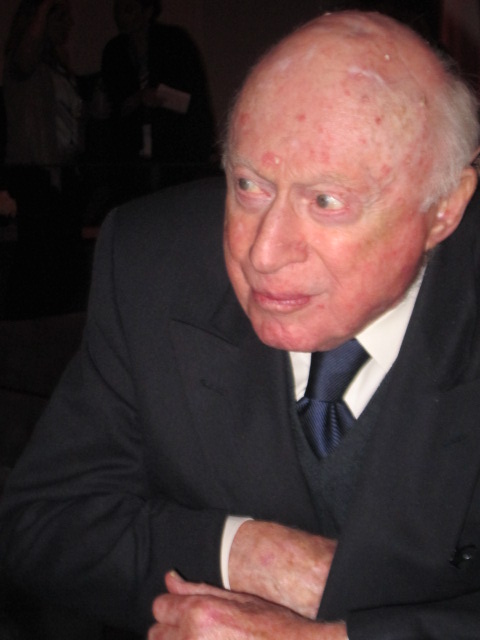
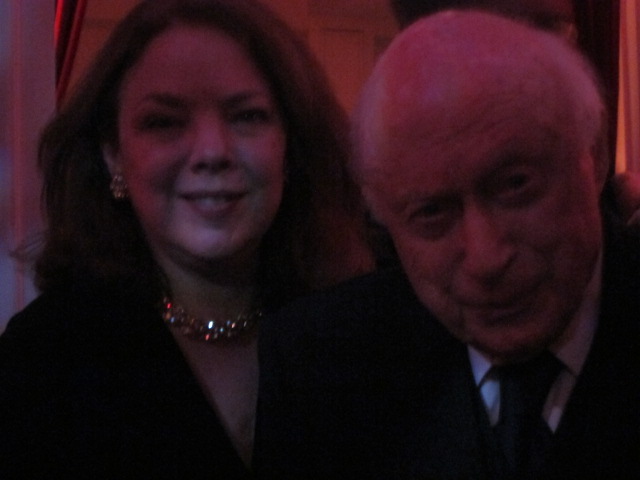
I’ve also run into the incredibly gracious Kim Novak in the ladies’ lounge at Grauman’s and a gregarious William Friedkin at Starbucks. And at the 2013 Vanity Fair party, Norman Lloyd, then a mere slip of a boy at 98, beamed and clasped my hand with great force when he found out I was from Brooklyn. “Brooklyn! We used to take the train to Ebbets Field! We were Dodger fans of course, and hated the Giants,” he hissed, shades of Saboteur slipping to the surface. “And their manager, John McGraw, was nicknamed Mugsy, which he loathed. So after the game, we’d gather round the visiting team’s exit, wait for him come out and shout ‘Mugsy! Mugsy!’”
As he rattled off memories as if they’d happened that very afternoon, I felt sort of an ominous cloud surging up behind me. It was a mob, growing ever more impatient, waiting to talk to him. Not wanting to be a hog—i.e. one of those fans—I reluctantly bid him goodnight, and he cried, “You’re not getting away without a picture!” (The room was dark and the photo’s blurry… but sigh.)
So I guess what I should say is, you never know.
TCM host and Ben Mankiewicz is unfailingly friendly and will chat whenever he has a minute. But sadly, Robert Osborne’s health is keeping him home for the second year in a row. If you’ve ever seen how he throws himself into at the Festival—running around from group breakfasts in the morning to screenings well into the night—you understand why he needs a well-earned rest. And he was always so accommodating that his assistant had to drag him away to get him to his next event on time.
Any classic-film tours I can round out my visit with?
The TCM Movie Locations Tour is two hours of Wayback Machine fun, gliding you past vintage movie palaces, Charles Chaplin’s old studios and the Paramount gates, stopping at Union Station and the Bradbury Building, and hitting lots of old-Hollywood points in between. And The L.A. Conservancy offers terrific docent-led and self-guided tours all over the city, including the theatre district, the fabulously deco Biltmore Hotel and Harold Lloyd’s movie locations.
On her touching and informative tours of Hollywood Forever, Karie Bible guides you gently around the final resting places of luminaries like Rudolph Valentino, Cecil B. DeMille, Tyrone Power, Marion Davies, John Huston and Douglas Fairbanks, among many others. During Festival week, her tours fill up quickly, so act now. And Philip Mershon hoofs all over Hollywood to give you a fascinating glimpse into its early years.
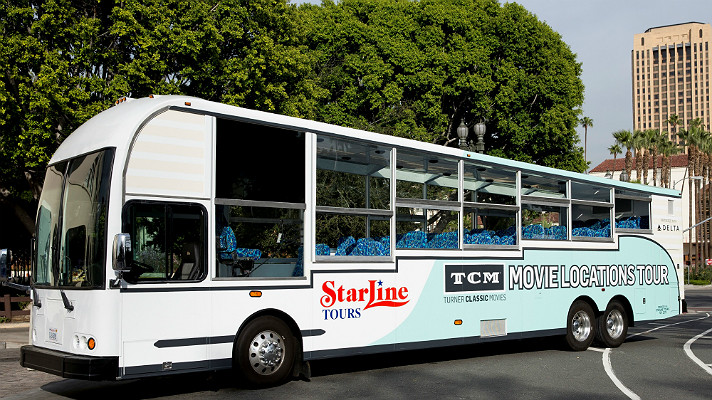
As for the studios, I loved the Warner Brothers Tour when TCM organized one just for festivalgoers, but as far as I know, they’re not doing that this year. Usually, the tour has a lot more modern content, so before you book, you might want to call Warner’s and see if you can get a guide who’s a classic-movie buff.
The six-hour Paramount Studios VIP Tour is pricey but so worth it. After passing under the famous arch, you’ll spend much of the day in classic movie heaven, peeking into Billy Wilder’s old writer’s room, touring the film archives and talking with the preservationists, and ogling fabulous props, costumes and accessories, including Claudette Colbert’s baubles from Cleopatra, Ginger Rogers’ glorious gowns, and the original cameras from Wings.
Whew! Okay, I’ll stop talking now… but I hope all this has been helpful! Just one more thing—and this is important—remember to mingle! Pull your head out of your phone and chat with people on line or wherever you see other passholders. As my husband once told a friend as I was heading to the airport, “She’ll be with her own people!” There’ll never be a more kindred crowd to share your oddball crushes (Alan Mowbray, anyone?) and obsessions with, so let your film flag fly!
Have fun, my dears! And if you get a chance, raise a glass eastward toward upstate New York. I’ll be thinking of you!
TINTYPE TUESDAY: Baseball, Hot Dogs, Apple Pie and… Tallulah Bankhead?
Welcome to another edition of TINTYPE TUESDAY!
Ah, April—when our hearts and minds turn to baseball! Which of course brings us to Tallulah Bankhead.


Wait, what?

Oh yes, people! We all know Tallulah was a colorful character (to put it mildly, which she never would) and one-woman pithy-quote machine. (“I’m as pure as the driven slush.”) And also a brilliant actress, which, sadly, her offstage antics often obscured. But did you know about her other favorite pastime—the one she pursued passionately, with all her clothes on and even a modest little woolen hat?
Baseball.
And she wasn’t just a casual fan, like the celebs you see nowadays who show up for playoff games to get some national exposure. (“Oh, look who’s in the stands, Buck! It’s Suzi Silicone, from the new Fox series Stripper Cops!”) Nope—our Tallu followed baseball, and her beloved Giants, religiously.
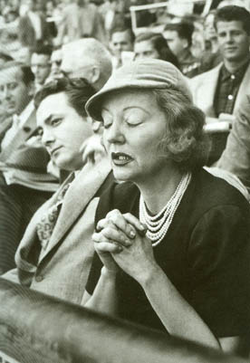
She agonized when they were losing…

…and whooped it up when they won!

Oh, and not for nothing, but see the letters on her cap? She was a fan way back when they were the real Giants, playing their home games at the Polo Grounds in Harlem.
Of her favorite player, she once said, “There have been only two geniuses in the world. Willie Mays and Willie Shakespeare. But, dahling, I think you’d better put Shakespeare first.” Oh sure. But guess which one she wrote an article for Look magazine about?
“Even when he strikes out, he can put on a show,” she wrote, sounding every inch the smitten fan. “In the terms of my trade, Willie lifts the mortgage five minutes before the curtain falls. He rescues the heroine from the railroad tracks just as she’s about to be sliced up by the midnight express. He routs the villain when all seems lost.”
Years later, she happily hollered out his name, “Willieee! Willieeee!” when introducing him on The Merv Griffin Show:
Tallulah once even slipped into a Giants uniform herself—but with bedazzled letters and a jauntily tilted cap, of course.

So this spring, as you settle in on the sofa to root for your favorite team, raise a glass—or even a fabulous pump—to Miss Bankhead. Or do it her way, with a shoe in one hand and a goblet in the other. Cheers, Tallu!

TINTYPE TUESDAY is a regular feature on Sister Celluloid, with fabulous classic movie pix (and usually some backstory!) to help you make it to Hump Day! For previous editions, just click here—and why not bookmark the page, to make sure you never miss a week?
TINTYPE TUESDAY: Classic Film Stars Let Their Freckles Fly Free!
Welcome to another edition of TINTYPE TUESDAY!
In April 1976, George Hurrell wrote to Joan Crawford, his friend of almost half a century, asking her to say a few words for a book about his work. With it, he sent a 1930 photograph, his favorite of the thousands they’d shot in 33 sessions together.

“I’ve always thought the soulful, tender beauty in the attached print was among our best efforts,” he said. “The depth of feeling and emotion you expressed in this pose has a dramatic quality that only a great actress could reveal.”
Also revealed in the photo were Joan’s fabulous freckles. And while the studios insisted they be airbrushed away, no less a light than George Hurrell was just fine with them. And so was Joan, when she wasn’t filming.


But when she was working, out they went. Here’s a studio before-and-after shot:
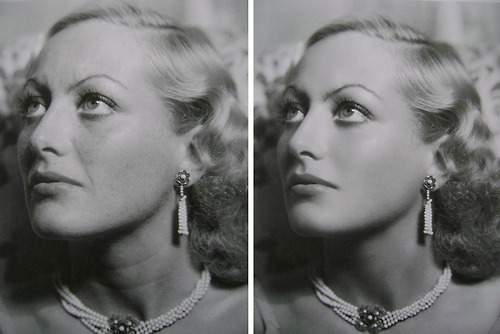
Of course, these little flecks of “imperfection” were but one casualty of retouching. Sometimes, entire personalities were erased. Here’s Bette Davis being turned into Betty Boop:


But now that the studio bosses aren’t looking, let’s give these glorious freckles the space they deserve, shall we?


Just to be fair, we’ll close things out with a couple of guys—who were pretty much the gold standard for freckled men everywhere. And on the set of The Strawberry Blonde, you can see how delighted Cagney was to have his Irish beauty marks covered up with greasepaint.


Happy Spring, my fabulous friends! Be sure to protect your skin from the sun… but let your freckle flag fly!

TINTYPE TUESDAY is a regular feature on Sister Celluloid, with fabulous classic movie pix (and usually some backstory!) to help you make it to Hump Day! For previous editions, just click here—and why not bookmark the page, to make sure you never miss a week?
TINTYPE TUESDAY: Dan Duryea — Gardener and Cub Scout Leader!
Welcome to another edition of TINTYPE TUESDAY!
A few years ago, between films of a double feature at the Film Forum in New York (Black Angel and Criss Cross), this old guy sitting next to me muttered, to no one in particular, “I wonder if that was really Dan Duryea playing the piano.”


And I jumped in with something like, “Oh yes, it was! And you can tell by his hands—those long, tapering fingers—that he’d be a good at it. You know, he grew up not far from here, in White Plains! And then went to Cornell, where he was head of the drama society, right after Franchot Tone. But then he went into advertising, which he thought was more stable, but it was so stressful he had a heart attack! Can you imagine! And he didn’t get into movies until he was in his thirties and…”
When I finally paused to breathe, I realized I wasn’t the only one who needed a little air. The guy I was talking to—okay, yammering to—looked a little scared. He jumped up and said, “I’m just gonna go get a soda…” Then he scurried up the aisle, his white hair flying over the back of his shirt collar. He never came back.
Yes, I gushed so hard over Dan Duryea that I frightened an old man. Usually when I go to a revival theater on the odd Wednesday afternoon, I run into a troubled loner or two. That day, apparently, it was me.
I never even got to tell the guy that Dan was a homebody at heart…


…and that any resemblance between him and his characters was purely coincidental—though his choice of roles was intentional.
“I looked in the mirror and knew with my ‘puss’ and 155-pound-weakling body, I couldn’t pass for a leading man, and I had to be different,” Duryea once said in an interview with Hedda Hopper. “So I chose to be the meanest S.O.B. in the movies. Strictly against my mild nature, as I’m an ordinary peace-loving husband and father.” (Okay I’m just gonna interrupt him here to say is there anything more fabulous than a great-looking guy who has no idea how attractive he is?)
When the conversation turned to co-stars, Duryea admitted to a favorite: “Joan Bennett… a true professional and so easy to work with in the two films we made with Eddie Robinson, The Woman in the Window and Scarlet Street… I found her very attractive.” But the guy couldn’t even talk about her without bringing up his wife: “Before you ask, Hedda, no, I did not have an affair with her or any other of my co-stars for one very good reason: I was very happily married and never broke my vows.”


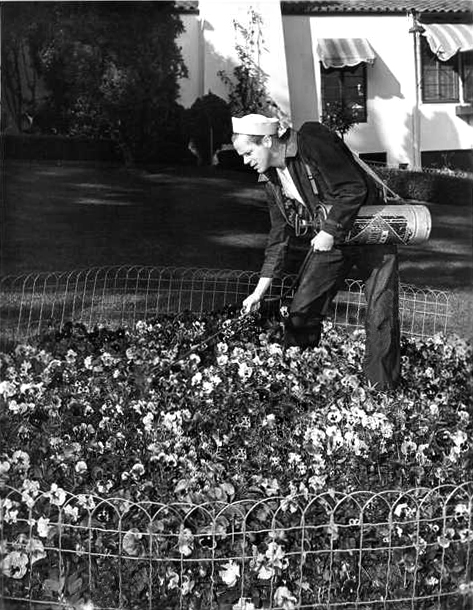
Dan and Helen Duryea and their sons, Peter and Richard, lived in a sprawling, Mediterranean-style house on Mulholland Drive, on a hilltop overlooking Hollywood and the San Fernando Valley. Soon after he bought the house, he began planting roses, lilacs and peonies, which thrived in the SoCal sun but still required lots of attention. Eventually, Dan was tenderly caring for about 175 rose bushes. (Always, it seems, while wearing that one hat.)
Dan was even more devoted to dogs. First came a cocker spaniel named Jerry and then a mutt named—aw, go ahead, take a guess—Blackie.


He even had a favorite comfy chair—the only thing he brought with him from his days in New York—where he’d read scripts and make notes. Most of the books on the shelves were about photography, gardening and boating; he never read murder mysteries, as they kept him up nights.


And while in the pix below, he might seem to be saying, “Here’s where I shove Joan onto the bed!” he was scrupulous about protecting his kids from his seamier screen side. “We weren’t allowed to go to his movies, because he didn’t think it was a good thing for us to see him slapping women,” Richard recalled at a 2013 film festival.


Home movies, though, were an altogether different affair, often featuring the kids’ Cub and Boy Scout outings (Dan was a troop leader, and also active in the PTA).


But sometimes his movie roles spilled over, at least a little bit, into his serene family life. For instance, if you’ve ever wondered what it looks like when a notorious outlaw takes his kids to the amusement park, here’s your chance. (The sideburns were for the title role in Black Bart.)


P.S.: If you’d like to see Black Angel, the movie I was gushing over in the theater the day I sent the old man screaming for the lobby, the whole film is right here; I featured it in one of my Streaming Saturdays.
TINTYPE TUESDAY is a regular feature on Sister Celluloid, with fabulous classic movie pix (and backstory!) to help you make it to Hump Day! For previous editions, just click here—and why not bookmark the page, to make sure you never miss a week?
The Academy Strikes Again: The 2016 Oscar Memorial Snubs
Last night, according to the official Academy Awards website, “the Oscars took time to honor the many talents we lost during the previous year, the lives they touched and the art they made or made possible…”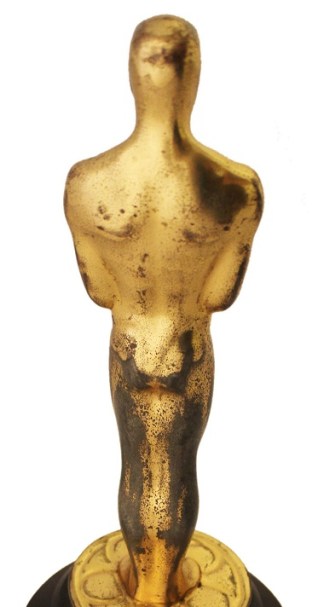
Yes but they never take quite enough time, do they? I mean, it’s entirely up to them how many minutes they devote to the Memorial Reel versus, say, lame-ass production numbers or cringe-worthy canned banter. (And somehow, while leaving out genuine artists, they found enough time to squeeze a bunch of publicists in there. And Kirk Kerkorian, Destroyer of MGM. Which is a bit like Chicago building a monument to Mrs. O’Leary’s cow.)
So here we go again, kids, with our annual tradition: taking a moment to honor those who were shamefully left off the reel.


This year, Oscar seemed especially eager to show his back half to those who toiled in classic film, with snubs including Joan Leslie, Coleen Gray, Betsy Drake, Dickie Moore, George Cole, Jayne Meadows, Nova Pilbeam, Betsy Palmer and Setsuko Hara. But there was plenty of dissing to go around. And talk about ironic: Abe Vigoda, subject of a running joke about being dead when he was still alive, was left out the year he actually left the earth.


Here are the names that ran through my mind in the hours after Oscar ran the dagger through once again: Joan Leslie, James Best, Jayne Meadows, Setsuko Hara, Dick Van Patten, Betsy Drake, Gunnar Hansen, Dickie Moore, Fred Thompson, Franco Interlenghi, Colin Welland, Abe Vigoda, Tony Burton, Elizabeth Wilson, Wally Cassell, Marty Ingels, Geoffrey Lewis, Marjorie Lord, Grace Lee Whitney, Jack Larson, Nicholas Smith, George Cole, Patrick Macnee, Ron Moody, Nigel Terry, Nova Pilbeam, Kevin Corcoran, Betsy Palmer, Al Molinaro, Jean Darling, Monica Lewis, Angus Scrimm, Richard Dysart, Glenn Frey (songs and soundtracks for films including Beverly Hills Cop and Thelma and Louise), Wayne Rogers, Colleen Gray, Martin Milner, Gerald O’Loughlin, David Canary, Amanda Peterson, Gene Saks, George Gaynes, Jacques Rivette, George Winslow…


…and yes, Uggie, who was the heart of The Artist, which won five Oscars, including Best Picture, Best Director and Best Actor. The little guy even attended the ceremony.


And oh, this is priceless: the Academy is quick to point out that many people who didn’t make it into the televised memorial segment can be found in a photo gallery on the website. So apparently in Hollywood, the whole A-list/B-list thing literally never ends…


I know, in my haste and fury, I overlooked people, so please mention them in comments, and I’ll add them here. So far, my incredibly astute readers have pointed out three Oscar winners—cinematographer Andrew Lesnie, screenwriter Michael Blake and costume designer Julie Harris—as well as writer/producer/directors Manoel de Oliveira and John Guillermin, actor/activist John Trudell, producer/graphic artist Michael Gross, producer Robert Stigwood, animators Yoram Gross and Brian Michael Jennings, and actors Roger Rees, Richard Libertini, Jacques Sernas, Frank Finlay and Denise Matthews (Vanity).
Here’s a warm, wholehearted farewell to everyone we’ve lost since last year’s show. Thank you for everything you gave us, from all the little people out there in the dark…
Saying Goodbye to My Dad and CASABLANCA
“Where I’m going, you can’t follow.”
Not the most famous line in Rick’s closing speech to Ilsa, but the one that stays with me. Casablanca was the last movie I ever saw with my Dad, who I followed everywhere.
We were true kindred spirits, and there was no one I saw more movies with. Saturday mornings were for comedies on Channel 5, especially if W.C. Fields was on. We saw It’s a Gift so often we did the routines at the breakfast table. (“You tell me where to go!” “I’d like to tell you both where to go!”) On nights I couldn’t sleep, he let me bundle in my blanket on the couch and watch the late movie with him, which is how I fell in love with Buster Keaton. And every year, to my delight and my mother’s horror, he woke me at roughly three in the morning to trundle downstairs and watch Alastair Sim’s A Christmas Carol, which, unlike the other 97 versions, somehow never aired at a normal hour.


Sometimes he threw me a curveball, like the time he sat me down to watch one of his favorite films, The Informer, without warning me I’d want to hurl myself out the window afterward. (His response? “Of course it’s depressing! It’s about Ireland!”) But usually we were completely in sync.
My father knew more about movies, and what went on behind the scenes, than anyone I’ve ever known. He’d throw out little tidbits as we watched—explaining bits of business, or telling me who that third banana was or how the woman playing the star’s grandmother used to have a vaudeville act and who she was married to. And he said it so casually, like everybody knew this stuff.
The way you do when you’re a kid, I thought those days by his side on the sofa would last forever. But when he was just 46, my father was diagnosed with cancer of the esophagus. Immediate surgery revealed it had metastasized. He was told he had about three months to live.
Summer was starting, so I could spend most every day with him until, I thought, he’d be coming home. His hospital window overlooked the Verrazano-Narrows Bridge, and one day, a line of sailboats bobbed lazily through the bay, maybe stragglers from the July Fourth flotilla a couple of weeks earlier. We watched the boats for a while, but then Casablanca was coming on. My Dad had just seen it—the local stations had a handful of classics they played over and over again—but he was happy to watch it again with me.

Usually we talked a little during movies, but that day, we were mostly quiet. He was tired, I could tell. But he piped up a couple of times.
“Did you know Conrad Veidt was the highest-paid actor in the film?” No, really? “He barely escaped the Nazis, and then he donated his salary to the war effort.” I said something about how sad it was that the poor guy was forced to play Nazis all the time, but my Dad said he wanted it that way, to show how evil they were.


At one point he started to say something and broke off, and I thought maybe there was some racy tidbit he’d stopped himself from telling me. So now I had to know. He finally blurted it out: “Dooley Wilson didn’t play the piano.” For an old-movie lover, that’s right up there with “no Santa Claus.” He softened the blow by telling me Wilson was a great drummer, though, and once led his own big band.
And he talked about Humphrey Bogart, and how brave he was when he was dying, how all his friends came by, one by one, to say goodbye. And how his kids were so young, but they knew he’d always be with them. I remember thinking it must have been horrible for them just the same, and wondered to myself why my Dad, who always said things straight, had put such a soothing face on it.


When the movie ended, I could see how tired he was, just from straining to stay awake for me for those two hours. When I leaned over to kiss him goodbye, I clasped his arm, and realized I could nearly close my hand around his wrist. I almost gasped but swallowed hard to hide it. When I brushed my face against his cheek, I could feel the bone beneath. But as frail as he was, it never occurred to me he wasn’t going to get better and come home. It’s not even that I suspected the worst and dismissed it. The thought never dared come anywhere near me.
My father often called me kiddo—I was the youngest—or Babe, as his seven older brothers and sisters called him. That day, when I turned to leave, he smiled and said, “Here’s lookin’ at you, kiddo.” And he seemed so happy as he drifted off to sleep.


My Dad was slightly color-blind, and I remember going home that night and organizing his brown, blue and black socks so they’d be ready for him when he went back to work. And checking the cupboard for Bisquik, so I could make pancakes for him.
Just a couple of weeks later, he was gone. He hadn’t even gotten those three stingy months they promised him.
In all the years since, with all the times it’s been on television, I’ve never been able to watch Casablanca. Some memories comfort you, some reduce you to rubble. Some do both.
When TCM brought it back to the big screen in 2012, somehow I thought my Dad, who loved that movie, would want me to give it a try. And this was such a different setting—a billion-plex in Times Square. When I got there, I had to go up so many escalators that before I even got to my theater, I was already down to the part of the popcorn where I’d buttered it in the middle.


That morning, I’d gone back and forth so much about whether to go that I barely made it before the house lights went down. There was one spot on the end, in a little two-seater off to the side, but a woman had plunked her bag there. When I asked if she could move it, she said she was saving it “for a friend.” She also seemed mildly crazy. (One thing about New York: no matter what’s preying on your mind, there’s a good chance you’ll be distracted by an insane person.) I promised to move as soon as her friend arrived, and she huffily freed up the seat.
I made it through the introduction by Robert Osborne and the first scene of the movie. Then I started crying, then panicking because I was crying, then crying and panicking because I couldn’t figure out how to get out of there in the dark. As I grabbed my purse and started to get up, the seat-saver threw her arm around me and pressed my head to her shoulder. “It’s okay, I’m sorry! My friend said she isn’t coming!” I thanked her, wriggled free, and stumbled down the stairs and the escalators, crying and laughing and still kind of panicking till I was finally out in the street, in the light.
I tried, Daddy. I really did. But I have a feeling that my last time seeing Casablanca will always be that summer day— whiling away another afternoon watching movies with you, waiting for you to come home.
TINTYPE TUESDAY: Judy Garland Is Trapped in a “Summer Stocky” Wardrobe
Welcome to a special venting edition of TINTYPE TUESDAY! I just need to get something off my chest, okay? Or rather, something off Judy Garland’s…
I watched Summer Stock again last night—so much fun, so underrated, and one of Judy’s most difficult films to complete, though, as usual, you’d never know it from her performance.


And let’s throw some extra love to Gene Kelly, who was uber-patient and fiercely loyal. Normally a bit of a perfectionist, he remembered how Judy had helped him when they worked together eight years earlier on his film debut, For Me and My Gal, and he helped carry his co-star—sometimes literally—through the long, demanding workdays. Once when Judy wasn’t up to coming in, he went so far as to feign a fall to deflect the blame for the delay onto his own, far sturdier shoulders.


In Garland’s most recent effort for MGM, Louis B. Mayer had fired her from Annie Get Your Gun. Kelly, meanwhile, was coming off back-to-back hits with Take Me Out to the Ballgame and On the Town. Judy had gained some much-needed weight during a hospital stay in Boston, but was still physically and emotionally fragile. Even more insecure than usual, she begged Mayer to let her out of Summer Stock, but he pressed her to stay on.

Her reward—and here’s where the venting part comes in—was just about the most hideous collection of costumes ever to escape from the Closet of the Damned. To say nothing of her hair, which seems to have been set upon by millions of tiny, angry curlers with a score to settle.
I know Judy’s character, Jane, is supposed to be a hick, but look at her sister Abigail (Gloria DeHaven)! She’s a bumpkin too—but an MGM bumpkin, dammit! Cute, clingy gingham, adorable eyelet tops, gay colors—she seems to have kicked the sh#t off her shoes quite nicely, thank you. But poor Judy! She’s only three years older than Gloria, but the way they’ve dowdied her down, she might as well be Aunt Eller in Oklahoma! Or perhaps she could rewrite a tune from The Sound of Music: “I am 28 going on 68…”
Take the striped shift dress. Please. It helpfully gathers all the dazzling colors from the floor of a stable into one piece of fabric. I suspect she’s praying her humongous collar will open up and swallow her, like a giant clamshell.


Next come the overalls—and not movie-musical overalls. Actual farmer-wear. Only worse: they seem to have been starched. You get the feeling if she took them off, they’d just stand there, mocking her.
Then Judy’s off to feed the animals, in a stiff, shapeless shirt, paired with stovepipe pants that stop short at the ankles—perfect for a tiny woman who barely grazes the five-foot mark and is nervous about her weight. Yes, let’s make her legs look shorter and heavier! Her thick, clunky shoes further enhance to the stumpy effect. You know you’re in trouble when you’re out-glammed by Phil Silvers. And chickens.


And then, oh, goody, we’re back to ginormous collars—now with extra bunchiness! This time set off by a sparkly cardigan—the kind your grandma hauls out of mothballs for special occasions. All she’s missing is the lint-covered hard candy at the bottom of her pocketbook.


The next sequence contains a special tip for the ladies: If you ever get the chance to dance with a man as divine as Gene Kelly, be sure to whip out your old Brownie uniform. And don’t get all self-conscious if it’s busting at the seams, allowing a bit of frumpy corset to peek through. Men love that!


Perhaps the most amazing part of this fashion hellscape is that the designer was the legendary Walter Plunkett, who did the crazy-fun costumes for movies like Flying Down to Rio as well as Katharine Hepburn’s fantastical moth dress in Christopher Strong, her slinky black evening gown in Adam’s Rib, and much of her personal wardrobe. What in the name of Heaven—or Hades—was going on here?


I mean, Good God, up until now, this was pretty much Judy’s best outfit in the whole film:
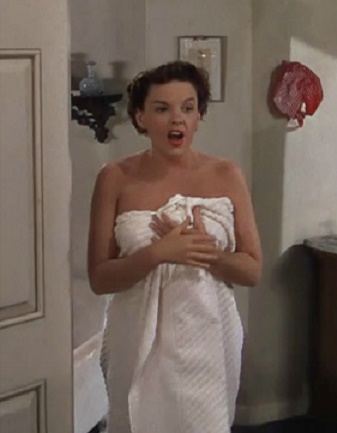 But there’s always hope if you hang in there long enough. And finally— finally!—Judy gets to be Judy in the legendary Get Happy! number that closes the film. (She’s also slimmer, as the routine was filmed more than a month after the rest of the movie.)
But don’t give Plunkett credit for this one: her iconic outfit was designed by then-husband Vincente Minnelli for a number in Easter Parade called Mister Monotony, which was ultimately cut. But never mind how it happened. For whatever forces of fate got her out of those damn dung-colored dresses, shout Hallelujah…


TINTYPE TUESDAY is a weekly feature on Sister Celluloid, with fabulous classic movie pix (and backstory!) to help you make it to Hump Day! For previous editions, just click here—and why not bookmark the page, to make sure you never miss a week?
Ginger and Jimmy in VIVACIOUS LADY: The Backstory Was Even Crazier and Sexier Than the Movie
Vivacious Lady may be a fabulous screwball comedy, but what went on behind the scenes was even loopier.
A year before the film was made, Ginger Rogers and director George Stevens had an affair while filming Swing Time, which, as these things tend to do, wrapped when the picture did. Then she started dating an up-and-comer named James Stewart—and pushed for RKO to borrow him from MGM for her next project. Guess who was directing it?

But just two weeks into filming on Vivacious Lady, Stewart got sick—and by the time he was well again, MGM had him booked for Of Human Hearts. So RKO shelved the project until he was available.
Rogers, by the way, was free only because Fred Astaire hankered to do his next picture for Stevens, A Damsel in Distress, without his six-time screen partner. But in a classic case of “careful what you wish for,” he quickly regretted it. After failing to land either Jessie Matthews or Carole Lombard as his leading lady, the studio settled on a 19-year-old newcomer who, it soon became clear, wasn’t up to the job—especially for a notorious taskmaster like Astaire. “[RKO boss] Pandro [Berman] and Freddie came down to the set and said, ‘Can we talk to you? We are very disturbed about Joan Fontaine. We’ve got to make a change… we’ve got to replace her,’” Stevens recalled in his journal.
They suggested that (yikes) Ruby Keeler step in—and what happened next tells you everything you need to know about Stevens, who stood up to his boss and the studio’s biggest male star in defense of a real-life damsel in distress. “I said, ‘If we take this girl out of the picture she’ll probably kill herself,’” he wrote. “They said that was an exaggeration and I said ‘It probably is but I’m going to stay here and you’re not going to do it. You can’t do it. We all made the decision.’ They were right. She was the wrong girl in the wrong spot. But she never knew that they wanted to take her out of the picture, or she would have collapsed.”


While Astaire fumed, his erstwhile dancing partner spent a blissful summer in Big Bear, filming Having Wonderful Time with Douglas Fairbanks Jr. while waiting to work with her current beau and her former lover on Vivacious Lady. (Oh and as an added plot twist, Stevens was called up the mountain to shoot a scene with Rogers and Fairbanks when director Alfred Santell briefly fell ill.)
When Stewart was finally free, Berman seized on the narrow window in his schedule to resume filming. Which left Stevens running all over the lot—working with Rogers on one soundstage, Astaire on another, and Katharine Hepburn, with whom he’d had a fling during Alice Adams, on a third, in Quality Street.
All of which makes the plot of Vivacious Lady—nerdy scientist goes to the big city to rescue a relative from the clutches of a showgirl, falls in love and weds her himself, and brings her home without telling his stuffy family they’re married—seem like pretty tame stuff by comparison.


As our story opens, botany professor Peter Morgan (Stewart) has been dispatched from the staid college town of Old Sharon to Manhattan by his frantic family to retrieve his wayward cousin Keith (James Ellison), who’s fallen for a cabaret singer. He tracks him down at the club where she works and tries to talk sense to him, all while fending off the waggling tail feathers of a dancer in the floor show.
Then Peter dutifully calls home to tell his pompous, overbearing father (Charles Coburn) that he’s bagged his prey. (In a scene that could have been shot yesterday, he yells into the phone over the din of the crowd, so wrapped up in his own conversation he’s oblivious to how irritating he is to everyone around him.)
But what’s that lovely cooing sound off in the distance? Why, it’s the siren herself, Francey (Rogers)! Only Peter doesn’t realize that. He only knows he’s being drawn back toward the dance floor, stumbling and clattering over a cooler as he gazes at her—finally nearly collapsing into a chair at Keith’s table. (His cousin, meanwhile, is hiding in the men’s room.)
After her number, Francey drops by the table to look for Keith, and Peter realizes—in that halting, stammering way only Jimmy Stewart can—that this is the girl. She teases him about the commotion he caused (“Say, what were you trying to do—break me up?”), and before long, they’re laughing… and talking… and slipping out into the night together. Leaving poor Keith, who was trying to give Peter the slip, on the other end of the raw deal. (In a small role as the maÎtre d’, Jack Carson dryly delivers the bad news that his cousin and his girl have vamoosed.)


Thus begins a whirlwind New York night of open-air double-decker buses, walks along the water, and eating corn on the cob (!) from a street cart. (When did that stop being a thing? And when is it coming back?) As morning breaks—yes, that’s the milkman on his way!—Peter and Francey circle dizzily back to her front door, but aren’t even ready to say goodnight, let alone goodbye.
“Do you, uh, do you always think things out carefully?” he asks her, practically proposing right there in the doorway.”Well if they’re small things, I never do,” she confides, “but if they’re important things, I never do either…” Hanging on by a thread to what’s left of their senses, they kiss, first softly, then hard, before she dreamily drifts upstairs. Then Peter bolts for the payphone across the street and invites her to breakfast— where, now that a respectable amount of time has passed, he asks her to marry him.


Waiting for the newlyweds back in Old Sharon—oh boy!—are Peter’s father, the president of the college where his son teaches, and his mother (who else but Beulah Bondi, in one of five turns as Stewart’s mom), who’s prone to fainting spells. And oh, yes—his utterly humorless fiancée, Helen (Frances Mercer), who really should see about having that pole removed.
Because he’s a damn good sport, Keith is there too, and even puts Francey up until Peter has a chance to explain everything. This is the rare case where the third wheel isn’t some eminently dumpable stooge—the kind of guy who makes you wonder, “And she was with him why, exactly?” He’s funny and loosey-goosey and altogether a fabulous fallback should Peter weasel out and let Francey down. (How Ellison broke into movies was also pretty nifty: while working at Warner’s film lab, he was offered a screen test—which he developed himself, hated, and promptly hid. But a producer unearthed it and signed him to a contract.)


Of course, breaking the news of the marriage turns out to be a long, arduous process. To make matters worse, Francey and Peter have yet to spend a night together, and their frustration is palpable. (So is the chemistry between Rogers and Stewart. And for a guy with such a wholesome screen rep, no one is better at simmering, unholy lust than Jimmy.) In the meantime, Francey poses as one of Peter’s botany students, convincing exactly no one.
Mr. Morgan knows something’s going on, but has no idea what. All he knows is that his once reliably bland son, who always fell into line before, is suddenly a bit… wobbly. And least happy of all is Helen, who may be a stiff, but she’s no dummy.
Peter’s mother doesn’t much care who Francey is—she’s just happy to have someone she can relax with, who doesn’t have ivy stuck up her… nose. At the college formal, the two unlikely allies bond over where to buy the best stockings as they sneak a smoke in the ladies’ lounge.


Helen, though, is in no mood to make nice. When she heads out to the veranda to warn Francey to back off, the tension builds deliciously. Finally she asks, “Now are you going to mind your own business or must I really give you a piece of my mind?” Smiling demurely, her rival responds, “Oh I couldn’t take the last piece!”
That tears it: Helen lets loose with the first slap… which leads to a counter-slap… and finally an all-out sequin-and-satin brawl. Harking back to his days with Laurel and Hardy, Stevens stages it to perfection, cutting between close-ups and medium shots, capturing every ounce of outrage amid the hair pulling, kicking and yes, even biting.
(Rogers fought at something of a disadvantage: RKO, which had insured her legs for half a million dollars, insisted they be strapped to boards and padded during the melee.)


The brawl also tells us everything we need to know about these two ladies: Francey is honest and direct, even loosening up like a prizefighter before putting up her dukes. Helen, on the other hand, opts for sneaky maneuvers like a stickpin to the caboose.
You wanna see class struggle? Skip the sociology books and watch these two go at it.
But that’s not even the best number in the film. Because later on, Keith pops home to show Francey a new dance he’s learned called The Big Apple. And who should be there but his aunt… who’s coaxed into cutting the rug with them. Thus giving us the rare opportunity to see Beulah Bondi shake her moneymaker.
And this isn’t one of those tiresome scenes where “grandma does something wacky.” Stevens was a master at using musical numbers to move the story along, and here it’s clear that Mrs. Morgan is sick of this suffocating town, tired of her tyrannical husband, and ready to shake loose. It’s great to see Bondi, who easily holds her own with Rogers and Ellison, break free as more than just somebody’s mother.
In fact everything about this movie is pretty great. Deservedly, and despite all the screwball drama that preceded it, Vivacious Lady turned out to be one of RKO’s biggest hits. Oh and soon after, Rogers and Astaire were reunited for Carefree, bringing the universe back into balance.

STREAMING SATURDAY! An All-Star Cast Discovers WE’RE NOT MARRIED!
Welcome to another edition of Streaming Saturdays, where we embed a free, fun film for you to watch right here every week!


This week: Edmund Goulding’s 1952 anthology, We’re Not Married! The premise borrows (okay steals) a page from Hitchcock’s Mr. and Mrs. Smith: five couples discover that through a technical error—in this case a Justice of the Peace who jumped the gun before his license was valid—they’re not legally married. (The bumbling clerk secured the job through his shady, politically powerful family named… wait for it… Bush.) In various stages of wedded bliss or lack thereof, the couples are:
- A squabbling husband-and-wife radio team who bill and coo only when their mikes are on (Ginger Rogers and Fred Allen);
- A genial millionaire and his gold-digging wife, who’s trying to frame and fleece him for a tidy settlement (Louis Calhern and Zsa Zsa Gabor);
- A bored suburban couple with nothing to talk about but the Book of the Month Club (Eve Arden and Paul Douglas);
- A young soldier on the verge of being shipped overseas and his pregnant wife (Eddie Bracken and Mitzi Gaynor); and
- A beauty queen who’s just been crowned Miss Mississippi and her doting husband (Marilyn Monroe and David Wayne, who are oddly adorable together).


The snappy script was penned by Nunnally Johnson, whose credits covered the waterfront from searing dramas (The Grapes of Wrath, The Man in the Gray Flannel Suit) and noirs (The Woman in the Window) to action-adventures (The Dirty Dozen) and musical comedies (How to Marry a Millionaire, which reunited Monroe and Wayne). But 1952 was clearly his year for anthologies, which were all the rage at the time: that same year, he wrote the screenplays for Phone Call from a Stranger and O. Henry’s Full House.


Rogers and Allen’s vignette was adapted from a skit he did on his radio show in 1946, where he played half of a bickering breakfast team with Tallulah Bankhead as his wife; the two revived the routine for her show in 1950. Allen also turned up with Oscar Levant in the hilarious Ransom of Red Chief chapter of O. Henry’s Full House.
Oh and by the way, the ten actors who make up the five couples were very much married—a total of 32 times. Allen, Bracken, Gaynor and Wayne were wed only once, but Zsa Zsa was something of a curve-buster, with nine trips to the altar. Rogers and Douglas were no slouches either though, with five each. When Douglas married his last wife, the fabulous Jan Sterling, he sighed, “If you go to bat often enough, you’re bound to get a hit.”
STREAMING SATURDAYS is a regular feature on Sister Celluloid, bringing you a free, fabulous film every weekend! You can catch up on movies you may have missed by clicking here! And why not bookmark the page to make sure you never miss another?
 Sister Celluloid
Recent Comments